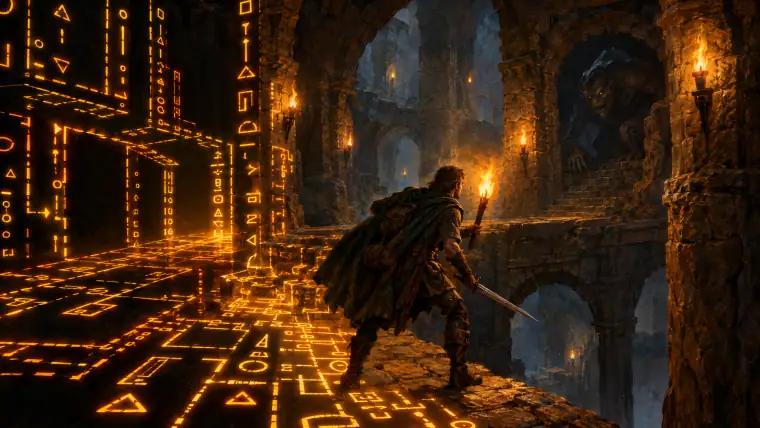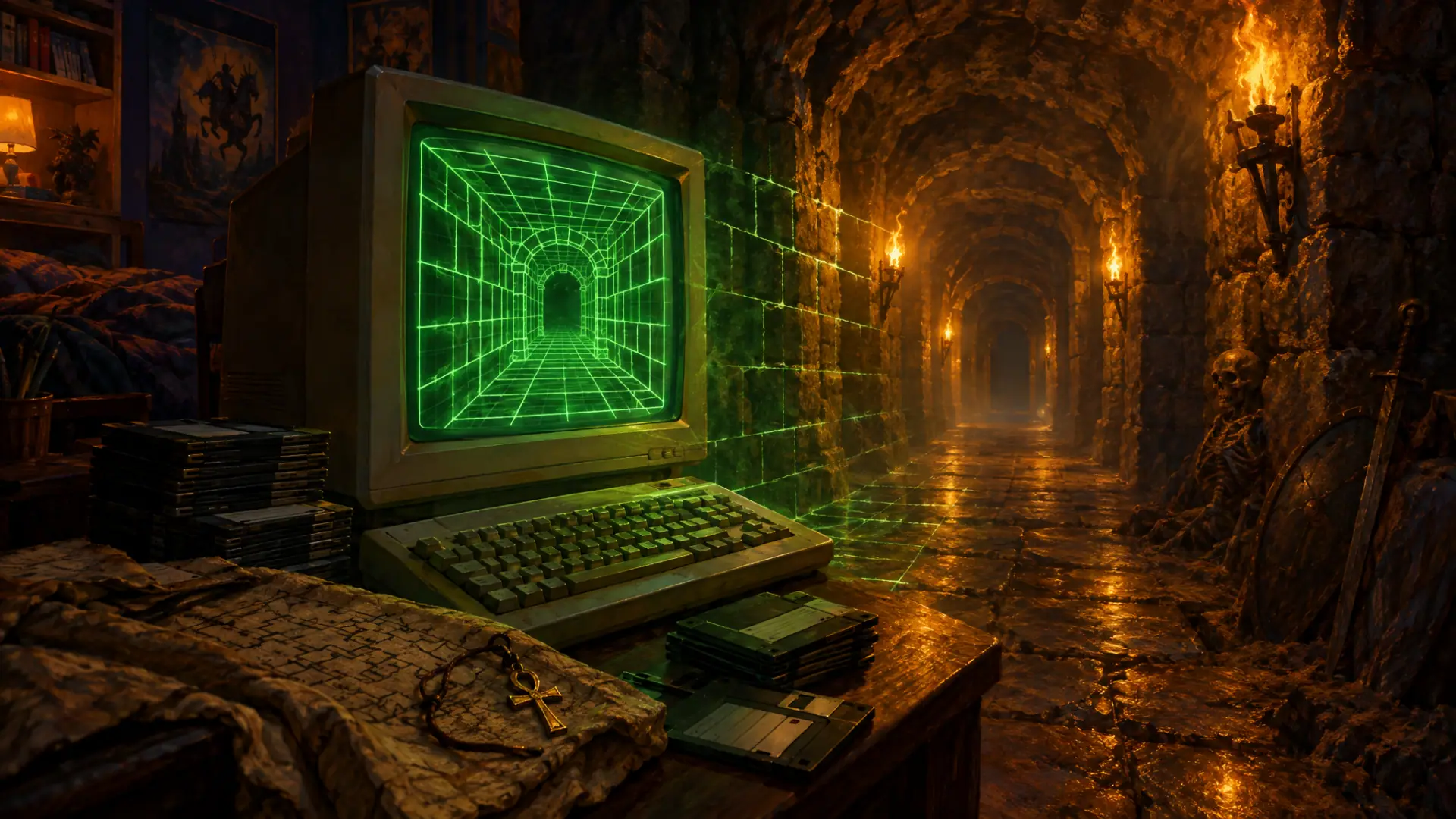
NetHack turned the Rogue formula into an encyclopedic simulation of interlocking rules, became the most famous of the 'major roguelikes,' and pioneered open, internet-based collaborative game development.
Overview
NetHack is a single-player roguelike, first released on July 28, 1987, and maintained ever since by a small, famously secretive group of volunteers called the NetHack DevTeam. The player picks a role, race, sex and alignment, then descends through about fifty dungeon levels, most of them procedurally generated on first entry, to recover the Amulet of Yendor from the depths of Gehennom. Winning means climbing all the way back up, crossing the elemental planes and offering the Amulet to one's god on the Astral Plane — an act called "ascending."
The game draws its world in text characters: @ for the hero, d for a jackal, % for a corpse, # for a corridor. Behind that austere display lies one of the densest rule systems in any game, where almost any object can interact with almost any other, and where the dungeon remembers what you did on each level. Death is permanent, and it comes often.
Origins
NetHack is the grandchild of Rogue, the 1980 Unix dungeon game by Michael Toy and Glenn Wichman, with Ken Arnold. At Lincoln-Sudbury Regional High School in Massachusetts, students Jay Fenlason, Kenny Woodland, Mike Thome and Jonathan Payne played Rogue on computers at the University of California, Berkeley, and set out in 1982 to build their own. They asked Toy and Wichman for Rogue's source code and were refused, so they wrote their own dungeon-creation routines. The result was named Hack, partly for its hack-and-slash play and partly because the dungeon generator was considered a programming hack. Fenlason gave the code to a USENIX conference, and Andries Brouwer released a greatly extended version on Usenet in 1984. Hack introduced shops to the formula and greatly expanded Rogue's roster of monsters, items and spells.
With no formal maintainer, Hack splintered into many versions. Mike Stephenson eventually took charge of the code and began a new fork, collaborating with University of Pennsylvania philosophy professor Izchak Miller and programmer Janet Walz. Because they worked together over the Internet, they called the result NetHack. From the start the DevTeam allowed anyone to modify the game, but only its members could change the official source, so players always knew which version was canonical. In 1989 Stephenson wrote the NetHack General Public License, modeled on Richard Stallman's GNU Bison license.
How it plays
Roles range from the traditional — Knight, Wizard, Priest, Valkyrie — to the eccentric, such as the Archeologist, the Caveman and the camera-toting Tourist, borrowed from Discworld. A pet kitten or little dog usually follows the hero, and much of the fun comes from its independent behavior. The dungeon includes special branches such as the Gnomish Mines and Sokoban, a set of box-pushing puzzle levels, and each role has its own quest.
Items are unidentified at first: a "pink potion" or a scroll labeled "TEMOV" could be anything, and the labels are shuffled every game. Every object is also blessed, uncursed or cursed. Learning to identify things, and to exploit their interactions, is the heart of the game — drinking a cursed potion of gain level, for instance, sends the hero up through the ceiling to the level above. Food, weight and the gods' patience all impose limits.
Death is final: the save file is erased on loading, which is why copying it beforehand, save scumming, is considered cheating. Deaths are so varied that players coined "YASD," for "Yet Another Stupid Death." Occasionally the game preserves a death level as a "bones file," so that a later player may meet the dead hero's ghost and loot the — often cursed — remains. Experienced players impose voluntary "conducts," such as vegetarianism or killing nothing.
Reception & impact
NetHack spread through Usenet, where the newsgroup rec.games.roguelike.nethack became its forum, and later through the public server nethack.alt.org. Version 3.0 arrived in July 1989, and the DevTeam's habit of revealing almost nothing between releases, combined with the game's uncanny anticipation of odd player actions, gave rise to the saying "The DevTeam Thinks of Everything." Roguelike historian John Harris counts it among the "major roguelikes"; Salon in 2000 called it "one of the finest gaming experiences the computing world has to offer." Time included it in a 2012 list of the 100 greatest video games.
After version 3.4.3 in December 2003 the official game went quiet for twelve years, and fan variants such as Slash'EM and UnNetHack flourished under the license. Version 3.6.0, released on December 7, 2015, restarted development and made NetHack one of the oldest games still being worked on; version 5.0.0 followed in May 2026.
Legacy
Its influence is traced in games from ADOM and Diablo to Spelunky, Minecraft and Japan's Mystery Dungeon series, and its insistence that objects should interact plausibly with one another anticipates the systemic ambitions of later simulation-heavy games such as Dwarf Fortress. In 2021 Facebook AI researchers and university partners proposed it as a grand challenge for artificial intelligence through the NetHack Learning Environment; at that year's NeurIPS competition, no AI agent managed to ascend. MoMA's inclusion of the game in its 2022–23 "Never Alone" exhibit confirmed its standing as a museum piece — one that is still being patched.
Marginalia
- The DevTeam's first release of NetHack came on July 28, 1987; the "Net" refers to the fact that its developers collaborated over the Internet.
- Hack's creators, high-school students, asked Rogue's authors for Rogue's source code and were refused, so they wrote their own dungeon generator.
- Players who win are said to "ascend," offering the Amulet of Yendor to their god and becoming a demigod.
- "Bones files" can place the ghost and cursed possessions of a dead character into another player's later game.
- Fans sum up the depth of its rules in the initialism TDTTOE: "The DevTeam Thinks of Everything."
- Its Tourist role was inspired by Terry Pratchett's Discworld, and version 3.6.0 (2015) included a tribute to Pratchett.
- NetHack was included in the Museum of Modern Art's exhibit "Never Alone," which ran from September 2022 to July 2023.
Quick answers
- When was NetHack first released?
- NetHack was first released in 1987 (first release July 28); Hack 1982–85.
- Who created NetHack?
- NetHack was made by Michael Toy (co-creator of Rogue, NetHack's ancestor) and Glenn Wichman (co-creator of Rogue, NetHack's ancestor).
- What kind of work is NetHack?
- NetHack is a roguelike in the Roguelikes tradition, released for Unix, MS-DOS, Amiga, Linux, Windows, macOS, OS/2, VMS and Public telnet/SSH servers.
- Why is NetHack important?
- NetHack turned the Rogue formula into an encyclopedic simulation of interlocking rules, became the most famous of the 'major roguelikes,' and pioneered open, internet-based collaborative game development.