Terry Pratchett's Discworld proved comic fantasy could carry the weight of serious ideas and made him the UK's best-selling author of the 1990s; it also crossed repeatedly into games, from 1980s text adventures to GURPS and a long-running MUD.
Overview
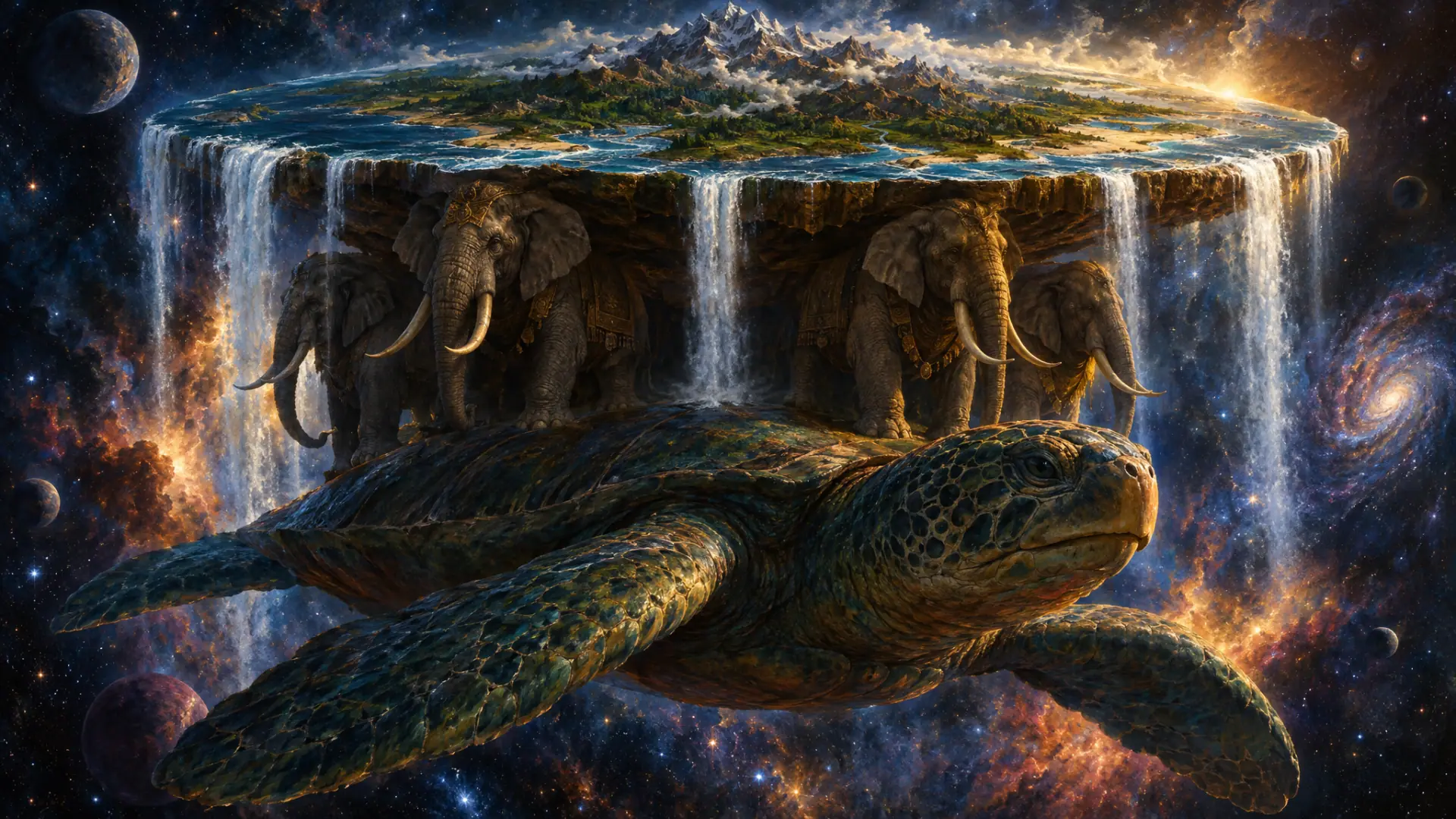
The Discworld is a flat world, carried on the backs of four elephants who stand on the shell of Great A'Tuin, a star turtle swimming slowly through space. Terry Pratchett introduced it in 1983 as a place to make fun of fantasy, and spent the next 32 years using it to make serious points about nearly everything else: journalism, policing, death, religion, the post office, racism, war and the business of growing old. Forty-one novels later, Discworld stands as the defining work of Comic Fantasy and one of the great sustained achievements of popular British fiction.
Origins
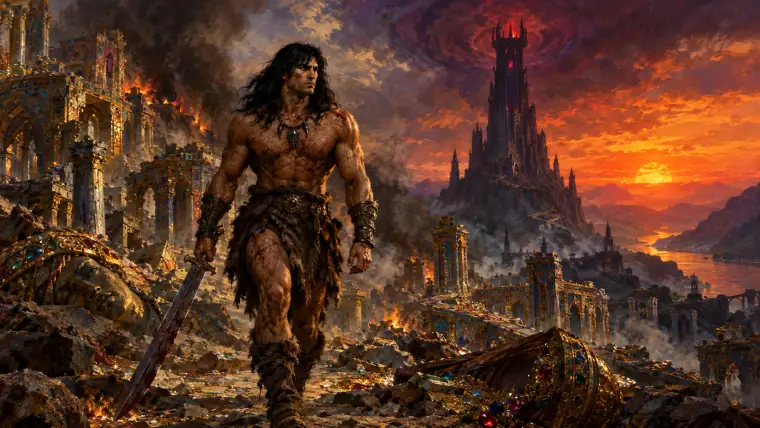
The Colour of Magic was published by the small house Colin Smythe on 24 November 1983. It is overtly a spoof of the paperback fantasy of the 1960s and '70s. It opens with a pair of rogues called Bravd and the Weasel, a transparent send-up of Fritz Leiber's Fafhrd and the Gray Mouser, and introduces Hrun the Barbarian, a muscle-bound hero in the mold of Robert E. Howard's Conan. Its unlikely heroes are Rincewind, a cowardly failed wizard, and Twoflower, the Disc's first tourist, followed everywhere by the Luggage, a chest of sapient pearwood on hundreds of little legs.
Pratchett, a former journalist and press officer for the Central Electricity Generating Board, wrote with a newspaperman's ear for cliché. The early books also borrow freely from the conventions that tabletop gaming had made familiar: dungeons, monsters, heroic quests and the logic of magic as a rule-bound system.
The story
There is no single story. Discworld unfolds in overlapping sub-series: the Rincewind books; the Death novels, beginning with Mort (1987); the Witches, led by Granny Weatherwax and Nanny Ogg; the City Watch of Ankh-Morpork under Sam Vimes, beginning with Guards! Guards! (1989); the wizards of Unseen University; the young-adult Tiffany Aching novels; and the Moist von Lipwig books about the Disc's industrial revolution, from Going Postal (2004). As the series matured, the parody receded and satire moved to the foreground, with Ankh-Morpork growing from a Lankhmar pastiche into a living, modernizing city.
Reception & impact
Discworld made Pratchett the best-selling author in the UK during the 1990s, and more than 80 million copies have been sold in 37 languages. The books' covers, painted by Josh Kirby from 1983 to 2001 and by Paul Kidby from 2001 to 2015, became part of their identity.
The Disc crossed into games early and often. Delta 4 and Piranha adapted The Colour of Magic as a text adventure in 1986. Psygnosis published the point-and-click adventure Discworld in 1995, with Eric Idle voicing Rincewind, and followed it with Discworld II: Missing Presumed...!? (1996) and the hard-boiled Discworld Noir (1999). Steve Jackson Games published GURPS Discworld (1998) for its GURPS system, and the text-based Discworld MUD gave fans a persistent online Ankh-Morpork, part of the wider MUDs (Multi-User Dungeons) tradition. Board games such as Discworld: Ankh-Morpork (2011) followed. On screen, Sky produced live-action films of Hogfather (2006), The Colour of Magic (2008) and Going Postal (2010).
Legacy
Pratchett was diagnosed with a rare form of early-onset Alzheimer's disease in 2007 and campaigned publicly on dementia and assisted dying. He died on 12 March 2015; the final novel, The Shepherd's Crown, appeared that August. His fans' tribute — "GNU Terry Pratchett," a hidden header echoing the clacks-tower code in Going Postal — still circulates on web servers.
Discworld showed that humor and High / Epic Fantasy were not opposites, and that a long fantasy series could grow wiser rather than merely longer. Its influence runs through later comic fantasy and through the jokey, self-aware tone of many games; it also demonstrated, decades before Dungeon Crawler Carl, how much comedy is hiding inside the rules of a genre.
Marginalia
- The first novel, The Colour of Magic (1983), opens with a parody of Fritz Leiber's Fafhrd and the Gray Mouser, named Bravd and the Weasel.
- The series runs to 41 novels, ending with The Shepherd's Crown, published posthumously in 2015.
- More than 80 million Discworld books have been sold in 37 languages.
- Eric Idle voiced Rincewind in Psygnosis's 1995 point-and-click adventure Discworld.
- Steve Jackson Games published GURPS Discworld in 1998.
- Josh Kirby painted the covers from 1983 to 2001; Paul Kidby took over after Kirby's death.
Quick answers
- When was Discworld first published?
- Discworld was first published in 1983–2015.
- Who created Discworld?
- Discworld was made by Terry Pratchett (author).
- What kind of work is Discworld?
- Discworld is a book series in the Comic Fantasy tradition, released for Novels, Adventure games (1995–99), GURPS Discworld (1998) and Discworld MUD.
- Why is Discworld important?
- Terry Pratchett's Discworld proved comic fantasy could carry the weight of serious ideas and made him the UK's best-selling author of the 1990s; it also crossed repeatedly into games, from 1980s text adventures to GURPS and a long-running MUD.