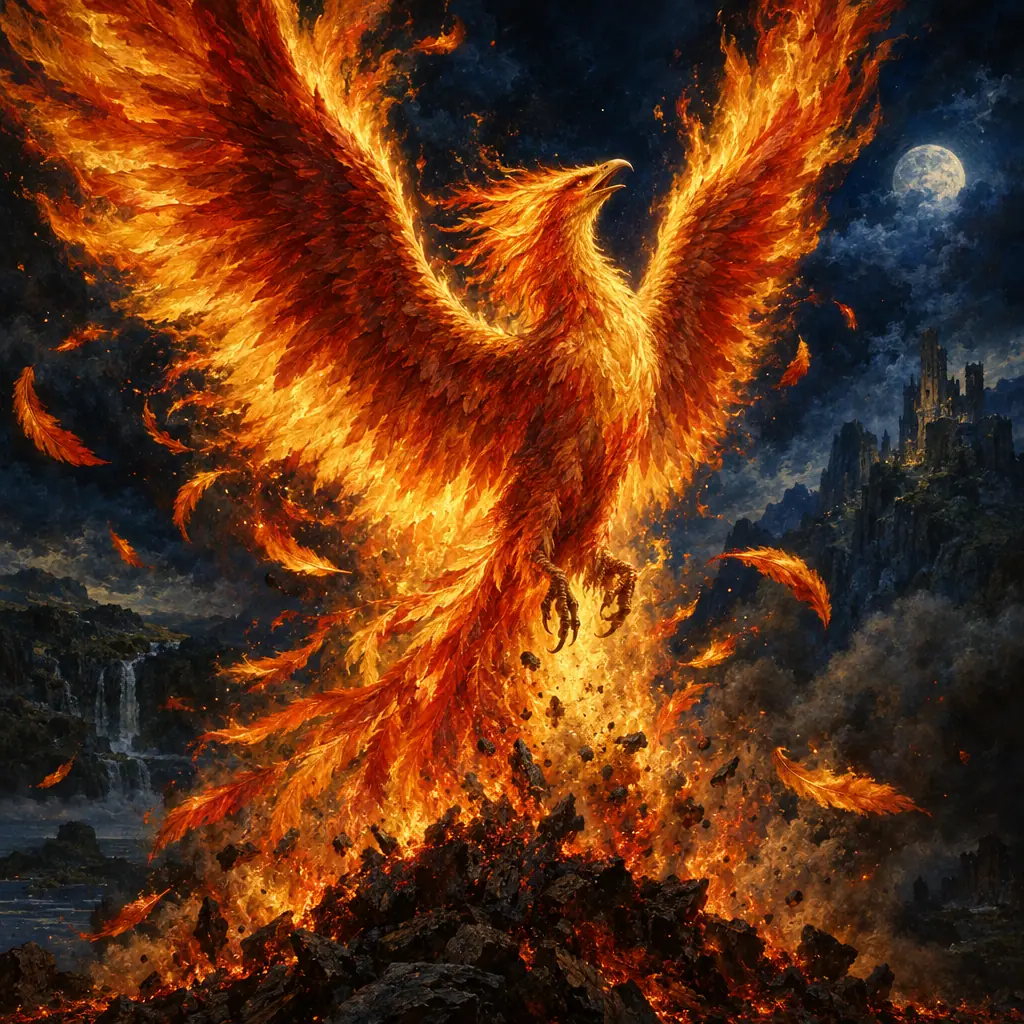
The phoenix supplied fantasy with its most enduring image of renewal. In games that image became a mechanic — resurrection — from Final Fantasy's Phoenix Down to the rare phoenix mounts of MMOs.
Origins
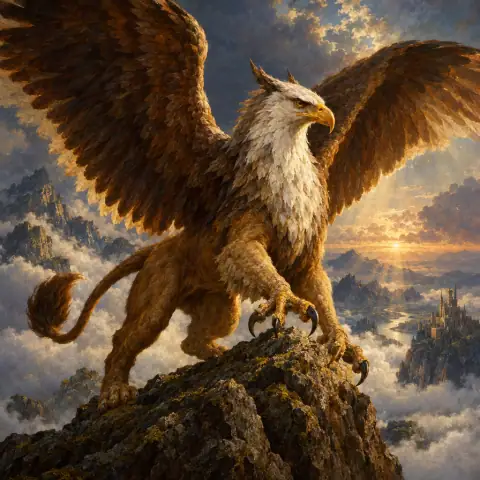
The phoenix enters literature as a measure of time. In a fragment attributed to Hesiod, the wise centaur Chiron tells the young Achilles that a crow lives nine human generations, a stag four times as long as a crow, a raven three times a stag, and the phoenix nine times a raven, while the nymphs outlive ten phoenixes. Even earlier, a Mycenaean Linear B word, po-ni-ke, may name a Griffin-like creature; the Greek word phoinix also meant a red-purple dye and the date palm, so the bird may simply be "the crimson one".
Herodotus, in the 5th century BCE, gave the story its Egyptian address. The priests of Heliopolis told him of a bird he had seen only in pictures, red and gold and the size of an eagle, which came from Arabia once in 500 years when its parent died. It shaped an egg of myrrh, hollowed it, sealed the dead parent inside and carried it to the temple of the Sun. Herodotus said plainly that he did not believe it. Nineteenth-century scholars connected the tale to the Bennu, a heron-like solar bird venerated at Heliopolis, though the Egyptian evidence is ambiguous and the influence may have run the other way.
Roman writers multiplied the details. Pliny the Elder described a purple bird with a golden neck and a blue, rose-flecked tail; Ovid told of its nest of spices, Tacitus recorded a reported sighting in Egypt, and over the centuries the story of renewal settled on fire, with the bird dying on its perfumed pyre and rising from the ashes. Early Christian writers, from Clement of Rome to the poet Lactantius, read the phoenix as a figure of resurrection, and medieval bestiaries, heraldry and Elizabethan portraiture carried it forward. Dante's Inferno describes it feeding on incense and dying in its five-hundredth year.
Into the dungeon
The phoenix arrived in Advanced Dungeons & Dragons relatively late, with an entry in Monster Manual II (1983), long after the griffons and basilisks of 1974. Its real home in games is as a mechanic. Resurrection is an ordinary part of role-playing, and the phoenix became its emblem: the Phoenix Down that revives a fallen ally in the Final Fantasy series, recurring phoenix summons that bring a whole The party back into the fight, and phoenix-feather items across countless Japanese and Western RPGs.
It also became a prize. The Conflux town added to Heroes of Might and Magic III in 1999 fields firebirds that upgrade into phoenixes, and World of Warcraft's Burning Crusade expansion (2007) made the phoenix god Al'ar a raid boss in Tempest Keep, and its rare "Ashes of Al'ar" mount turned a fiery bird into a status symbol.
Variations
Modern fantasy has written the phoenix both as a noble companion and as a joke. J. K. Rowling's Fawkes, in Harry Potter, bursts into flame on his "burning day", carries heavy loads, heals with his tears and, in Chamber of Secrets (1998), blinds the Basilisk; his feathers form the cores of Harry's and Voldemort's wands. Terry Pratchett's Discworld novel Carpe Jugulum (1998) builds a subplot around a search for the phoenix.
Outside Europe, the Chinese fenghuang, the Persian simurgh and the Slavic firebird are often translated as "phoenix", although they are distinct traditions with their own meanings. What unites them in fantasy is the promise the Greek bird has carried for nearly three thousand years: that an ending can be the beginning of the next life.
Migration
How the creature traveled from story to story.
- 700 BCEHesiodic fragment, Precepts of ChironThe earliest clear literary mention: the phoenix outlives nine ravens, and the nymphs outlive ten phoenixes.
- 440 BCEHerodotus, Histories, Book 2The Heliopolis story: a red-and-gold, eagle-sized bird that comes from Arabia once in 500 years, carrying its dead parent in an egg of myrrh.
- 77Pliny the Elder, Natural HistoryEagle-sized, gold at the neck, purple-bodied, with a blue and rose tail and a feathered crest.
- 300Lactantius, De ave phoeniceThe Latin poem makes the self-renewing bird a figure Christian readers took as a symbol of resurrection.
- 1983AD&D Monster Manual IIThe phoenix receives its own entry in AD&D's second monster book, nearly a decade after griffons and basilisks.
- 1998Harry Potter and the Chamber of SecretsDumbledore's phoenix Fawkes heals with his tears and blinds the basilisk; the fifth book names the Order of the Phoenix.
- 2007World of Warcraft: The Burning CrusadeThe phoenix god Al'ar guards Tempest Keep, and the rare Ashes of Al'ar mount lets players fly on a phoenix.
Marginalia
- Herodotus admitted he had seen the phoenix only in pictures, and found the Heliopolis story about its myrrh egg hard to believe.
- The Greek word phoinix also meant a red-purple dye and the palm tree; a Mycenaean Linear B form, po-ni-ke, may have meant 'griffin'.
- A Hesiodic fragment gives the phoenix a lifespan that works out to about 972 human lifetimes.
- Egypt's Bennu bird of Heliopolis was long taken as the phoenix's source; some scholars now think Greek ideas influenced the Egyptian sources instead.
- Queen Elizabeth I was painted wearing a phoenix jewel, a compliment to a monarch who ruled alone.
- In the Final Fantasy series, Phoenix Down, the feather that revives a fallen ally, is one of the most familiar items in role-playing games.
Quick answers
- Where does the Phoenix come from?
- Greek literature (a Hesiodic fragment, c. 8th–7th century BCE), linked by Herodotus to Egypt's Heliopolis.
- When did the Phoenix first appear?
- c. 700 BCE, in Hesiodic fragment, Precepts of Chiron.
- How did the Phoenix get into games?
- Key appearances: AD&D Monster Manual II (1983) and World of Warcraft: The Burning Crusade (2007).
- Why is the Phoenix significant?
- The phoenix supplied fantasy with its most enduring image of renewal. In games that image became a mechanic — resurrection — from Final Fantasy's Phoenix Down to the rare phoenix mounts of MMOs.