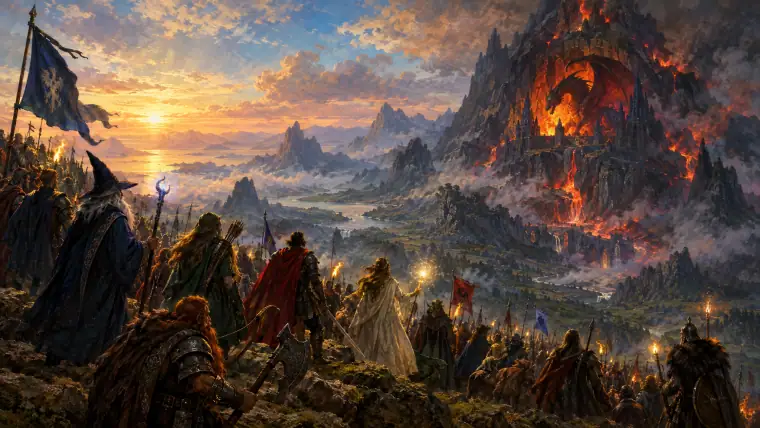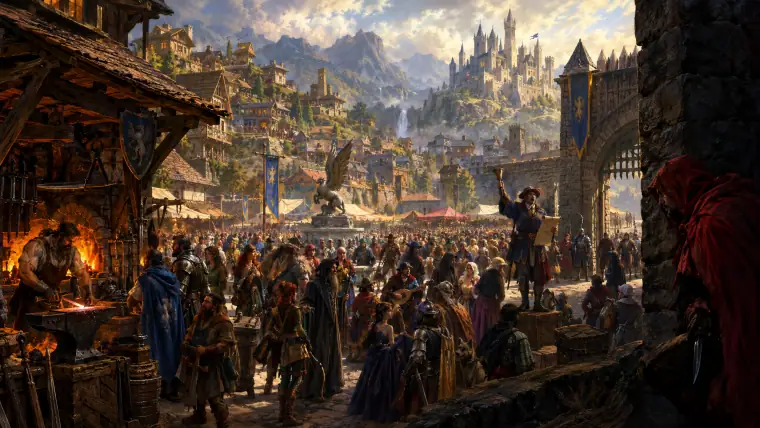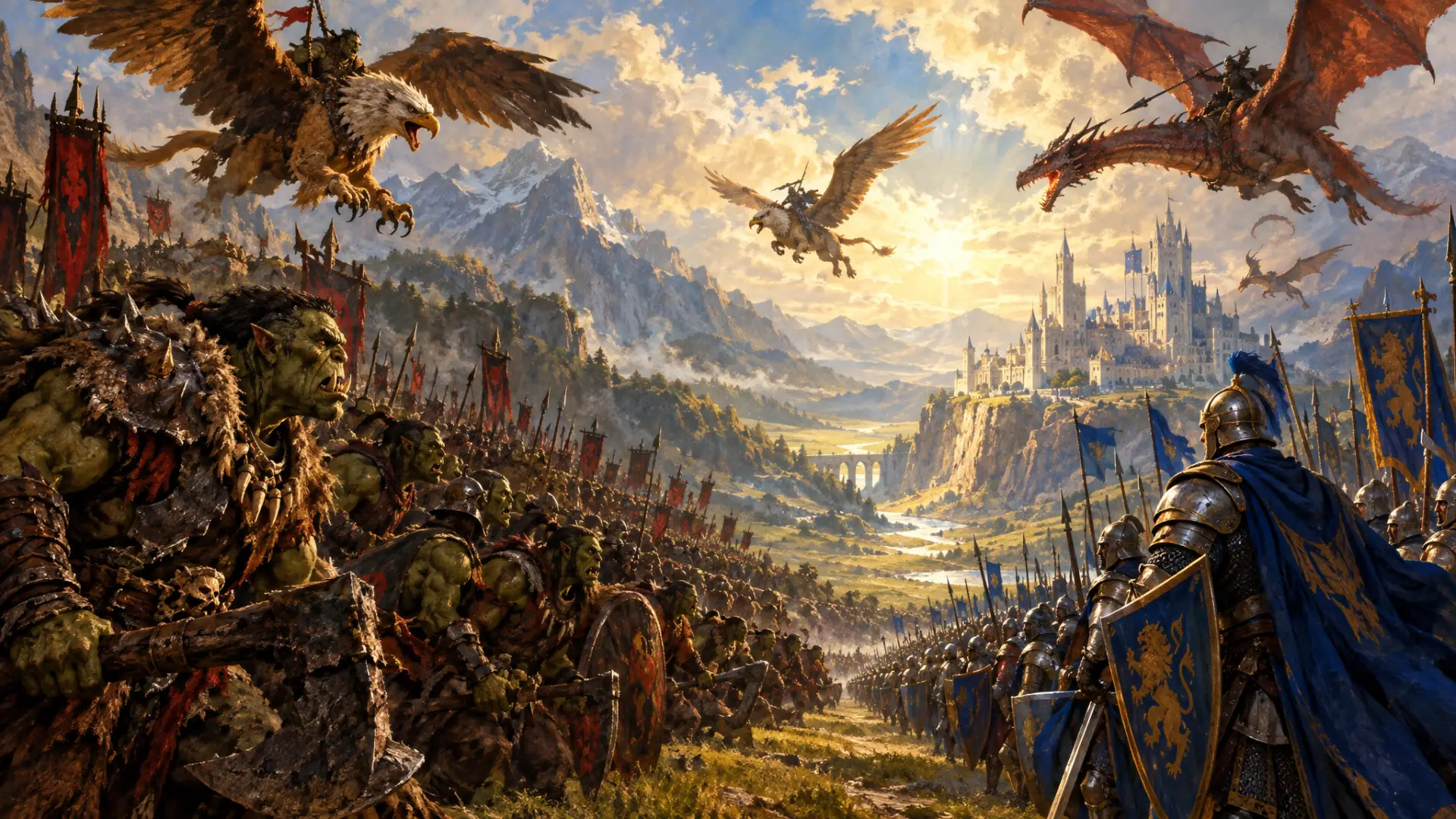
World of Warcraft turned the MMORPG from a niche hobby into a mass medium. Its quest-driven leveling, instanced dungeons and structured raids became the template for a generation of online games, and its culture spilled into television, epidemiology and economics.
Overview
For most of its first decade the massively multiplayer fantasy world was a hard place: slow, punishing and built for people who could spend whole evenings waiting for a monster to respawn. World of Warcraft made it welcoming. Released by Blizzard Entertainment in North America and Australasia on November 23, 2004, and in Europe on February 11, 2005, it set players loose on Azeroth, the bright, exaggerated world of Blizzard's Warcraft strategy games, and gave them something to do every minute they were there. Quests pointed the way from level 1 to 60. Death cost a short walk back as a ghost. Dungeons were private. The art ran on modest PCs and Macs, and one hybrid disc installed on both.
The result was the most successful subscription game ever made. It passed 10 million subscribers in January 2008 and peaked at 12 million in October 2010, and by 2014 more than 100 million accounts had been created. Two decades later it is still running, still expanding, and still the reference point for every online role-playing game that follows.
Origins
After StarCraft shipped in 1998, Blizzard's next project was Nomad, a post-apocalyptic game based on Games Workshop's tabletop skirmish game Necromunda. It drifted. Many of Blizzard's developers were spending their nights in Verant's EverQuest (1999), several of them as guild leaders, and talk turned to making an online world of their own, one that fixed the things they found tedious about Norrath. In a management vote everyone except Nomad's project lead chose the new direction, and by the end of 1999 Nomad was dead and World of Warcraft had begun.
The Warcraft games gave the team a ready-made world with factions, heroes and a sense of humor. Orcs, trolls, tauren and the undead Forsaken formed the Horde; humans, dwarves, gnomes and night elves the Alliance. Rob Pardo, who had worked on StarCraft and Warcraft III, was lead designer, with Jeff Kaplan and Tom Chilton on the design team, Mark Kern as team lead and Chris Metzen shaping the story. The engine borrowed from Warcraft III. Blizzard announced the game at the ECTS show in London in September 2001, and development ran roughly four to five years, including long public beta tests.
The core design goal was to cut downtime. Every class could recover health between fights. A "rested" bonus gave extra experience to players who had been away, so casual players could keep up with friends. Quests were plentiful enough that Grinding became optional, and they were used to move players from zone to zone, spreading them out to avoid what the designers called player collision. Each group got its own copy, or Instanced dungeon, of a dungeon, so nobody had to camp a boss or queue behind strangers.
How it plays
A player picks a realm, a faction, a race and a class, such as warrior, mage, priest, rogue or hunter, and enters a seamless world in which a character can run the length of a continent without a loading screen. Much of the game's story is told through quests handed out by non-player characters: kill ten boars, gather herbs, carry a letter to a distant town, and follow the chain until it reveals a cult, a plague or a dragon in disguise. Professions such as mining, blacksmithing and tailoring feed an auction house economy. Players can fight other players in battlegrounds, and on some servers anywhere in the open world.
The endgame is cooperative. Five-player dungeons teach groups to play the holy trinity of tank, healer and damage-dealer and to manage Aggro. Beyond them lie raids, which at launch required up to 40 players to coordinate against bosses like the fire lord Ragnaros in Molten Core. Raiding turned guilds into small organizations with schedules, loot rules and officers. Later expansions shrank raid sizes, added difficulty tiers and a Mythic level whose "Race to World First" became a spectator sport. The subscription model, backed since 2015 by a WoW Token that lets players buy game time with in-game gold, has never changed.
Reception & impact
Reviewers praised the pacing, the quests, the art and the sound, and criticized the overcrowded launch servers. The game won Best PC Game, Best Multiplayer Game and Best RPG at the 2005 Spike TV Video Game Awards and the Academy of Interactive Arts & Sciences' award for massively multiplayer game of the year. It was the best-selling PC game of 2005 and 2006. By April 2008 it was estimated to hold 62 percent of the MMORPG subscription market.
The expansions kept the numbers climbing. The Burning Crusade (January 2007) opened Outland; Wrath of the Lich King (November 2008) went to Northrend and sold about 2.8 million copies in its first day; Cataclysm (December 2010) remade the original continents. After the October 2010 peak, subscriptions fell, to 7.1 million in May 2015 and 5.5 million by that September, the last figure Blizzard reported before it stopped publishing subscriber counts. Expansions still arrived every two years or so: Mists of Pandaria (2012), Warlords of Draenor (2014), Legion (2016), Battle for Azeroth (2018), Shadowlands (2020), Dragonflight (2022), The War Within (2024) and Midnight (March 2026), the second part of a three-expansion story called the Worldsoul Saga that is planned to end with The Last Titan.
The game became a culture. The 2005 Leeroy Jenkins video turned a botched dungeon pull into a catchphrase. The Corrupted Blood incident that September, when a raid boss's contagious curse escaped into the cities, became a case study for epidemiologists. Blizzard launched its own convention, BlizzCon, in 2005. South Park's 2006 episode "Make Love, Not Warcraft" won an Emmy. Gold farming, account selling and bot programs made the game a central text in the study of virtual economies, and scholars from anthropology to economics wrote books about life in Azeroth. China became one of its largest markets, first through the licensee The9 and from 2009 through NetEase; a contract dispute took the Chinese servers offline in January 2023, and they returned in 2024. In 2008 the game shared a Technology & Engineering Emmy with EverQuest and Neverwinter Nights.
Legacy
World of Warcraft redefined the MMORPG as a theme park rather than a simulation. Ultima Online had offered players a world to shape; WoW offered a sequence of polished experiences, and for a decade almost every large online game, from The Lord of the Rings Online to Final Fantasy XIV and The Elder Scrolls Online, was built to compete with it. Its quest hubs, talent trees, instanced dungeons and structured raids became genre conventions. Many of those rivals struggled or switched to free-to-play; Guild Wars and others defined themselves by what they refused to copy.
The game has also had to compete with its own past. In August 2019 Blizzard launched World of Warcraft Classic, a re-creation of the 2004 game running on modern servers, after years of fan demand and unofficial private servers, and later added versions of early expansions. The franchise spread into board games, a trading card game, novels, comics, the digital card game Hearthstone (2014) and Duncan Jones's film Warcraft (2016). The Strong National Museum of Play inducted World of Warcraft into its World Video Game Hall of Fame in 2015. Ownership has changed around it, from Vivendi to Activision Blizzard in 2008 and to Microsoft in 2023, but Azeroth has stayed open.
Did you know?
The first World of Warcraft–themed restaurant opened in Beijing in 2008. And for its 20th anniversary in 2024, Blizzard partnered with the University of Washington, whose football team briefly became the "University of Warcraft."
Marginalia
- Blizzard's next game after StarCraft was Nomad, a post-apocalyptic project based on Games Workshop's Necromunda. It was shelved in 1999 because the team had fallen in love with EverQuest.
- The game was announced at the ECTS trade show in London in September 2001 and launched on November 23, 2004, the tenth anniversary of the Warcraft series.
- In April 2008 World of Warcraft was estimated to hold 62 percent of the entire MMORPG subscription market.
- Wrath of the Lich King sold about 2.8 million copies in its first 24 hours in November 2008, then a record for a PC game.
- In 2008 it shared a Technology & Engineering Emmy with EverQuest and Neverwinter Nights for advancing the art of the MMORPG.
- The Corrupted Blood plague of 2005 became a case study for epidemiologists modeling real outbreaks.
- The Strong National Museum of Play inducted it into the World Video Game Hall of Fame in 2015.
Quick answers
- When was World of Warcraft first released?
- World of Warcraft was first released in 2004 (Windows & Mac OS X).
- Who created World of Warcraft?
- World of Warcraft was made by Rob Pardo (lead designer).
- Who published or developed World of Warcraft?
- Blizzard Entertainment.
- What kind of work is World of Warcraft?
- World of Warcraft is a MMORPG in the MMORPGs and Western Computer RPGs (CRPG) tradition, released for Microsoft Windows and macOS.
- Why is World of Warcraft important?
- World of Warcraft turned the MMORPG from a niche hobby into a mass medium. Its quest-driven leveling, instanced dungeons and structured raids became the template for a generation of online games, and its culture spilled into television, epidemiology and economics.