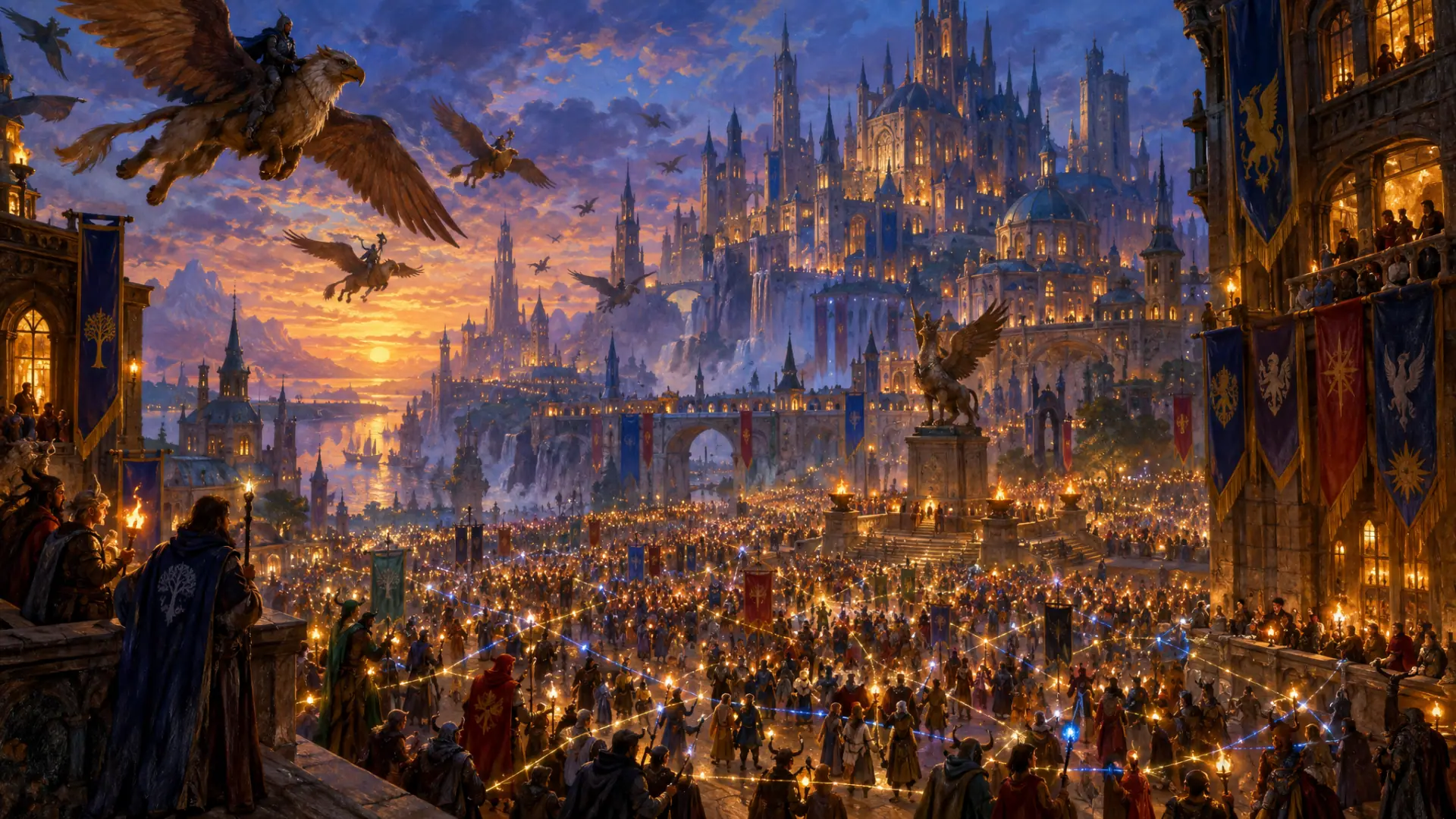
Final Fantasy XI brought the MMORPG to consoles and joined PlayStation 2 and PC players, and Japanese and Western players, in a single world; it turned a single-player JRPG series into a persistent online one and by 2012 was the most profitable game in the franchise.
Overview
For fifteen years Final Fantasy had meant a handcrafted story played alone. With its eleventh numbered entry, Square put the series online. Released in Japan on May 16, 2002, for PlayStation 2, then for Windows that November, in North America in 2003–04 and on Xbox 360 in 2006, Final Fantasy XI is a subscription MMORPG set in the world of Vana'diel. It was the first MMORPG to let PlayStation 2 and PC players share servers, and it put Japanese and Western players into the same worlds. Critics found it demanding and slow; players stayed for years. By June 2012 it had become the most profitable title in the series, and more than two decades later its servers are still running.
Origins
The idea came from Hironobu Sakaguchi. While establishing Square Pictures' studio in Hawaii, he was struck by Western online games such as EverQuest, and he persuaded Square to build its own MMORPG on the Final Fantasy name. Development began in November 1999 under producer Hiromichi Tanaka and director Koichi Ishii, merging four teams: the Osaka crews behind Parasite Eve II and Brave Fencer Musashi and the Tokyo teams behind the Mana series of Secret of Mana and Chrono Cross. Tanaka said the design drew heavily on Final Fantasy III, especially its battles and magic, and called the result the most representative Final Fantasy of all.
The announcement, at the Square Millennium event in Yokohama on January 29, 2000, drew skepticism, including questions about whether an online game deserved a numbered title at all. Square spent two to three billion yen building the game together with its PlayOnline network service, expecting profits over five years; building one shared world instead of separate regional ones, it said, cut development costs by 66 percent. On PlayStation 2 the game required the console's hard-drive add-on, which limited its early audience.
How it plays
Players create a character from five races, the Hume, the proud Elvaan, the childlike spellcasting Tarutaru, the catlike Mithra and the hulking Galka, and pledge to one of three nations: San d'Oria, Bastok or Windurst. Twenty years after the Crystal War against the Shadow Lord and his beastmen, missions for one's nation carry the main story, while quests fill out the world. For the first time in the series, monsters roam the world and fights happen in it, rather than in random encounters on a separate battle screen, a change every later numbered game kept.
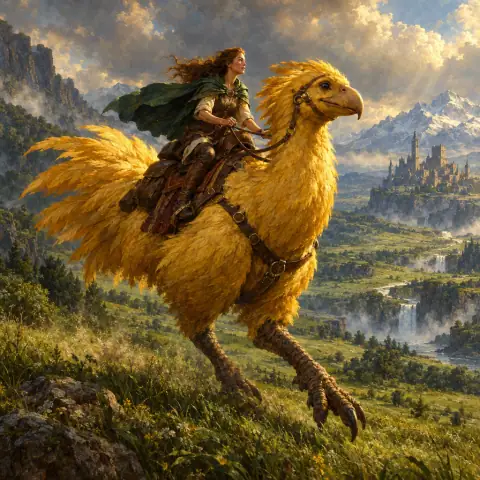
The job system is the core. Any character can change job, and can also set a support job, gaining that job's abilities, traits and spells at half the character's level: a level 20 Warrior with Ninja support fights with the tools of a level 10 Ninja. To defeat stronger monsters and earn experience efficiently, players form parties of six, built around a tank, a healer and damage dealers, and manage "enmity," the game's term for aggro. Alliances of up to 18 players tackle harder foes. Weapon skills can be chained by party members into skillchains, and spells timed onto a skillchain become Magic Bursts, a system that rewards coordination over raw numbers. Crafting, fishing, and later chocobo breeding and racing round out the life of Vana'diel, along with familiar foes such as goblins and tonberries.
Reception & impact
Critics praised the scale and polish while complaining of long installs, awkward controls and the grind for experience. American players arriving in 2003 found Japanese players already far ahead, and Square Enix opened new worlds so newcomers had space. The business case held: by December 2003 there were more than 200,000 subscribers, enough to break even, and in 2006 the game had about 500,000 active players, with around 150,000 online at a time. It won GameSpy's 2003 PC MMORPG of the Year award, and its U.S. PC edition sold 340,000 copies by August 2006.
Expansions arrived steadily: Rise of the Zilart (2003), which topped the Japanese charts with 90,000 copies in its first week; Chains of Promathia (2004); Treasures of Aht Urhgan (2006); Wings of the Goddess (2007); and Seekers of Adoulin (2013). Like every successful online world, Vana'diel attracted real-money traders; in 2006 Square Enix banned 700 accounts and removed 300 billion gil from circulation, then banned or suspended more than 8,000 more that July.
Legacy
Final Fantasy XI made online play part of the Final Fantasy identity. Square Enix followed it with Final Fantasy XIV in 2010, rebuilt in 2013 as A Realm Reborn, and in 2024 that game's Dawntrail expansion added a raid series, Echoes of Vana'diel, that sent a wave of curious players back to the original. As the population swelled, several of XI's worlds were closed to new characters from 2025. The final main scenario, Rhapsodies of Vana'diel, arrived in 2015; PlayStation 2 and Xbox 360 service ended on March 31, 2016, but the PC game continues with new story content. At a time when World of Warcraft was about to redefine the genre in the West, Final Fantasy XI showed that a console audience, and a Japanese one, would live in an online world too.
Marginalia
- Hironobu Sakaguchi pushed for the game after discovering Western MMORPGs such as EverQuest while setting up Square Pictures in Hawaii.
- It was the first MMORPG to offer cross-platform play between PlayStation 2 and Windows.
- Players of every language share the same worlds, communicating partly through a built-in library of auto-translated phrases.
- Uematsu's opening theme is a choral piece sung in Esperanto, chosen to symbolize communication across cultures.
- In 2006 Square Enix banned 700 accounts and removed 300 billion gil after catching players generating currency for real-money sale.
- It was the last game still running on the PlayStation 2's online service when console support ended in 2016.
- By June 2012 it had become the most profitable title in the Final Fantasy series.
Quick answers
- When was Final Fantasy XI first released?
- Final Fantasy XI was first released in 2002 (Japan, PlayStation 2); 2003 (North America, Windows).
- Who created Final Fantasy XI?
- Final Fantasy XI was made by Hironobu Sakaguchi (originated the project) and Nobuo Uematsu (composer (with Naoshi Mizuta and Kumi Tanioka)).
- Who published or developed Final Fantasy XI?
- Square / Square Enix.
- What kind of work is Final Fantasy XI?
- Final Fantasy XI is a MMORPG in the MMORPGs and Japanese RPGs (JRPG) tradition, released for PlayStation 2, Windows and Xbox 360.
- Why is Final Fantasy XI important?
- Final Fantasy XI brought the MMORPG to consoles and joined PlayStation 2 and PC players, and Japanese and Western players, in a single world; it turned a single-player JRPG series into a persistent online one and by 2012 was the most profitable game in the franchise.