Japanese designers took Wizardry and Ultima, redesigned them for a game controller and a mass audience, and within fifteen years made the console RPG a worldwide form, from Dragon Quest's slimes to Final Fantasy VII.
On the morning of February 10, 1988, long lines formed outside electronics shops in Tokyo. Many of the people waiting were schoolboys who should have been in class. They had come for Dragon Quest III, the third game in a series that was barely two years old. By the end of the day it had sold more than a million cartridges. Almost three hundred students were reportedly picked up by police for truancy, and newspapers reported on the fever it caused. Enix, the publisher, decided on its own that future Dragon Quest games would come out on weekends. In a few years, a form invented by American wargamers and programmed by American students had become a Japanese national pastime. This chapter traces how that happened, and how the Japanese version then spread back around the world.
Wizardry in Akihabara
The route ran through the personal computer. In the early 1980s Japan's hobbyists used NEC's PC-8801, Fujitsu's FM-7, and the MSX standard, and the American imports that reached them included Wizardry and Ultima, the games described in Mainframes to Microcomputers: the First Computer RPGs. Wizardry in particular developed a devoted cult following in Japan. Its sparse wireframe mazes and unforgiving death rules suited players who liked a stern challenge, and the series was eventually licensed, adapted, and continued by Japanese companies long after its American popularity had faded.
The first homegrown hit came from an outsider. Henk Rogers, a Dutch-born American living in Japan, founded Bullet-Proof Software and in 1984 released The Black Onyx, an RPG designed for Japanese players who had never seen a character class or hit point. It became a bestseller and taught many players the basics of the form. (Rogers later made history again by bringing Tetris to Nintendo.) The same year, Nihon Falcom's Dragon Slayer, designed by Yoshio Kiya, and T&E Soft's Hydlide moved combat into real time: the hero fought by walking into enemies on a scrolling overhead map. These were among the first action RPGs, and Falcom refined the approach with Ys (1987), which combined fast play with a lavish soundtrack. Japanese computer RPGs were already putting speed, music, and presentation ahead of simulation.
Tabletop gaming arrived in Japan by a similar indirect path. In September 1986 the computer magazine Comptiq began publishing "replays," edited transcripts of real D&D sessions run by Ryo Mizuno with members of the design collective Group SNE. The campaign became Record of Lodoss War, which Mizuno turned into novels and which was adapted into a celebrated 1990 original video animation (OVA) series. Its half-elf and Elf heroes defined how a generation of Japanese artists drew fantasy characters. Group SNE's own Sword World RPG (1989) followed. In Japan, fantasy reached many players as something to read and watch before it was something to play at a table.
The hero of Alefgard
Yuji Horii was a freelance writer for Weekly Shōnen Jump, the country's most popular manga magazine, and an enthusiast of Wizardry and Ultima. He had won an Enix programming contest and written the detective game The Portopia Serial Murder Case (1983). He wanted to bring the RPG to Nintendo's Famicom, which was in millions of Japanese homes, for players who had never touched a computer keyboard. With the programmers of Chunsoft he designed Dragon Quest, released on May 27, 1986.
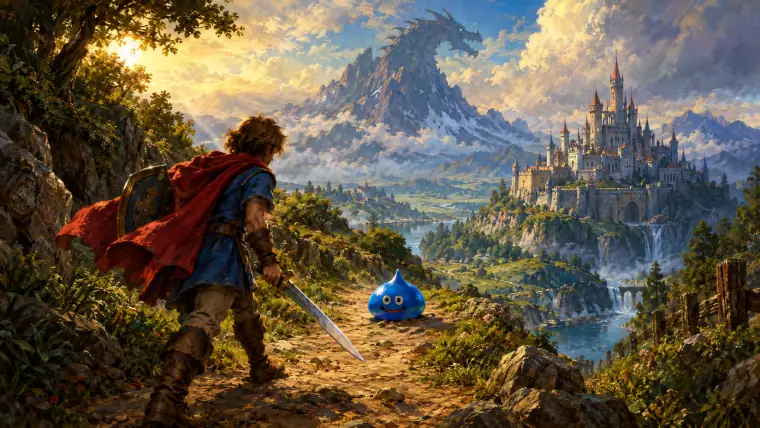
Its simplicity was deliberate. There was one hero, and the menus had just a few commands. The world was small and could be learned: the kingdom of Alefgard, a castle, a princess, and the Dragonlord's island across the water. Difficulty came from the landscape. Monsters grew stronger with distance from the castle, so the player's own grinding determined when they were ready to go further. Horii recruited his Jump colleague Akira Toriyama, the creator of Dr. Slump and Dragon Ball, to design the monsters. Toriyama's grinning, teardrop-shaped Slime became the series mascot, a harmless first enemy that tens of millions of players would recognize. The veteran television composer Koichi Sugiyama wrote a classical score whose overture is still performed in concert halls. Horii promoted the game in his Jump columns. By Dragon Quest III in 1988, with its class system and a twist connecting it to the first game, the series was a national institution in Japan.
The same year as the first Dragon Quest, Nintendo released Shigeru Miyamoto's The Legend of Zelda (February 21, 1986), on the Famicom Disk System. It wasn't strictly an RPG, since it had no experience points or levels, but its open overworld, hidden dungeons, and heart containers set the template for the action-adventure. It showed another way to combine exploration and fantasy on a game controller, and many games later drew on both Zelda and Dragon Quest.
Crystals and final fantasies
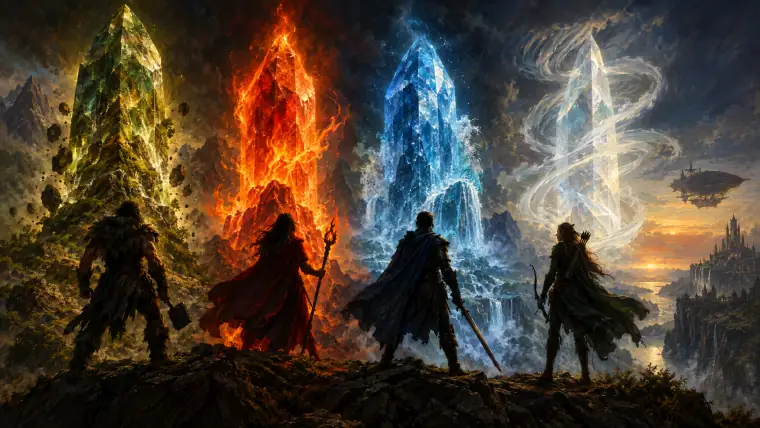
Square was a small, struggling developer when Hironobu Sakaguchi staked his future on an RPG of his own. Accounts differ on why it was named Final Fantasy, whether for the company's precarious finances, Sakaguchi's own career, or simply because the name sounded good, but it was released on December 18, 1987. Where Dragon Quest had one hero, Final Fantasy gave the player four Light Warriors of chosen classes, side-view battles in the style of the tabletop, and a plot that looped back on itself through time. Its music was by Nobuo Uematsu, its illustrations by Yoshitaka Amano, whose delicate, Art Nouveau–influenced watercolors gave the series a romantic look unlike Toriyama's cartoons. Final Fantasy II (1988) introduced the chocobo and a cast of named characters. From the start, the two series defined the genre's two poles: Dragon Quest as reliable, humorous, and gradual; Final Fantasy as ambitious and willing to change its systems with every installment.
Sega offered its own answer two days after Final Fantasy. Phantasy Star (December 20, 1987), for the Master System, was a science-fantasy epic across three planets with smoothly animated first-person dungeons. Its heroine, Alis Landale, set out to avenge her brother. Its designer, Rieko Kodama, one of the most important women in early game design, went on to direct Phantasy Star IV (1993) and many other Sega games.
Crossing the Pacific
American players didn't take to the Japanese console RPG immediately. Dragon Quest arrived in North America as Dragon Warrior in August 1989, with its sprites redrawn and its dialogue rendered in mock-Elizabethan English. Sales were modest until late 1990, when Nintendo gave the cartridge away to subscribers of Nintendo Power, its house magazine. The offer drew nearly half a million new subscribers and put the game in a very large number of American homes. Final Fantasy reached America in July 1990. The next game released in North America under the Final Fantasy name, in 1991, was actually the Japanese fourth installment, relabeled Final Fantasy II. The numbering confused Western fans for years.
Publishers guessed, often wrongly, at what Americans wanted. Square built Final Fantasy Mystic Quest (1992) as a simplified introduction for Western beginners, and later set up a team in Redmond, Washington, that made Secret of Evermore (1995) specifically for the American market. Many games were never translated at all. Dragon Quest V and VI and Final Fantasy V stayed in Japan during their original release, and Western fans learned of them from import shops and magazine previews. In the late 1990s hobbyists began producing unofficial fan translations to fill the gap.
Sega's machines kept a parallel tradition alive. Phantasy Star II (1989) opened the Genesis era with a darker story and an early major character death, and its successors and the tactical Shining Force (1992) gave Sega owners an RPG library of their own. NEC's PC Engine, sold in America as the TurboGrafx-16, used its CD add-on to give Falcom's Ys voice acting and recorded music, an early sign of the cinematic presentation that later dominated the form.
The early Western audience was small but devoted, drawn to games that seemed to take their stories seriously and to magazines such as Nintendo Power that printed maps and walkthroughs. In both countries, the console RPG taught young players to read long stories on a television screen.
Sixteen-bit opera
The Super Famicom (sold in the West as the Super Nintendo) made the 1990s the height of the form. Final Fantasy IV (July 1991) introduced designer Hiroyuki Ito's Active Time Battle system, in which combatants acted when their timers filled, a hybrid of turn-based combat and real-time pressure. It also told a melodrama of betrayal, sacrifice, and redemption for its dark knight, Cecil. Fire Emblem (April 20, 1990, Famicom), from Intelligent Systems and designer Shouzou Kaga, moved the RPG onto a grid of tactical battles in which fallen units died permanently. It was the tactical RPG with permadeath as a principle, and players grieved for units lost to careless moves.
Square's run in these years is still regarded as one of the most remarkable in the medium. Secret of Mana (August 6, 1993) was a real-time action RPG with a ring-shaped menu and room for three players at once. Final Fantasy VI (April 2, 1994) had an ensemble cast of fourteen playable heroes, a world that is actually destroyed halfway through, the nihilist clown Kefka as its villain, and an opera performed with synthesized singing on sixteen-bit hardware. Chrono Trigger (March 11, 1995) brought together a "Dream Team": Sakaguchi, Horii, and Toriyama, with music by Yasunori Mitsuda and Uematsu. It was a time-travel story with multiple endings, combat without separate battle screens, and a New Game+ mode that invited players to replay it.
The other side of the tradition developed as well. Quest's Tactics Ogre (1995) brought political complexity to tactical battle. Shigesato Itoi's Mother (1989) and its sequel, Mother 2 (1994, released in America in 1995 as EarthBound), moved the RPG to a satirical small-town America. Enix's Dragon Quest V (1992) followed a single hero from childhood to fatherhood and allowed him to recruit monsters as companions. By the mid-1990s the Japanese RPG was a recognizably distinct form: linear but expressive, driven by character and composer, and fond of chosen ones and angst-ridden heroes.
Pocket monsters
The most commercially successful RPG franchise of all began on the least powerful hardware of its day. Satoshi Tajiri had grown up collecting insects in the fields of suburban Tokyo, and he founded Game Freak as a fanzine before it became a developer. He imagined creatures that could travel between Game Boys along the link cable. After six years of development, Pokémon Red and Green was released on February 27, 1996.
Its design was a traditional RPG turned into a collection. Instead of a party of characters, the player trained captured creatures; instead of gear, they gathered species, 151 in all. The two versions contained different Pokémon, so completing the collection meant trading with a friend who owned the other. The monster-collecting RPG had predecessors, including Megami Tensei and Dragon Quest V, but nothing had worked as a social mechanism so effectively. Media Factory's trading card game (October 1996) and the anime series (April 1, 1997) followed quickly. In December 1997 one episode's flashing effects sent hundreds of Japanese children to hospitals with seizures, and the broadcast went on hiatus for four months. The franchise reached North America in September 1998, and by January 1999 Wizards of the Coast was selling the English card game. That connection brings us to Collapse & Renaissance: Cards, Vampires & Baldur's Gate.
The PlayStation gambit
The final turn of the Japanese line was a change of platform. Square had planned its next Final Fantasy for the Nintendo 64, but tests showed that cartridges couldn't hold what Sakaguchi's team wanted, and cartridge production costs were rising. In 1996 the company announced a move to Sony's CD-based PlayStation, a major defection from the manufacturer that had supported its growth. Final Fantasy VII was released on January 31, 1997. Its development reportedly cost about $40 million. It combined pre-rendered backdrops with three-dimensional characters and full-motion video. It took place in Midgar, an industrial city powered by an energy company draining the planet's life, and told a story of eco-terrorists, identity, and grief, with a villain, Sephiroth, whose motives emerged only gradually. Aerith's death partway through became one of the most discussed events in games.
It sold more than two million copies in Japan in three days. In North America, where it launched on September 7, 1997, Sony promoted it with television advertising on a scale rarely used for an RPG, and a Windows port followed in 1998. For millions of Western players Final Fantasy VII was their first RPG of any kind. It also briefly made the Japanese tradition look like the future of the genre, at a time when Western computer RPGs were struggling.
The rest of the decade was ambitious and occasionally overreached. Final Fantasy Tactics (1997) brought Yasumi Matsuno's tactical design to the series. Final Fantasy VIII (1999) and IX (2000) extended the PlayStation era. Dragon Quest VII arrived on August 26, 2000, on the PlayStation, confirming the move away from Nintendo. On December 21, 2000, Sega's Phantasy Star Online put console players together on the internet through the Dreamcast's built-in modem. The overreach came in 2001, when Square's computer-animated film Final Fantasy: The Spirits Within lost a great deal of money. On April 1, 2003, the former rivals merged as Square Enix.
What came next
As the Japanese line reached its peak, the Western industry it had overshadowed was changing course. In America a card game from Seattle was drawing money and talent away from the tabletop, TSR was collapsing, and a few small studios were preparing to revive the computer RPG. Chapter Collapse & Renaissance: Cards, Vampires & Baldur's Gate follows that story. The Japanese creators would remain influential long after 2000. Horii, Uematsu, and Sakaguchi kept working for decades, and when Akira Toriyama died on March 1, 2024, tributes came from around the world.