The Famicom and Game Boy were the stages on which Dragon Quest, Final Fantasy and Pokémon were born, and Nintendo's own Zelda, Fire Emblem and Mother series shaped the action RPG, the tactical RPG and the modern-day RPG.
History
Fusajiro Yamauchi founded Nintendo in Kyoto on September 23, 1889, to make hanafuda, the flower-patterned playing cards, and it spent most of the next century as a toy and card company. Its transformation into the hub of Japanese role-playing began with the Family Computer, or Famicom, launched in Japan in July 1983 and in North America as the Nintendo Entertainment System in 1985.
The Famicom was the stage for the Japanese Line: Console RPGs. Enix's Dragon Quest (1986) and Square's Final Fantasy (1987) were both Famicom games, and Nintendo of America itself published them in the West, Dragon Warrior in 1989 and Final Fantasy in 1990, when few American publishers believed in the genre. Nintendo's own designers, meanwhile, were making something different. Shigeru Miyamoto and Takashi Tezuka's The Legend of Zelda, released on the Famicom Disk System on February 21, 1986, combined overhead real-time combat with open exploration and an inventory of tools. Alongside Falcom's Dragon Slayer and T&E Soft's Hydlide, it defined the Action RPGs & Hack-and-Slash, and its battery-backed cartridge let players save a long adventure.
The Game Boy (1989) proved just as important. Game Freak's Pokémon Red and Green, pitched to Nintendo by Satoshi Tajiri in 1990 and published on February 27, 1996, turned the handheld's link cable into a trading post and created the Monster-Collecting RPGs. Nintendo is one of the three owners of The Pokémon Company, alongside Game Freak and Creatures, and publishes the core games worldwide.
The 1990s also brought Nintendo's most famous loss. Its Nintendo 64 kept expensive, limited cartridges, and Square moved Final Fantasy VII (1997) to Sony's CD-based PlayStation. The split cost Nintendo the defining Japanese RPG of the decade and left bad feeling between the companies; Square did not return to a Nintendo console until Final Fantasy Crystal Chronicles on the GameCube in 2003, which Nintendo published.
Notable work
Beyond Zelda, Nintendo's RPG heritage runs through partners. Intelligent Systems, a Kyoto studio that works almost exclusively for Nintendo without being owned by it, made Fire Emblem: Shadow Dragon and the Blade of Light (1990), designed by Shouzou Kaga, whose permanent character deaths and grid battles became a template for the Tactical & Strategy RPGs; the series continued through Three Houses (2019, with Koei Tecmo) and Engage (2023). Shigesato Itoi's Mother (1989) and its sequel EarthBound (1994) moved the Dragon Quest formula into a satirical modern America. Monolith Soft, a Nintendo subsidiary, created Xenoblade Chronicles, and Nintendo co-developed Super Mario RPG (1996) with Square. Zelda itself was reinvented as an open-world game in Breath of the Wild (2017) and Tears of the Kingdom (2023).
Legacy
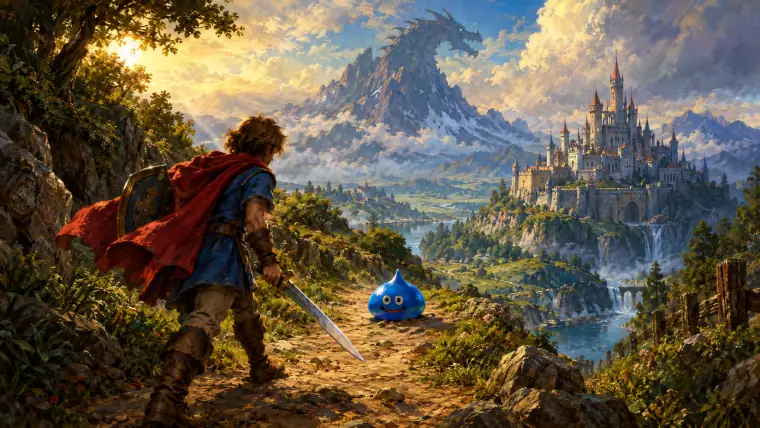
For forty years Nintendo has been the platform on which Japanese fantasy reached children first: the slime of Dragon Quest, the Master Sword, the first Pokémon. Its hardware line continued with the Nintendo Switch 2 in June 2025, and Game Freak's Pokémon Legends: Z-A (October 2025) sold more than 5.8 million copies in its first week. In 2024 Nintendo and The Pokémon Company sued Pocketpair, maker of the creature-collecting survival game Palworld, for patent infringement in Japan. Led by president Shuntaro Furukawa, with Miyamoto as an executive fellow, Nintendo remains the company whose machines have carried more of the Japanese RPGs (JRPG)'s history than any other.
Marginalia
- Fusajiro Yamauchi founded Nintendo in Kyoto on September 23, 1889, to make hanafuda playing cards by hand.
- The original The Legend of Zelda (1986) was one of the first games with a battery-backed save inside the cartridge; its North American release came in a gold cartridge.
- Nintendo of America published Enix's Dragon Quest as Dragon Warrior (1989) and Square's Final Fantasy (1990), introducing both series to North America.
- Fire Emblem: Shadow Dragon and the Blade of Light (1990) is made by Intelligent Systems, a Kyoto studio that works almost exclusively with Nintendo but is not owned by it.
- Nintendo published Pokémon Red and Green (1996); Shigeru Miyamoto, among others, championed the project inside the company.
- Square left Nintendo for Sony's PlayStation with Final Fantasy VII (1997) and did not return to a Nintendo console until Final Fantasy Crystal Chronicles (2003).
Quick answers
- What is Nintendo?
- A Kyoto playing-card maker turned console giant, Nintendo built the machines the Japanese RPG grew up on and published Zelda, Fire Emblem and Pokémon.
- When was Nintendo founded?
- Nintendo was founded in 1889 and is based in Kyoto, Japan.
- Who founded Nintendo?
- Fusajiro Yamauchi.
- What is Nintendo known for?
- The Legend of Zelda, Fire Emblem: Shadow Dragon and the Blade of Light and Pokémon Red and Green.