The Collection
204 works across four mediums, from the Epic of Gilgamesh to Baldur’s Gate 3. Filter by medium, form, decade or genre; every filtered view has its own link.
Epic of Gilgamesh
A tyrant king, a wild man shaped from clay, a monster in a cedar forest and a doomed quest for immortality: the oldest great adventure story on Earth.
The Odyssey
A cunning veteran spends ten years trying to sail home, outwitting a one-eyed giant, a witch, the Sirens and the dead — the template for every wandering adventure since.
Beowulf
A hero tears the arm off a man-eating monster, dives into a haunted mere to kill its mother, and dies fifty years later fighting a dragon woken by a stolen cup.
One Thousand and One Nights
A queen tells a murderous king a story every night and stops at dawn on a cliffhanger — and inside her tales come jinn in bottles, flying carpets, ghouls and Sinbad's roc.
The Mabinogion
Shape-shifting magicians, a woman made of flowers, a severed head that talks for eighty years and Arthur's earliest prose adventure: the dream-logic storytelling of medieval Wales.
The Eddas
Two medieval Icelandic books preserve the Norse cosmos — Odin, Thor, the World Tree, Ragnarök — and a list of dwarf names Tolkien lifted straight into The Hobbit.
Le Morte d'Arthur
A knight-prisoner distills the sprawling French romances into one English saga — the sword from the stone, the Round Table, the Grail quest, Lancelot and Guinevere, and the last battle.
Orlando Furioso
Charlemagne's greatest knight goes mad for love while a woman warrior, a flying hippogriff, a ring of invisibility and a trip to the Moon run riot through Renaissance Italy's wildest epic.
The Faerie Queene
Knights of Holiness, Temperance and Chastity ride through a Faerie Land of dragons, witches, false wizards and an iron man in Elizabethan England's great allegorical romance.
Grimms' Fairy Tales
Two German philologists gather Snow White, Hansel and Gretel, Rapunzel and Rumpelstiltskin — and fix the dark forest, the witch's house and the wicked stepmother in the world's imagination.
Kriegsspiel
A Prussian officer's training game of painted blocks, staff maps and an all-seeing umpire — the 19th-century ancestor of every referee who has ever said "roll for it."
Phantastes
A young man wakes to find his bedroom dissolving into a forest and wanders a dreamlike Fairy Land of malevolent trees, a haunting shadow and a marble lady he sings to life.
Alice's Adventures in Wonderland
A bored girl follows a waistcoated White Rabbit down a hole into a world of shrinking potions, a grinning cat, a mad tea party and a queen who wants everyone's head.
The Well at the World's End
A king's youngest son rides out of his quiet valley in search of a legendary well whose water grants long life — the quest romance, set in a world wholly invented, that taught Tolkien and Lewis how fantasy could work.
Little Wars
H. G. Wells turned a nursery floor into a battlefield: toy soldiers, spring-loaded guns firing wooden dowels, and a rulebook that ends by calling real war "a blundering thing."
The Worm Ouroboros
The lords of Demonland wage a war of magnificent pride against the sorcerer-king of Witchland — and when they win, they ask the gods to let it all begin again.
The King of Elfland's Daughter
The lord of a small mortal vale marries an elf princess, and learns that Elfland's timeless beauty and the fields we know cannot easily share a home.
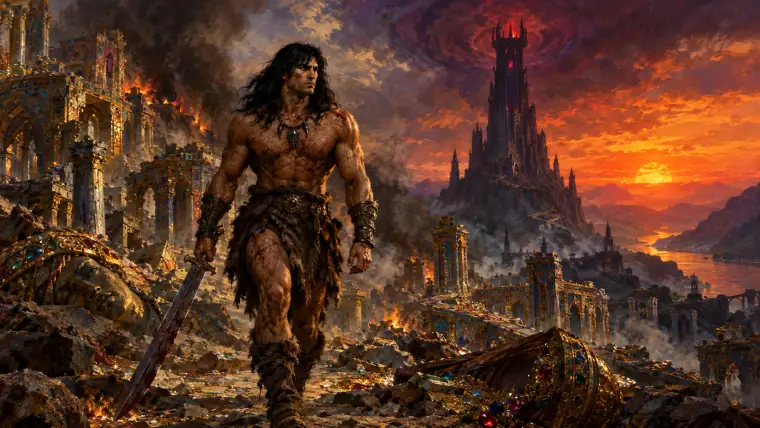
Conan the Cimmerian
A black-haired barbarian from the northern hills is thief, pirate, mercenary and king in a lost prehistoric age of decadent cities and ancient sorceries — the hero who founded sword and sorcery.
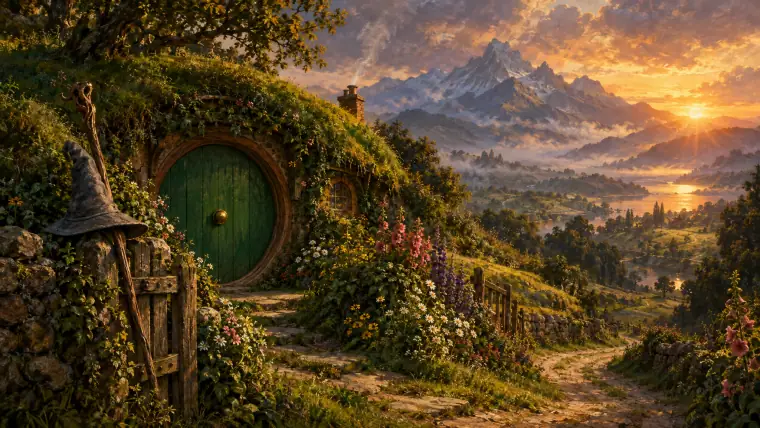
The Hobbit
A comfortable, pipe-smoking hobbit is hired as a burglar by thirteen dwarves and walks out of his round green door into the adventure that invented modern fantasy's map.
Fafhrd and the Gray Mouser
A towering northern barbarian and a small, sardonic thief in gray drink, brawl, steal and wisecrack through fifty years of adventures in Lankhmar, the fantasy genre's great rotten city.
Gormenghast
A crumbling castle the size of a country, bound by meaningless ritual, where a scheming kitchen boy named Steerpike climbs toward power — fantasy without a single spell.
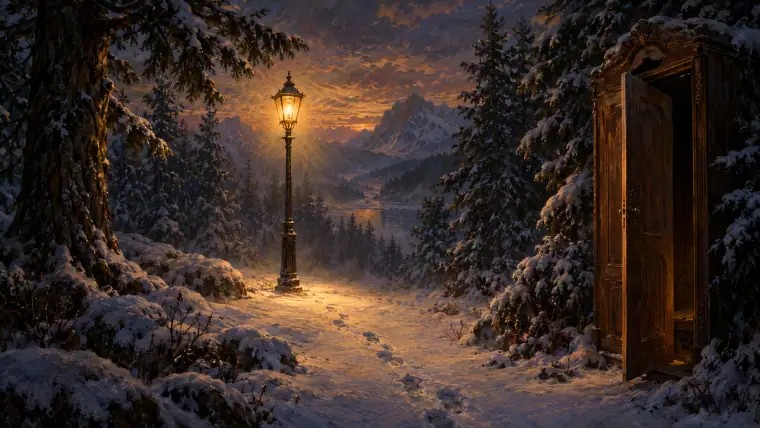
The Chronicles of Narnia
Four evacuee children step through a wardrobe into a land of talking beasts, a witch's endless winter and a great lion — the most famous doorway in fantasy.
The Dying Earth
Under a red sun that may go out any day, decadent wizards hoard a few surviving spells that vanish from their minds the moment they are cast — Jack Vance's jeweled far-future fantasy.
Three Hearts and Three Lions
A Danish engineer fighting the Nazis wakes in a world of chivalric romance, where he is a legendary paladin and a troll's severed hand crawls back to its body.
The Broken Sword
A human child stolen by elves, a changeling left in his place, and a cursed sword that must kill whenever it is drawn — Poul Anderson's pitiless Norse tragedy of 1954.
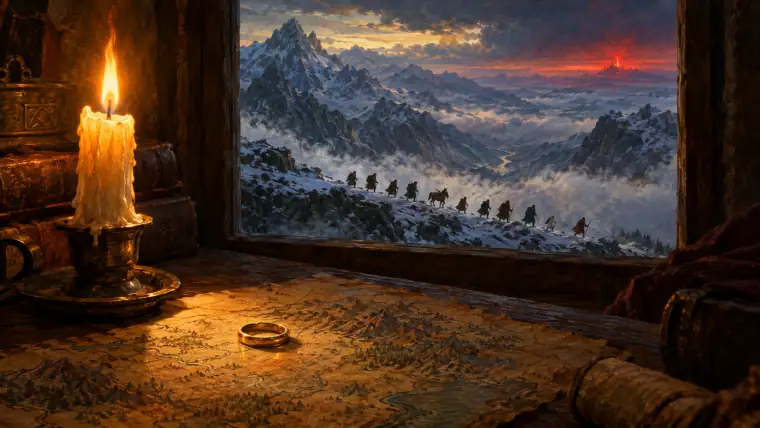
The Lord of the Rings
A hobbit carries the Dark Lord's ring across a dying world to destroy it — the twelve-year epic that defined high fantasy and handed the tabletop and computer RPG their races, rangers and quests.
The Once and Future King
The Wart learns to be a king by being turned into a fish, a hawk, an ant and a goose — T. H. White's funny, heartbroken retelling of Malory for the century of world wars.
The Elric Saga
An albino sorcerer-emperor, sickly without drugs and a demon-sword that drinks souls, betrays everyone he loves in a cosmic war between Law and Chaos.
The Chronicles of Prydain
An Assistant Pig-Keeper who dreams of heroism chases an oracular pig into a war against the Death-Lord — Lloyd Alexander's Welsh-myth epic for young readers.
The Dark Is Rising
On his eleventh birthday, the seventh son of a seventh son learns he is the last of the Old Ones, immortal servants of the Light in a war against the Dark that runs through British legend.
Dragonriders of Pern
On a colony world that has forgotten its origins, telepathic dragons and the riders bonded to them at hatching burn a deadly spore called Thread out of the sky.
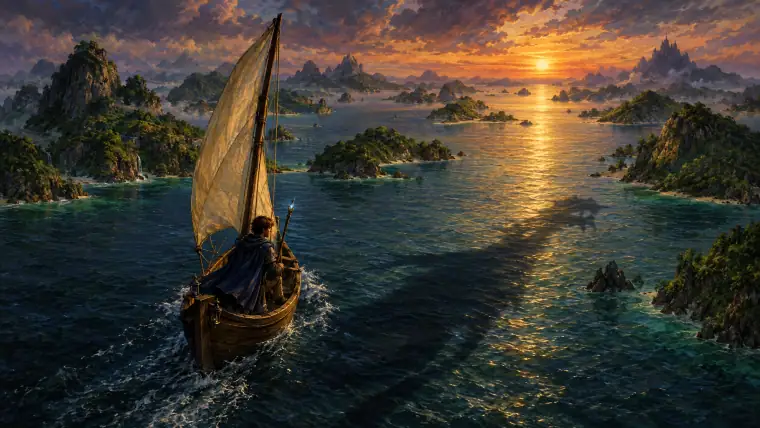
Earthsea
A proud island boy with a gift for magic goes to wizards' school, looses a shadow on the world, and must learn its true name — Ursula K. Le Guin's archipelago of balance and naming.
The Last Unicorn
A unicorn learns she may be the last of her kind and sets out, with a failed magician and a weary outlaw's cook, to find where the Red Bull has driven all the others.
Braunstein
A Minnesota wargame in which nearly twenty players were each handed a single townsperson to play — and started talking, scheming and dueling instead of fighting the battle.
The Chronicles of Amber
An amnesiac wakes in a New York clinic and discovers he is Prince Corwin of Amber, heir to a family of feuding immortals who can walk between infinite worlds.
Blackmoor
In a Twin Cities basement in 1971, Dave Arneson sent his wargaming friends beneath a model castle to hunt monsters and gold — and invented the dungeon adventure.
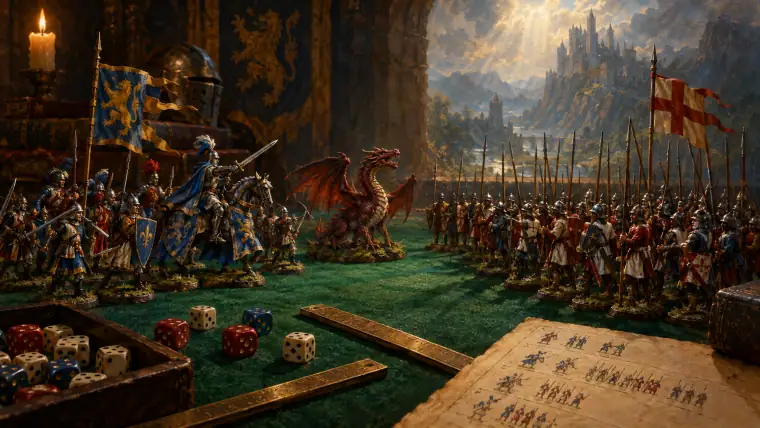
Chainmail
A medieval miniatures wargame from Lake Geneva whose 14-page Fantasy Supplement let Tolkien-reading wargamers field heroes, wizards, elves and dragons — and gave Dungeons & Dragons its combat rules.
The Princess Bride
A farm boy, a princess, a giant, a vengeful Spanish swordsman and a Sicilian genius tumble through a fairy tale that William Goldman claims merely to have abridged.
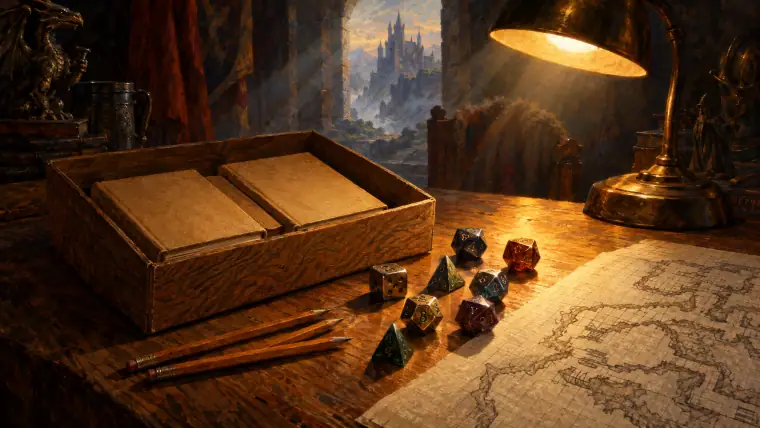
Dungeons & Dragons
Three little booklets in a woodgrain box, hand-assembled in Lake Geneva in January 1974: the first published roleplaying game, and the template for every tabletop and computer RPG since.
dnd
Named for the letters D and D, this PLATO dungeon sent players down the multi-level Whisenwood Dungeon after an Orb guarded by a dragon, arguably the first boss in video games.
Dungeon!
A race through a six-level dungeon for monsters and gold, designed by one of Dave Arneson's Blackmoor players — the first dungeon-crawling board game, and a perfect foil for the RPG it grew beside.
Empire of the Petal Throne
A linguistics professor's decades-old invented world — alien empires, underworld cities, gods and a full constructed language — published by TSR in 1975 as the first roleplaying game with a complete setting.
pedit5
A 1975 dungeon hidden in a lesson slot on the University of Illinois' PLATO network: one level, twenty-five monsters, and one of the earliest surviving computer role-playing games.
Tunnels & Trolls
A Phoenix librarian found the D&D rules baffling and wrote his own in 1975 — cheaper, funnier, six-sided-dice-only, and soon playable alone in a pioneering run of solo adventures.
Colossal Cave Adventure
A caver's memory of Kentucky's Mammoth Cave, mixed with a D&D campaign and a little magic, became the first famous text adventure and the namesake of a whole genre: XYZZY.
Advanced Dungeons & Dragons
Gary Gygax's three hardcovers of 1977–79 turned D&D's scattered booklets into an exhaustive, tournament-ready rulebook — the orange-spined canon of the 1980s boom.
Dungeons & Dragons Basic Set
The boxed doorway into D&D for millions: a blue book in 1977, a red-bordered book with Keep on the Borderlands in 1981, and Larry Elmore's dragon-slaying red box in 1983.
The Chronicles of Thomas Covenant
A leper who refuses to believe in the magical world that hails him as its savior: Stephen R. Donaldson's ten-novel epic turned the Tolkien quest inside out with a protagonist readers loved to hate.
The Fantasy Trip
Steve Jackson's pocket-sized answer to D&D: a $2.95 bag of hex-map arena combat that grew into a full RPG with point-bought characters — then vanished for decades and came back.
The Hobbit
Rankin/Bass's 78-minute NBC cartoon of Tolkien's first novel: watercolor goblins, a folk-ballad theme, and the first Middle-earth most American children ever saw.
The Silmarillion
Tolkien's lifelong book of the Elder Days — the making of the world, the theft of three holy jewels and the long doom of the elves — published by his son four years after his death.
The Sword of Shannara
A law student's seven-year homage to Tolkien that became the first fantasy novel on the New York Times trade paperback bestseller list, and proved epic fantasy could be a mass-market industry.
Zork
West of a white house, in an open field, lies the Great Underground Empire: MIT's witty, sarcastic answer to Adventure, home of the lurking grue and the best-selling text adventure of its age.
MUD1
Two Essex students turned the solitary text adventure into a shared world: MUD, where strangers met, fought and cooperated in real time on the way to Wizard rank, the seed of every online RPG since.
RuneQuest
Chaosium's 1978 answer to D&D: no classes, no levels, percentile skills that improve as you use them, hit locations for every blow — and the mythic Bronze Age world of Glorantha.
The Lord of the Rings
Ralph Bakshi's rotoscoped 1978 epic: Black Riders traced from live actors, a painted Middle-earth, and a story that stops halfway because the studio dropped the words "Part One."
Tomb of Horrors
Gary Gygax's deliberately merciless dungeon of false doors, sphere-of-annihilation mouths and gloating riddles, built to humble players who boasted their characters could survive anything.
Akalabeth: World of Doom
A Texas teenager's Apple II hobby game, sold in Ziploc bags at a ComputerLand: ten quests from Lord British, a wireframe dungeon in true perspective, and the unofficial first chapter of Ultima.
Avatar
PLATO's most popular game: a multiplayer, first-person dungeon crawl begun by two junior-high students, where parties explored together, chatted in real time and logged more than a million hours.
Choose Your Own Adventure
Bantam's 1979 paperback series that spoke to its readers as 'you' and let them pick the page — 184 books and more than 250 million copies that taught a generation that stories could branch.
The Keep on the Borderlands
A fortified keep on the edge of civilization, a ravine honeycombed with monster lairs, and a DM's primer in the margins — the adventure that introduced a generation to D&D.
The Neverending Story
A lonely boy steals a book, reads himself into the dying land of Fantastica, and discovers that its fate depends on him: Michael Ende's two-color novel about the danger and necessity of stories.
Thieves' World
Robert Asprin's squalid city of Sanctuary, where a crowd of famous fantasy writers shared one setting and one rulebook, invented the shared-world anthology and walked straight onto the gaming table.
Rogue
An @ sign descends through randomly generated dungeons drawn in ASCII, one life only, toward the Amulet of Yendor: the college-terminal obsession that named an entire genre.
Rolemaster
Born from a college Middle-earth campaign, Iron Crown's Rolemaster traded D&D's abstractions for percentile rolls, towering attack tables and critical-hit charts describing wounds in gruesome detail.
World of Greyhawk
Gary Gygax opened his own Greyhawk campaign to the world in 1980: a gazetteer of feuding kingdoms, a vast color map of the Flanaess, and D&D's first official home.
Call of Cthulhu
Sandy Petersen's 1981 game swapped heroes for librarians and private eyes, loot for clues, and hit points for a Sanity score that drains away as investigators glimpse the truth of the universe.
Excalibur
John Boorman's gleaming, blood-soaked retelling of Malory: chrome armor, green-lit forests, Wagner and "O Fortuna," and the whole Arthurian cycle from sword to barge in 140 minutes.
Ultima
A teenager's Apple II epic in which a stranger from another world crosses Sosaria's four continents, rescues princesses, becomes a space ace and travels back in time to shatter Mondain's Gem of Immortality.
Wizardry: Proving Grounds of the Mad Overlord
Six adventurers, a ten-level maze drawn in green lines, graph paper in the box, and no saving below ground: the Apple II dungeon crawl that defined the party-based computer RPG in America and Japan.
Conan the Barbarian
John Milius's brutal, near-wordless epic of revenge: Schwarzenegger's Cimmerian, a Frazetta-painted Hyborian Age, a snake cult, the Tree of Woe, and Basil Poledouris's thundering choir.
Fighting Fantasy
The 1982 Puffin paperbacks that put a dungeon, a pair of dice and a character sheet in a schoolchild's pocket, selling some 20 million copies and turning a generation of readers into solo adventurers.
The Belgariad
A farm boy named Garion learns he is the heir to a prophecy millennia in the making: David Eddings's five-book quest was built deliberately to give fantasy readers exactly what they wanted, and it did.

Discworld
A flat world riding through space on a giant turtle began as a parody of sword-and-sorcery and became, over 41 novels, the funniest and most humane long-form satire in fantasy.
Dungeons & Dragons
Six kids ride a haunted roller coaster into the Realm, receive class-based magic weapons from a riddling Dungeon Master, and spend three seasons dodging Venger and Tiamat on CBS.
Ravenloft
A vampire count, a castle drawn in dizzying isometric maps, and a fortune told in cards: the 1983 module that taught Dungeons & Dragons to be afraid, and grew into a whole Demiplane of Dread.
Talisman
Games Workshop's 1983 race to the Crown of Command: roll a die, walk a ring of perilous spaces, draw adventure cards and grow your hero until you are strong enough to reach the center.
Ultima III: Exodus
The first Ultima from Origin Systems sends a party of four against Exodus, spawn of Mondain and Minax, with animated tiles, tactical battles, a musical score, and a villain defeated not by the sword but by punch cards.
Warhammer Fantasy Battle
Games Workshop's 1983 rules for pitting whole armies of painted metal miniatures against each other — the wargame that built the grim Old World and a global hobby empire.
Dragon Slayer
Real-time sword fights in a maze where your own house can be pushed around the dungeon: Nihon Falcom's 1984 hit that helped invent the Japanese action RPG and launched a sprawling series.
Dragonlance
A world built to tell one epic story at once as game modules and novels: Krynn, its three moons of magic, its kender and draconians, and the War of the Lance that made TSR a fiction publisher.
Dragonlance Chronicles
The novels that turned a D&D adventure campaign into a bestselling fantasy trilogy, with Raistlin, Tanis and Tasslehoff playing the party, and made game-born fiction a publishing genre.
Hydlide
The knight Jim crosses the open fields of Fairyland to rescue Princess Ann from the demon Varalys, pausing to let his health regenerate: the 1984 action RPG that seeded a mechanic now found in nearly every modern game.
King's Quest
Sir Graham walks into a storybook: Roberta Williams's animated fairy-tale adventure, built to show off IBM's PCjr, where you steer a knight behind trees and in front of castles in search of a magic mirror, shield and chest.
Lone Wolf
Joe Dever's 1984 gamebook saga, in which a single reader-hero survives the massacre of his order and grows, book by book, from novice warrior-monk into the Grand Master of the Kai.
Middle-earth Role Playing
The first full Tolkien roleplaying game: Iron Crown's percentile-dice take on Middle-earth, set in the age of the Witch-king, with maps and Angus McBride paintings that became a generation's picture of Arda.
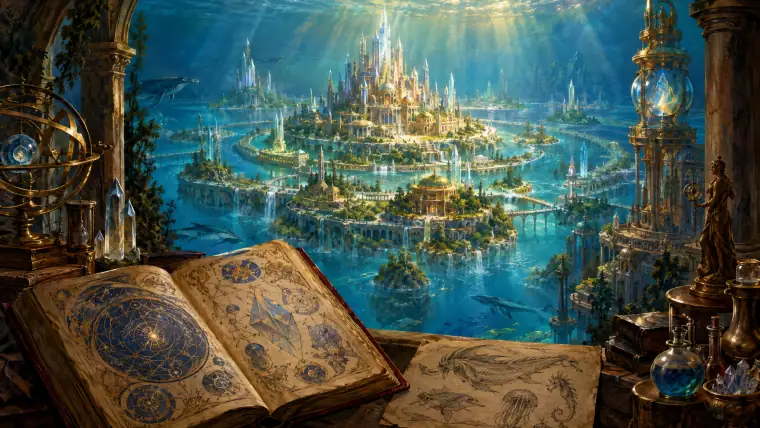
The Atlantean Trilogy
Three books that rebuilt Dungeons & Dragons for the drowned world of Atlantis — a magic-and-alchemy grimoire, an atlas of lost continents, and a bestiary — from the tiny Bard Games.
The Black Onyx
A Dutch-born programmer in Japan built Japan an RPG from scratch: a first-person party crawl beneath Utsuro, a town under eternal night, that taught a nation what hit points were.
Gauntlet
Four friends, four joysticks, one Warrior who needs food badly: Atari's 1985 arcade dungeon crawl turned D&D's party into a coin-fed, cooperative stampede through monster-filled mazes.
King Arthur Pendragon
Greg Stafford's 1985 roleplaying game casts players as knights of Arthur's Britain — and rolls dice for their chastity, pride and mercy as well as their sword arms, across generations.
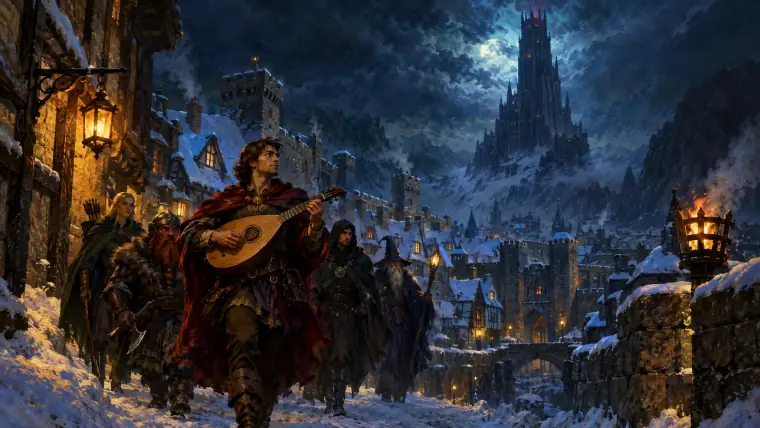
The Bard's Tale
Mangar the Dark has locked Skara Brae in eternal winter, and only a bard, a few rogues and some junior magic users stand in his way: the Commodore 64 dungeon crawl that out-sold every CRPG of the 1980s.
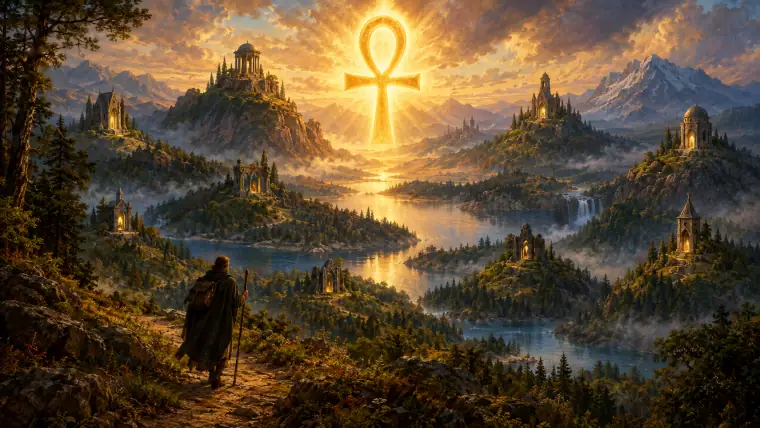
Ultima IV: Quest of the Avatar
The RPG that asked players to become good rather than merely strong: no dark lord to slay, only eight virtues to live by, a cloth map, a metal ankh, and the Codex waiting at the bottom of the Abyss.
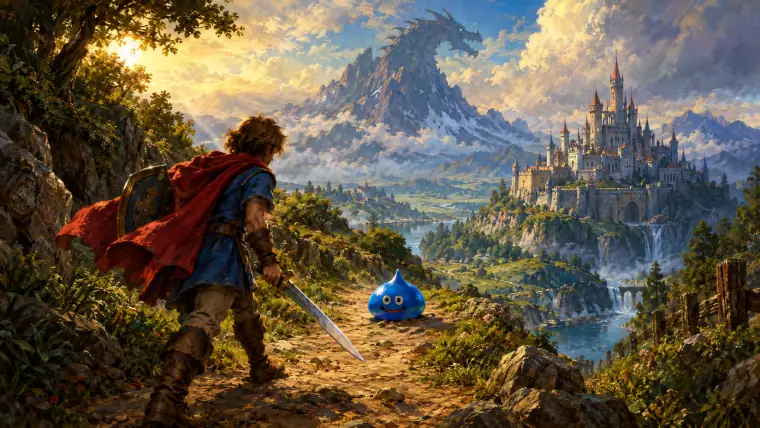
Dragon Quest
A lone descendant of the hero Erdrick sets out from Tantegel Castle to face the Dragonlord: Yuji Horii's streamlined Famicom RPG, drawn by Akira Toriyama and scored by Koichi Sugiyama, that made the role-playing game a Japanese national pastime.
GURPS
Steve Jackson's 1986 'Generic Universal RolePlaying System' — one set of 3d6 rules for knights, starship pilots and time travelers alike, built character by character from a budget of points.
Labyrinth
Jim Henson's goblin fairy tale: a teenage girl, thirteen hours, a maze of talking doors and Escher staircases, and David Bowie's glittering, menacing Goblin King.
Might and Magic Book One
Jon Van Caneghem's 1986 debut, written almost single-handedly over three years and sold from his apartment: a vast first-person world whose knights-and-dragons surface hides a science-fiction secret.
The Legend of Zelda
Nintendo's 1986 open-ended quest through Hyrule, in which a boy named Link pieces together the Triforce of Wisdom — the game that taught consoles to explore, save, and keep secrets.
The Witcher Saga
A mutant monster hunter-for-hire and the child of destiny he cannot escape: Andrzej Sapkowski's Polish saga became, through CD Projekt Red's games, one of the most-played fantasy worlds on Earth.
Warhammer Fantasy Roleplay
Games Workshop's 1986 roleplaying game swapped heroic dungeon-delving for rat catchers, plague, cults and mud — a grim, darkly funny Old World where Chaos hides next door.
Ars Magica
Jonathan Tweet and Mark Rein·Hagen's 1987 game of wizards in a medieval Europe where every legend is true — and where a spell is built like a Latin sentence, verb plus noun.
Dungeon Master
FTL's 1987 Atari ST landmark: a first-person dungeon crawl that ran in real time, let you grab objects with the mouse, and made you draw spells from runes while monsters shuffled toward you in the dark.
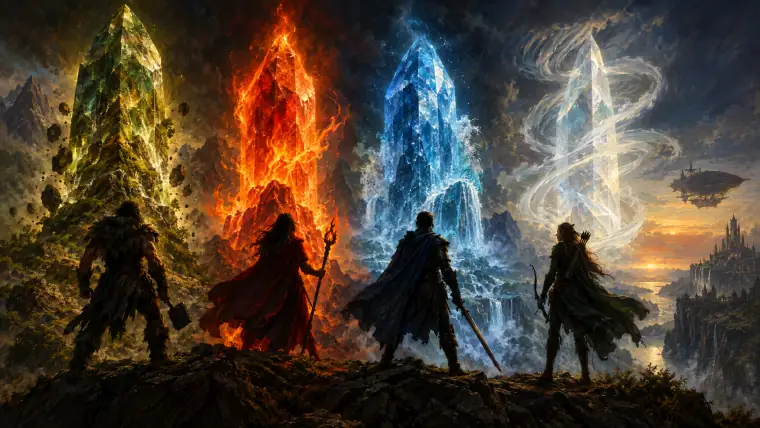
Final Fantasy
Square's 1987 all-or-nothing gamble: four Warriors of Light, four darkened crystals, and a time loop, built by a small team out of Wizardry, Ultima and D&D — and the first chapter of the most famous name in Japanese RPGs.
Forgotten Realms
A Canadian librarian's childhood story-world that became Dungeons & Dragons' home address: Waterdeep, Elminster, Drizzt, and the Sword Coast of Baldur's Gate.
NetHack
The open-source roguelike first released in 1987 and still maintained decades later: descend some fifty procedurally generated levels, retrieve the Amulet of Yendor, and die in a thousand inventive ways along the way.
Phantasy Star
Sega's 1987 answer to Dragon Quest: a heroine named Alis, a talking cat, three planets, and full-screen 3D dungeons that the Famicom could not match — science fantasy on a four-megabit cartridge.
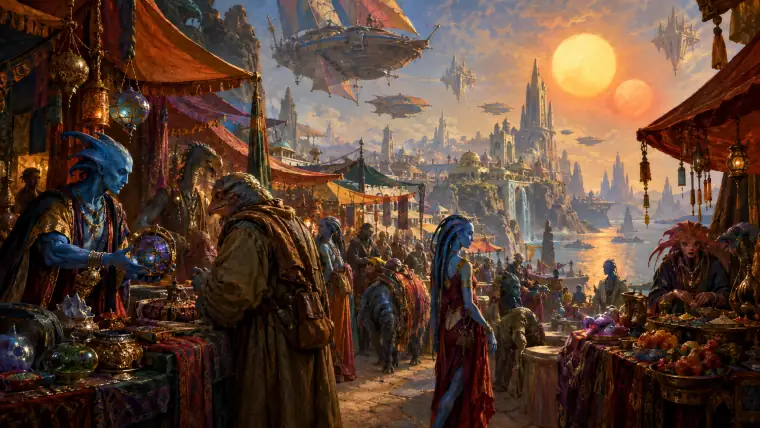
Talislanta
'No Elves!' promised the ads: Stephan Michael Sechi's 1987 roleplaying game swapped Tolkien's races for a Vancian bazaar of sorcerers, beast-folk and ruined sky-cities.
Memory, Sorrow, and Thorn
A kitchen boy, three legendary swords and an immortal people nursing an ancient grievance: Tad Williams's trilogy took the Tolkien template seriously enough to argue with it, and inspired George R. R. Martin.
Pool of Radiance
SSI's 1988 adventure in the ruined city of Phlan was the first computer role-playing game built on the full Advanced Dungeons & Dragons rules, and the engine behind a golden shelf of D&D games.
The Icewind Dale Trilogy
A drow ranger with two scimitars and a panther, invented on the spot in a TSR marketing meeting, became Dungeons & Dragons' most famous fictional hero and the star of a saga still running almost four decades later.
Willow
George Lucas's fairy-tale epic, directed by Ron Howard: a Nelwyn farmer, a stolen baby, a roguish swordsman, brownies, a two-headed dragon, and the first digital morph in a feature film.
Advanced Dungeons & Dragons, 2nd Edition
The 1989 rebuild of AD&D that tidied Gygax's rules, banished demons and assassins, gave the world THAC0, and launched Ravenloft, Dark Sun and Planescape; later the invisible engine inside Baldur's Gate.
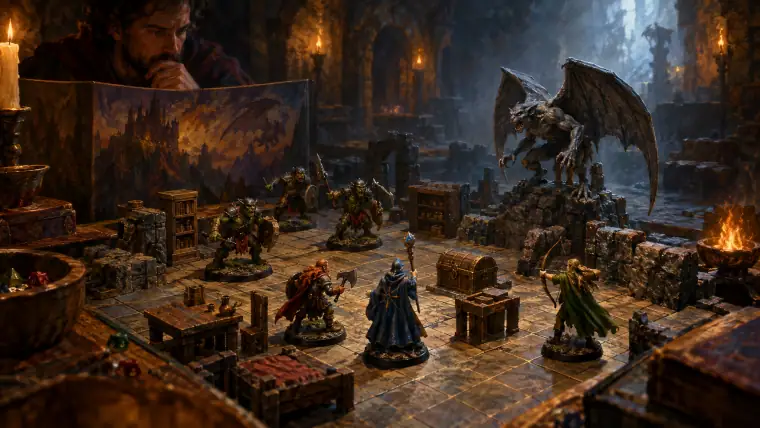
HeroQuest
The 1989 Milton Bradley and Games Workshop box that turned a kitchen table into a dungeon, with four heroes, plastic monsters, skull-and-shield dice and a friend playing the evil wizard.
Legend of the Red Dragon
Seth Robinson's 1989 text-based dragon hunt for dial-up bulletin boards: a few forest fights a day, a flirt with Violet at the Inn, and a village of callers racing to slay the Red Dragon.
Shadowrun
FASA's 1989 game fused cyberpunk and high fantasy: in 2050, magic has returned, dragons run corporations, and elf hackers and troll street samurai take deniable jobs in the shadows.
Fire Emblem: Shadow Dragon and the Blade of Light
The 1990 Famicom game in which Prince Marth leads an army across a grid-map war — and every soldier who falls stays dead. It made the tactical RPG a genre in Japan.
Rifts
Palladium's kitchen-sink epic: a future Earth torn open by ley-line energy, where power-armored soldiers, dragons, cyborgs and wizards collide on a continent-sized battlefield.
The Wheel of Time
Fourteen volumes, two authors and 23 years: Robert Jordan's saga of the Dragon Reborn defined the doorstopper epic of the 1990s and was finished by Brandon Sanderson after Jordan's death.
Dark Sun
TSR's most savage setting: a waterless world where magic kills the land, metal is rarer than gold, tyrant sorcerer-kings rule the last cities and every living thing has psychic power.
Eye of the Beholder
Westwood's 1991 descent beneath Waterdeep married the real-time, step-by-step dungeon of Dungeon Master to official AD&D rules, and gave PC owners the VGA dungeon crawl they had been waiting for.
Neverwinter Nights
From 1991 to 1997, AOL subscribers dialed into a shared Forgotten Realms city built on SSI's Gold Box engine — the first online role-playing game with graphics, and the seed of the MMORPG.
Vampire: The Masquerade
White Wolf's gothic-punk game of undead politics and inner monsters, where players are the vampires and the true enemy is the Beast inside.
Ultima Underworld: The Stygian Abyss
A tiny New England studio's 1992 'dungeon simulation' let players look up, jump, swim and fight in a texture-mapped 3D Abyss beneath Britannia — and changed first-person games forever.
Ultima VII: The Black Gate
Origin's 1992 murder mystery in a Britannia where you could bake bread, change a baby, and follow a smiling cult to the door of an invading god — the most richly simulated world of its day.
Earthdawn
FASA's post-apocalyptic high fantasy: after centuries sealed underground from soul-eating Horrors, the peoples of Barsaive open their doors and rediscover a scarred world.
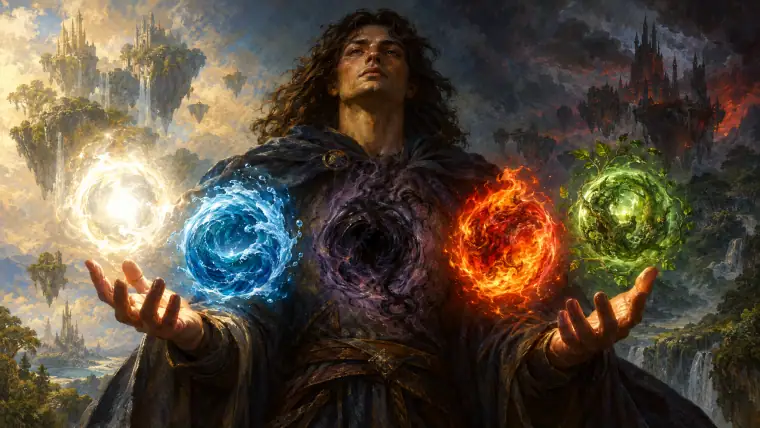
Magic: The Gathering
Richard Garfield's card game of dueling wizards invented a genre overnight: collect random cards, build a deck, tap lands for mana and fight across five colors of magic.
Secret of Mana
Square's 1993 real-time adventure for three friends at once: a boy pulls a rusted sword from a stone, and a hero, a girl and a sprite set out to stop an empire raising a flying fortress.
Final Fantasy VI
Square's 1994 16-bit masterpiece: an empire strip-mining magic from captive Espers, a clown who becomes a god, an opera, and a world that actually ends halfway through.
Planescape
TSR's philosophical multiverse: a ring-shaped city of portals ruled by the silent Lady of Pain, where belief can reshape reality and factions argue about the meaning of existence.
The Elder Scrolls: Arena
Bethesda's 1994 gladiator game that became something else entirely: a first-person RPG spanning all of Tamriel, with procedurally generated wilds, a day-night cycle, and the first of the Elder Scrolls.
Chrono Trigger
Square's 1995 time-travel epic, made by a 'Dream Team' from the rival Final Fantasy and Dragon Quest camps, in which a boy, a princess and an inventor cross millions of years to stop the world's end.
Heroes of Might and Magic
New World Computing's 1995 turn-based fantasy strategy game, in which heroes lead stacks of mythical creatures across a map of mines, castles and treasure — the start of one of PC gaming's most beloved series.
His Dark Materials
A girl, her shape-shifting daemon and a war against the Authority himself: Philip Pullman's trilogy rewrote Paradise Lost for young readers and became the most intellectually ambitious children's fantasy of its era.
Legend of the Five Rings
A samurai epic whose story was written by its players: a collectible card game and roleplaying game in which tournament winners decided the fate of Rokugan's clans.
The Farseer Trilogy
A royal bastard trained as a court assassin tells his own story of loyalty and loss: Robin Hobb's first-person epic traded battlefield spectacle for intimate, often painful character study.
Warhammer Quest
Games Workshop's cooperative dungeon crawl: four heroes, a deck that builds the dungeon as they explore, and a random event on every unlucky roll — no game master required.
A Song of Ice and Fire
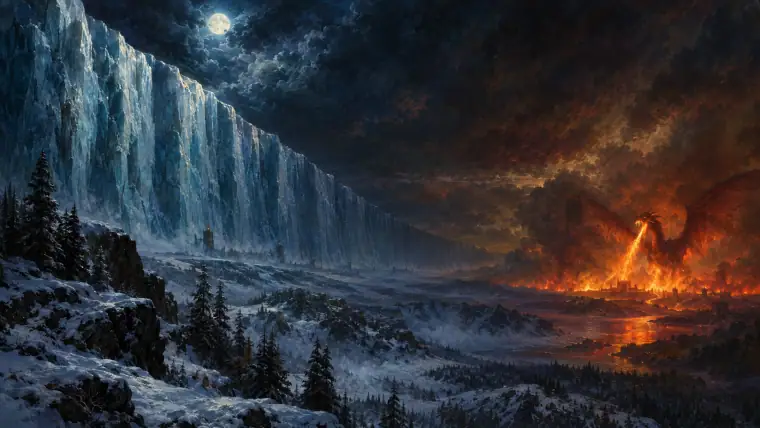
A war of noble houses on a continent where winters last for years and the dead are stirring: George R. R. Martin's unfinished epic remade fantasy as political history and conquered television.
Diablo
A roguelike dungeon crawl turned real-time over a weekend, Diablo sent players 16 levels down beneath a haunted cathedral, clicking through demons and loot, and invented the modern action RPG.
Meridian 59
A first-person 3D world opened to the internet a year before Ultima Online, Meridian 59 pioneered the flat monthly fee, guild politics and player justice, then refused to die for two decades.
Pokémon Red and Green
Satoshi Tajiri turned a childhood of insect collecting into a Game Boy RPG about catching and trading 151 monsters, and the 1996 release became the seed of the most lucrative franchise in entertainment.
The Elder Scrolls II: Daggerfall
Bethesda's 1996 sequel to Arena built a procedurally generated realm the size of Great Britain, with 15,000 places to go, custom classes, vampirism, bank loans and a plot with multiple endings, and shipped full of bugs.
Final Fantasy VII
Square's leap to CD and 3D, Final Fantasy VII followed a spiky-haired mercenary from the Mako reactors of Midgar to the edge of the Lifestream, and brought the Japanese RPG to a mass Western audience.
Harry Potter
An orphan learns on his eleventh birthday that he is a wizard: J. K. Rowling's seven-book school story became the best-selling book series in history and the foundation of a global media franchise.
Ultima Online
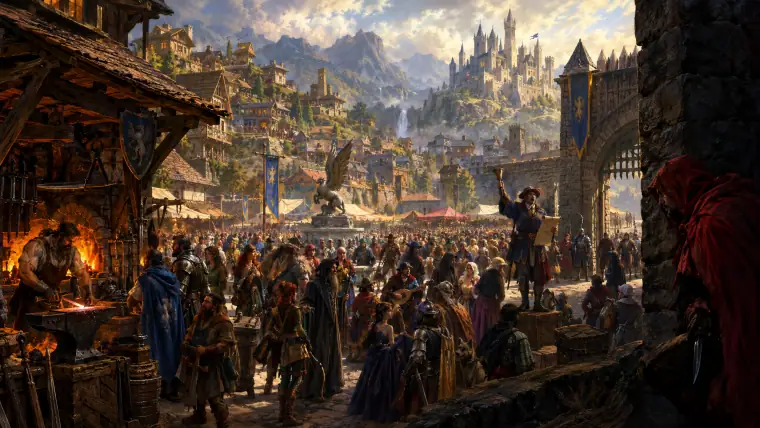
Richard Garriott's Britannia turned into a living, lawless shared world: thousands of players building houses, running shops, and killing one another. UO popularized the MMORPG and taught a generation of designers how hard virtual societies are.
Baldur's Gate
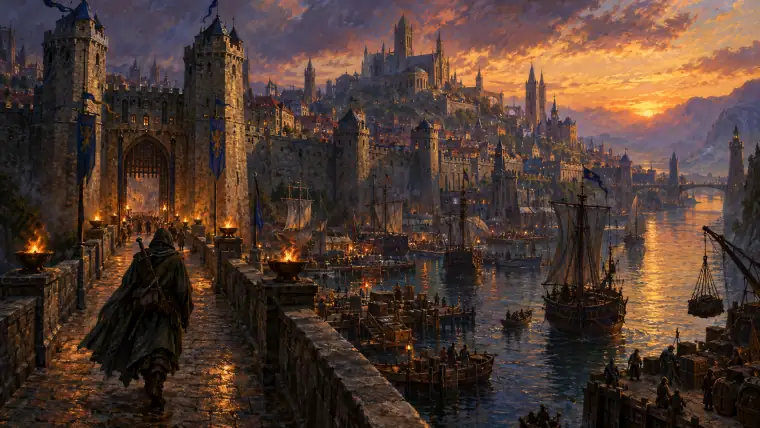
An orphan from the library-fortress of Candlekeep discovers the blood of a dead god of murder in their veins, and BioWare's debut RPG brings the computer role-playing game roaring back to life.
Lineage
A 2D feudal war of castles and blood pledges, adapted from a Korean comic, that rode the PC-bang boom to millions of subscribers and made NCSoft one of Asia's great game companies.
Asheron's Call
Turbine's seamless island of Dereth let players walk a whole continent without a loading screen, swear fealty to one another, and follow a story that advanced every month for fifteen years.
EverQuest
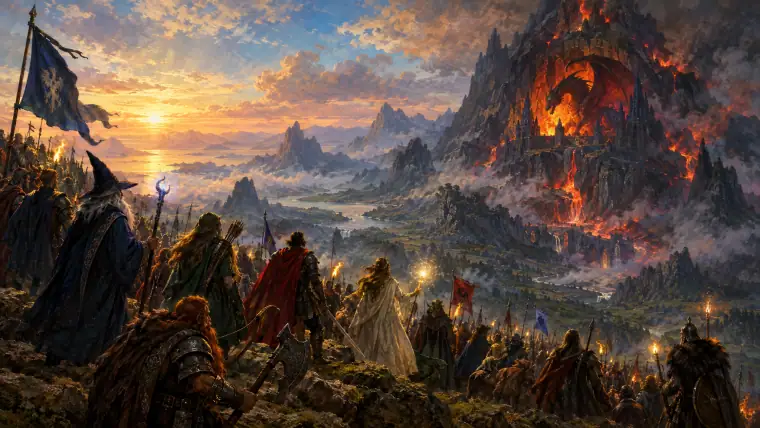
Sony's 3D world of Norrath turned the text MUD into a nightly obsession: camped spawns, corpse runs, forty-player raids, and a player base so hooked it nicknamed the game EverCrack.
Malazan Book of the Fallen
Ten enormous novels of gods, soldiers and ruined empires, born at a roleplaying table: Steven Erikson's Malazan is epic fantasy's most demanding, and for its admirers most rewarding, achievement.
Planescape: Torment
An immortal amnesiac wakes on a mortuary slab in Sigil, a floating skull at his side and instructions tattooed on his back, and asks the question the whole game is built on: what can change the nature of a man?
Baldur's Gate II
Imprisoned and dissected by the elven mage Jon Irenicus, the child of Bhaal breaks out into the merchant city of Athkatla, and BioWare builds one of the richest party RPGs ever made.
Diablo II
Blizzard North's 2000 sequel chased a possessed hero across deserts, jungles and Hell, and its skill trees, rune-socketed loot and Battle.net economy made it the model every action RPG would copy.
Dungeons & Dragons 3rd Edition
Wizards of the Coast's rebuild of D&D around one rule — roll a d20, add modifiers, beat a number — released alongside an open license that let anyone publish for it.
Icewind Dale
A caravan-guard job in the frozen north turns into a war against a demon and his giants, as Black Isle strips the Infinity Engine down to its bones: six heroes you roll yourself, and wave after wave of monsters.
Dark Age of Camelot
Three kingdoms rise from the ruins of Arthur's Britain and go to war forever: Mythic's Dark Age of Camelot made faction warfare over keeps and relics the reason to log in.
RuneScape
Two brothers' Java game, launched from a family home in Nottingham, became a free online world in a browser tab and the MMO with the most users on Earth.
The Lord of the Rings film trilogy
Peter Jackson shot all three films at once in New Zealand, and turned Tolkien's unfilmable epic into a $3 billion, 17-Oscar landmark.
Final Fantasy XI
Square staked its flagship series on an online world: one Vana'diel shared by Japanese, American and European players on PlayStation 2 and PC, and quietly the most profitable Final Fantasy of all.
Neverwinter Nights
BioWare hands players the Dungeon Master's screen: a D&D campaign in plague-struck Neverwinter, plus the tools to build worlds of their own and run them live for friends online.
The Elder Scrolls III: Morrowind
Bethesda's handcrafted alien island of giant mushrooms, silt striders and a sleeping god-villain, Morrowind shipped with its own construction kit and turned The Elder Scrolls into a modding culture and a console hit.
Jonathan Strange & Mr Norrell
Two rival magicians restore English magic during the Napoleonic Wars, in a vast, footnoted mock-history written in the manner of Austen and Dickens: Susanna Clarke's debut made fantasy literary news.
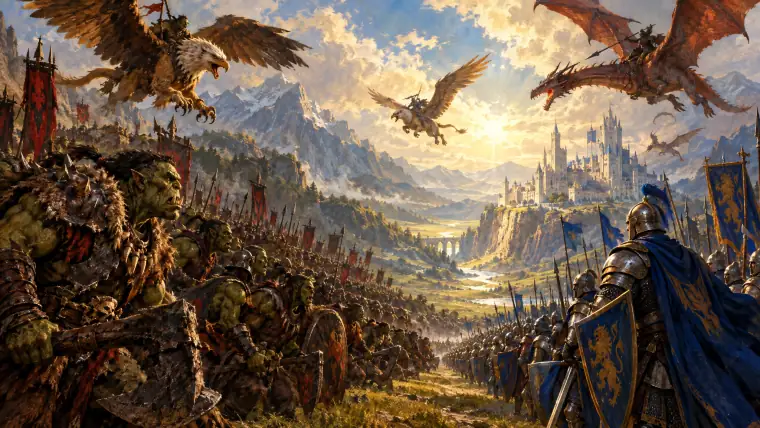
World of Warcraft
Blizzard took the grind out of EverQuest, poured in quests, cartoon color and Warcraft lore, and built the online world that twelve million people paid to live in and that is still expanding two decades later.
Descent: Journeys in the Dark
Fantasy Flight's big-box dungeon crawl: up to four heroes against an Overlord who spends threat to spring traps and summon monsters from a hand of dirty tricks.
Guild Wars
Three ex-Blizzard veterans bet that players would buy an online RPG without paying monthly. Guild Wars won the bet with instanced adventures, an eight-skill bar built like a card deck, and guild-versus-guild battles.
Dwarf Fortress
Two brothers, one text screen of smiley faces, and a simulation deep enough to track every dwarf's liver and grudges: Dwarf Fortress generates whole histories, then lets you watch your fortress drown, burn, or go mad.
Mistborn
What if the Dark Lord won? Brandon Sanderson's Mistborn begins a thousand years into the Lord Ruler's reign, with a heist crew of metal-burning magicians, and grows into a multi-era saga of a world industrializing.
The Elder Scrolls IV: Oblivion
The emperor dies in a sewer, the gates of a demon realm open across a green and golden province, and the player walks out into Cyrodiil free to ignore it all: Oblivion was the first 'next-gen' open-world fantasy.
The First Law
A barbarian who has killed too many men, a crippled torturer with a sense of humor, and a vain young nobleman: Joe Abercrombie's trilogy made cynicism fun and became a founding text of grimdark.
The Kingkiller Chronicle
An innkeeper who was once the most famous wizard, musician and killer alive tells his story over three days: Patrick Rothfuss's lyrical debut became a modern classic, and its sequel fantasy's most famous wait.
The Lord of the Rings Online
Start in Bree just after Frodo leaves, trail the Fellowship across Eriador, down into Moria and on to the Black Gate: Turbine's online Middle-earth let thousands walk Tolkien's roads, and play lutes at the Prancing Pony.
The Witcher
A Polish studio's first game revived Andrzej Sapkowski's white-haired monster hunter as an amnesiac in a plague-ridden city, and taught the world that a fantasy RPG could be about lesser evils rather than good and evil.
Dungeons & Dragons 4th Edition
D&D's boldest redesign: every class built from at-will, encounter and daily powers, tactical grid combat as the centerpiece, and a rules engine balanced like a precision instrument.
Demon's Souls
A failing Sony–FromSoftware project, rescued by a director who had nothing to lose, became a cruel, fog-shrouded kingdom of five worlds and one hub, and the seed of the entire soulslike genre.
Dragon Age: Origins
BioWare's own answer to Baldur's Gate: six origin stories, a blighted kingdom, a circle of sharp-tongued companions, and a war against the darkspawn in which every hard choice is yours to live with.
Pathfinder Roleplaying Game
Paizo's open-licensed heir to D&D 3.5: the 'edition 3.75' that kept an older engine alive, built a rich world called Golarion and, for a time, outsold Dungeons & Dragons itself.
Sword Art Online
Ten thousand players log into a virtual-reality MMORPG and discover they cannot log out, and that dying in the game kills them: Reki Kawahara's light novels turned the MMO into a genre of fiction.
Apocalypse World
Vincent and Meguey Baker's post-apocalyptic game of 'moves' and a two-dice roll that rarely just succeeds or fails — the seed of the Powered by the Apocalypse movement.
Final Fantasy XIV
Square Enix's second online Final Fantasy launched so broken the company apologized, replaced its leaders and dropped a moon on its own world. Rebuilt as A Realm Reborn, it became the most profitable Final Fantasy yet.
The Stormlight Archive
A storm-scoured world of spren, shardblades and oath-bound knights: Brandon Sanderson's ten-book epic is the biggest new fantasy series of its era, and a bridge between novels, crowdfunding and tabletop gaming.
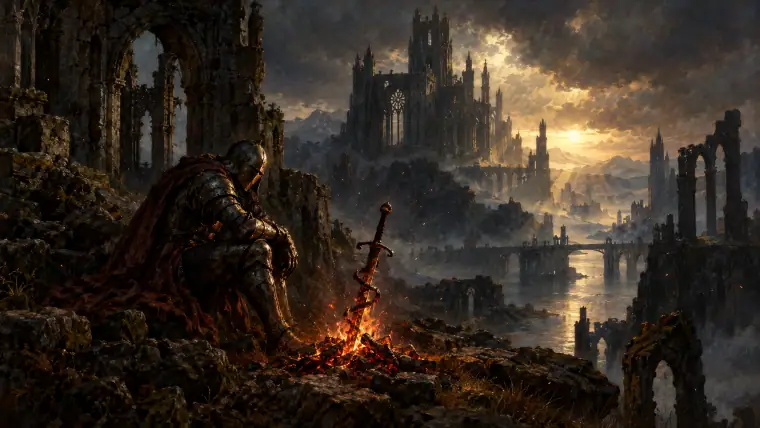
Dark Souls
An undead pilgrim, a dying age of fire, and a single interlocking kingdom of castles, sewers and cathedrals that fold back on themselves: Dark Souls made 'prepare to die' a promise and a genre.
Game of Thrones
HBO's eight-season adaptation of George R. R. Martin's saga put dragons, incest and beheadings on prestige TV and won more Emmys than any drama before it.
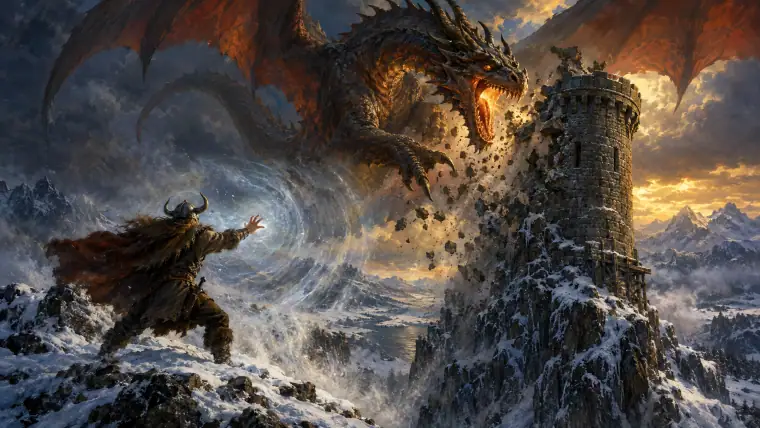
The Elder Scrolls V: Skyrim
Dragons return to a cold, Norse-flavored province at civil war, and the player, the last Dragonborn, can shout them out of the sky, or ignore destiny and wander off: Skyrim became the open world everyone has played.
The One Ring Roleplaying Game
A Middle-earth roleplaying game built around hope, weariness and the long road: custom dice bearing the Eye of Sauron and Gandalf's rune, and rules that make journeys as dangerous as battles.
Dungeon Crawl Classics Role Playing Game
Goodman Games' love letter to Appendix N: a gonzo sword-and-sorcery RPG where heroes begin as doomed peasants, spells mutate their casters, and the dice chain runs from d3 to d30.
Dungeon World
Classic dungeon fantasy — fighters, wizards, thieves and hit points — rebuilt on the Apocalypse World engine, where every roll moves the story and the GM is told to 'draw maps, leave blanks.'
Path of Exile
A small New Zealand studio built the dark successor to Diablo II that fans wanted: exiles on a cursed coast, a passive tree of well over a thousand nodes, and an economy with no gold, only orbs.
Dungeons & Dragons 5th Edition
The edition that made Dungeons & Dragons mainstream: a lighter rules set built on advantage and disadvantage, carried by actual-play shows and pandemic-era virtual tables to record sales.
The Elder Scrolls Online
The whole of Tamriel online: three alliances war for the Ruby Throne while a Daedric prince tries to drag the world into his realm. A lukewarm subscription MMO at launch, ESO became a billion-dollar success.
A Court of Thorns and Roses
A human huntress kills a wolf and is carried off to the faerie realm of Prythian: Sarah J. Maas's series of High Fae courts and slow-burning romance became the engine of the romantasy boom.
Pillars of Eternity
Veterans of Black Isle asked fans to fund the kind of isometric RPG publishers had abandoned, raised almost $4 million, and built a new world of soul-reading Watchers in the style of Baldur's Gate.
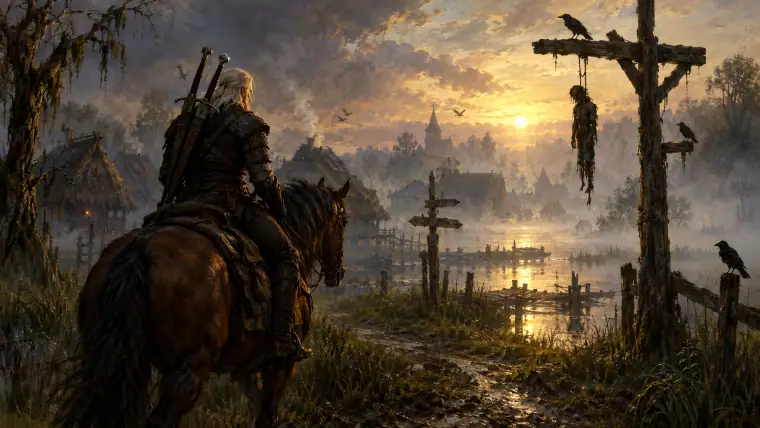
The Witcher 3: Wild Hunt
Geralt of Rivia crosses a war-torn land in search of his adopted daughter, and every village has a monster, a grudge and a story worth hearing. Its side quests set the standard for open-world RPGs.
Darkest Dungeon
Your ancestor dug too deep. Now you must send doomed mercenaries into the ruins beneath the family estate, and watch them crack under the strain as a gravel-voiced narrator reminds you that ruin has come to your family.
Stranger Things
The Duffer Brothers' 1980s horror saga opens with four boys playing Dungeons & Dragons, and names its monsters after the game.
Blades in the Dark
John Harper's game of scoundrels in a ghost-haunted industrial city, where position and effect frame every risk, clocks track every danger and flashbacks let the crew plan after the heist begins.
Divinity: Original Sin II
Shipped to an island prison as a Sourcerer, you and three companions can talk to animals, ignite poison clouds, betray each other in co-op and decide the fate of the gods: Larian's systemic masterpiece.
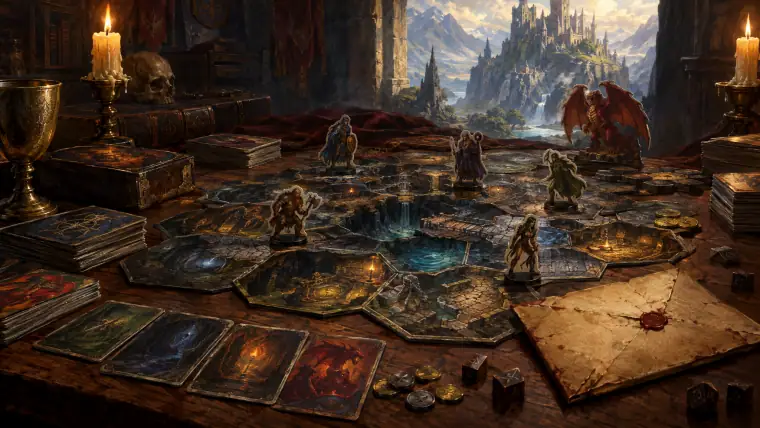
Gloomhaven
Isaac Childres's colossal campaign dungeon crawl: cooperative mercenaries, hand-management combat with no dice, and a legacy world of sealed boxes that changes as the story unfolds.
Mörk Borg
A doom-metal album of a roleplaying game: a tiny, ferociously designed rulebook about a world that is ending, where characters are wretches and a secret calendar counts down to oblivion.
Old-School Essentials
Gavin Norman's crisp reorganization of 1981 Basic/Expert D&D: the old rules, unchanged in spirit, laid out so every topic fits on a page or a spread you can find at the table.
Dungeon Crawler Carl
Earth is demolished for an alien game show, and a man in his boxer shorts and his ex-girlfriend's prize-winning cat must fight down through an 18-level dungeon: Matt Dinniman's LitRPG satire became a global bestseller.
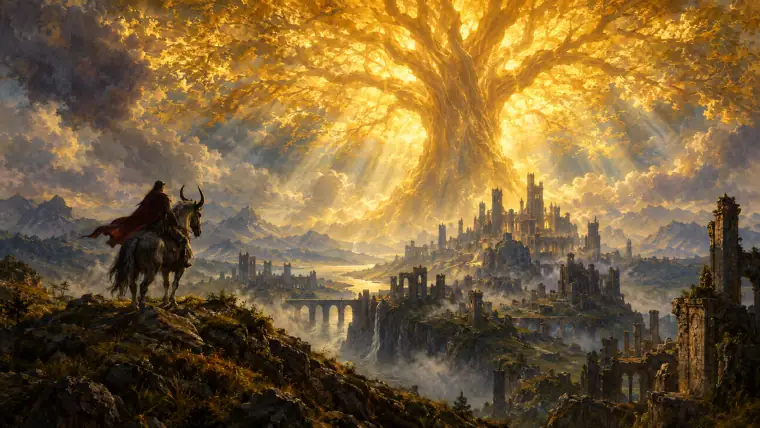
Elden Ring
FromSoftware opened the Souls formula onto a vast, haunted open world, George R. R. Martin wrote its ancient myths, and thirty million players rode out across the Lands Between to die, learn, and try again.
The Legend of Vox Machina
A crowdfunded cartoon about a crew of foul-mouthed D&D heroes. Critical Role's voice actors turned a home game into an Amazon series.
The Lord of the Rings: The Rings of Power
Amazon's hugely expensive Second Age epic follows Galadriel, Elrond and a disguised Sauron through the forging of the Rings of Power.
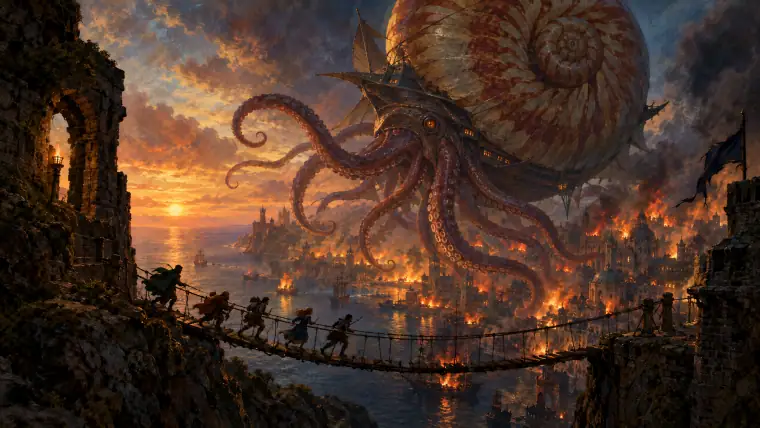
Baldur's Gate 3
A mind flayer tadpole behind your eye, a camp full of beautiful liars, and a twenty-sided die deciding everything: Larian's Baldur's Gate 3 turned fifth-edition D&D into the most celebrated role-playing game of its age.
Dungeons & Dragons: Honor Among Thieves
A bard, a barbarian and a crew of misfits pull a heist across the Forgotten Realms in the warm, funny D&D movie fans had waited forty years for.
Fourth Wing
A frail scholar is forced into a brutal war college where cadets bond with dragons or die trying: Rebecca Yarros's Fourth Wing turned romantasy into the biggest phenomenon in 2020s publishing.
No works match these filters. Clear a filter or try a different decade.