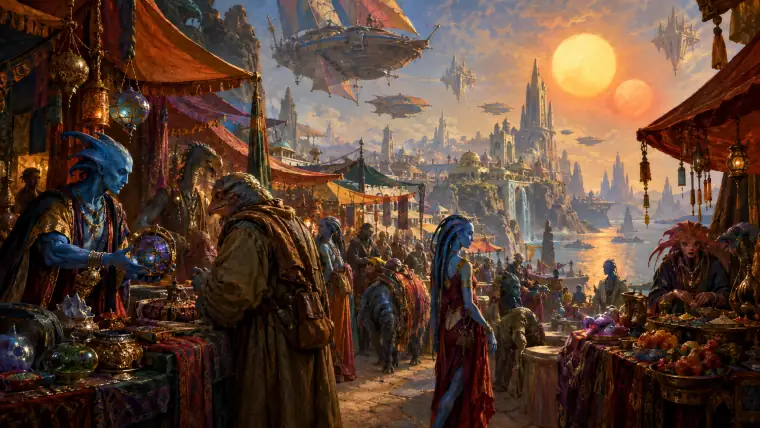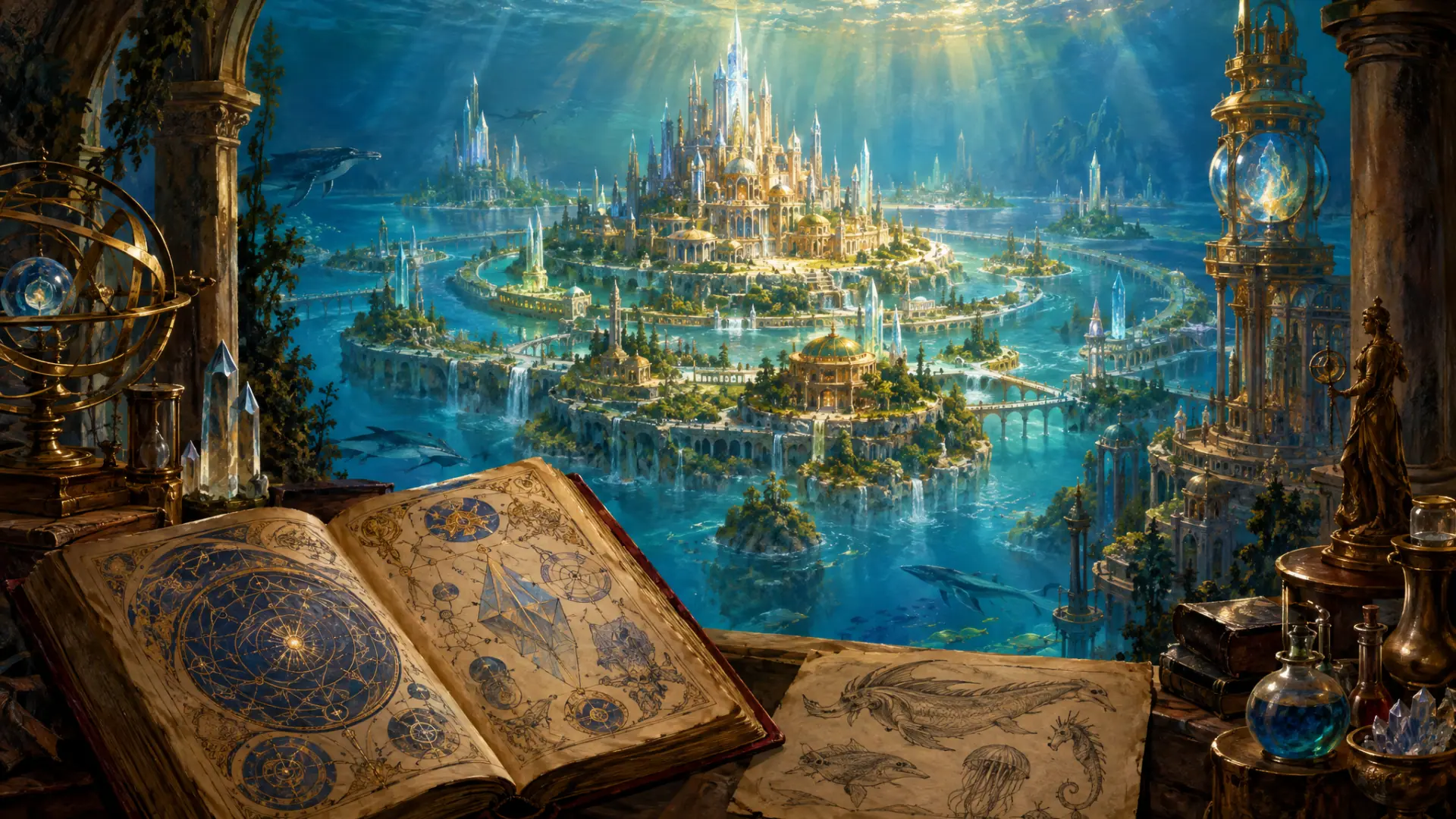
The clearest example of how 1980s hobbyists turned their house-ruled D&D into a publishable game of their own, and the direct ancestor of Stephan Michael Sechi's Talislanta and the long-lived Atlantis line.
Overview
The Atlantean Trilogy is a fantasy roleplaying game published by Bard Games in three volumes between 1984 and 1986: The Arcanum, a book of rules, character classes, spells and alchemy; The Lexicon, an atlas of a vanished prehistoric world; and The Bestiary, its creatures, gods and secret societies. Its guiding spirit was Stephan Michael Sechi, who shepherded the project over some three years with co-authors Vernie Taylor, Ed Mortimer and J. Andrew Keith.
The premise is Plato's Atlantis stretched into a whole planet of myth. Before the Flood, the trilogy imagines, the Earth held Atlantis and its rival continents Mu and Lemuria, the southern landmass of Gondwana, the Mediterranean basin and the sunken North Sea lands — a world in which sorcerer-alchemists, beast-men and sea-kings rise and fall long before recorded history. It is the swords-and-sandals Earth of Ray Harryhausen films and Robert E. Howard's Hyborian Age, built as a place to play.
Origins
Bard Games began as a house campaign. In the early 1980s, Sechi, Taylor and Steven Cordovano were running a heavily customized version of Dungeons & Dragons, thick with new classes and spells. In 1982 the three each put in $600 and began publishing their additions. The first product was The Compleat Alchemist (1983), followed by The Compleat Adventurer and The Compleat Spell Caster. These were generic supplements, written so a referee could drop them into AD&D or any other fantasy game. The books reportedly owed much of their success to placement in Waldenbooks, then a giant mall chain.
As historian Shannon Appelcline puts it in Designers & Dragons, the success of the Compleat books led Bard to "combine the best information from those supplements within a game system and a setting." The result was The Arcanum (1984), a complete game that folded in the Compleat material, followed by The Lexicon (1985) and The Bestiary (1986). A revised second edition of The Arcanum appeared in 1985, and in 1988 Bard merged the setting and monster volumes, with new material, into Atlantis: The Lost World.
How it plays
A roleplaying game is not a board game and not a book you read alone. One player, the game master, describes a world and voices everyone in it; the others each play a single hero — a Player character — and say what that hero tries to do. Dice and the rulebook settle whether it works. There is no board and no winner; a campaign can run for years.
The Arcanum is recognizably a D&D descendant. Characters have ability scores, Hit points, levels and Experience points, and fight with the familiar roll-to-hit logic. Veterans would have felt at home; White Dwarf's reviewer grumbled that it "whiffs of That Game a lot." But Appelcline notes that it was "clearly derivative" while also introducing character skills and point-based character creation — ideas D&D itself would only adopt later. Players chose from a wide menu of races, among them towering Aesir, animal-headed Andaman, mysterious Druas, winged Zephyrs, and familiar elves and dwarves, and from dozens of professions: alchemists, astrologers, beastmasters, charlatans, gladiators, harlequins, martial artists, necromancers, witches and more.
Magic was the book's glory. Beyond long spell lists split across several schools, it offered alchemical recipes, astrological lore, runes, sigils and wards — a grimoire as much as a rulebook, and usable on its own. Reviewers repeatedly said it could be mined as a supplement for other games such as RuneQuest. The Lexicon contains no rules at all: it is a gazetteer, region by region, with maps, histories and cities, adaptable to any system. The Bestiary catalogs Sidhe, goblin and sylvan races, giants, were-creatures, magical constructs, dragons, the living dead, demons, spirits and gods, with game statistics gathered in a second section.
Reception & impact
Reviews were respectful rather than rapturous. William A. Barton, in Space Gamer (May–June 1985), found The Arcanum "quite adequate as volume one" and useful for games "deficient in alchemical information." Phil Frances reviewed the whole set in White Dwarf #85, calling the rules "a solid starting base," admiring the Lexicon's "oodles of pretty maps" and reserving his real enthusiasm for the Bestiary, whose illustrations by the comics artist Bill Sienkiewicz made it, in his words, "A Monster Manual done with taste." Rick Swan's The Complete Guide to Role-Playing Games (1990) rated the game three out of four and called its magic "unsurpassed" for anyone wanting to supplement another system.
Commercially, the trilogy kept Bard Games alive long enough to fund something stranger. Sechi left the company in 1986 after disagreements with his partners, then reacquired it to publish Talislanta in 1987. The Atlantis line, however, carried a sting: a Waldenbooks buyer ordered Atlantis: The Lost World in bulk, and roughly a year later the chain returned much of it, forcing refunds of about $20,000. Appelcline counts it among the blows that ended Bard Games around 1990.
Legacy
The trilogy refused to stay sunk. Sechi kept the rights after Bard closed and licensed them onward. Death's Edge Games reissued The Arcanum in 1996, adding the Selkie race. In 2005 Morrigan Press — also the home of Talislanta's later editions — published Atlantis: The Second Age, a revised and expanded setting that replaced the D&D-style rules with its Omni System, an engine derived from Talislanta's d20 action table; the revision team included K. Scott Agnew and Aaron Dembski-Bowden. Khepera Publishing, led by Jerry D. Grayson, then produced a substantially reworked Atlantis: The Second Age in 2014 using its Omega System, with atlas and bestiary companions. A 30th-anniversary Arcanum followed in 2019 from K. David Ladage's ZiLa Games after a Kickstarter campaign.
Its deeper legacy is Talislanta. Sechi took the lesson of Atlantis — that an original world, lovingly described, matters more than yet another tweak to the combat tables — and went further, dropping the D&D chassis entirely. The Atlantean Trilogy sits at the hinge: the last Bard Games design still wearing D&D's clothes, and the first to show what its authors could build without them.
Did you know?
The Arcanum was pitched to D&D players who might never switch systems: much of the class and magic material was written so it could be lifted wholesale into other games to give them an Atlantean flavor, a design choice inherited directly from the system-neutral Compleat books.
Marginalia
- Bard Games was founded in 1982 by three friends — Stephan Michael Sechi, Vernie Taylor and Steven Cordovano — who each put up $600 to publish their house rules.
- Before the trilogy, Bard's 'Compleat' books (The Compleat Alchemist, Adventurer and Spell Caster, 1983) were add-ons meant to bolt onto D&D and other fantasy games.
- The Lexicon's atlas runs alphabetically through ten regions, from Atlantis and Gondwana to Lemuria, Mu and the Mesoamerican-flavored Tamoanchan, with a removable two-color map.
- The Bestiary was illustrated by comics artist Bill Sienkiewicz. White Dwarf's reviewer called it 'A Monster Manual done with taste.'
- Critic Rick Swan, in his 1990 Complete Guide to Role-Playing Games, called the Arcanum's treatment of magic 'unsurpassed' as a supplement for other games.
- A Waldenbooks order for the 1988 compilation Atlantis: The Lost World came back as returns a year later, costing Bard Games about $20,000 in refunds.
- Death's Edge Games' 1996 edition was largely a reprint; its one real addition was a new playable race, the Selkie.
Quick answers
- When was The Atlantean Trilogy first released?
- The Atlantean Trilogy was first released in 1984–86.
- Who created The Atlantean Trilogy?
- The Atlantean Trilogy was made by Stephan Michael Sechi (lead designer; co-author of all three books).
- Who published or developed The Atlantean Trilogy?
- Bard Games.
- What kind of work is The Atlantean Trilogy?
- The Atlantean Trilogy is a tabletop RPG in the Tabletop Roleplaying Games, Sword & Sorcery and Mythic Fantasy tradition, released for Three softcover books.
- Why is The Atlantean Trilogy important?
- The clearest example of how 1980s hobbyists turned their house-ruled D&D into a publishable game of their own, and the direct ancestor of Stephan Michael Sechi's Talislanta and the long-lived Atlantis line.