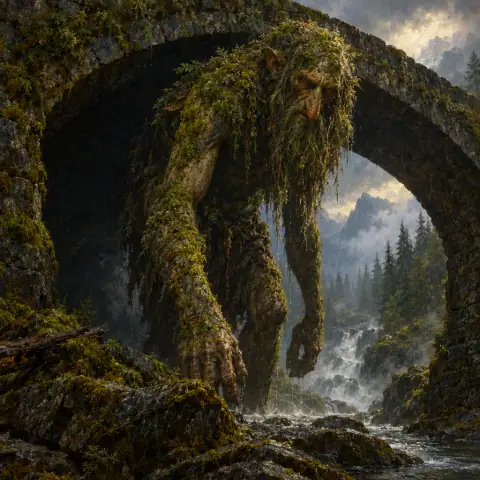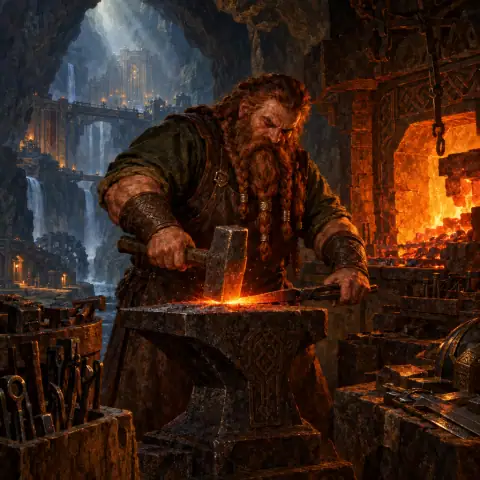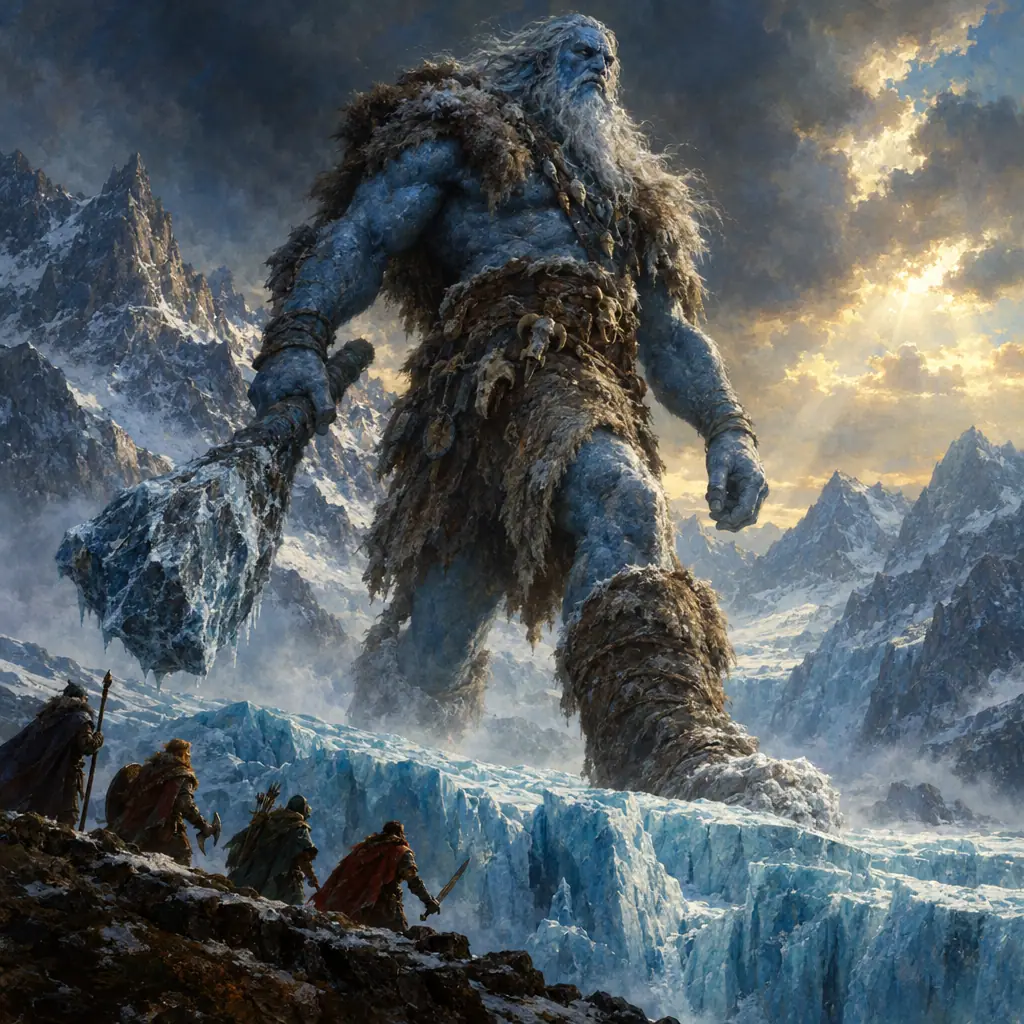
Giants are the primeval opponents of order in myth, and games turned their mythic types into a hierarchy — from brutish hill giants to regal storm giants — that structures some of D&D's most famous adventures.
Origins
Giants stand at the beginning of the world. In Hesiod's Theogony the Gigantes are children of Earth and Sky who wage war on the Olympian gods; in The Odyssey the one-eyed Cyclops Polyphemus traps Odysseus and his men in a cave and eats them two at a time until the hero blinds him. The Hebrew Bible's Nephilim and the Philistine Goliath gave Christian Europe its own giants. In the north, The Eddas describe the jötnar, the ancient rivals of the gods: Snorri Sturluson's Prose Edda (c. 1220) tells how the gods made the world from the body of the primeval giant Ymir, and how frost giants and the fire giant Surtr of Muspelheim will march against them at Ragnarök. Many jötnar are no bigger than humans, but the frost and fire giants are enormous, and they lent their elements to later games.
British legend supplied the fairy-tale giant. Geoffrey of Monmouth's giants were driven from Albion by the Trojan settlers, and the chapbook Jack the Giant Killer, first printed around 1711, set a Cornish farm boy against a sequence of dim, man-eating giants; the blood-sniffing chant of such giants was already old enough for Shakespeare to echo in King Lear. From there the giant ran through Gulliver's Travels and "Jack and the Beanstalk" to J. R. R. Tolkien, whose The Hobbit (1937) glimpses stone-giants hurling rocks in a mountain storm, and whose Ents take their name from the Old English phrase enta geweorc, "the work of giants" — the ancestor of the game Treant.
Into the dungeon
Giants were among the first non-humans on the wargaming table, fielded in Chainmail's Fantasy Supplement (1971); their rock-hurling, handled much like artillery, still betrays those wargame roots. The 1974 white box of Dungeons & Dragons codified five kinds — hill, stone, frost, fire and cloud — and the Greyhawk supplement (1975) added the storm giant; AD&D's 1977 Monster Manual set them in a rising order of size and power, with cousins such as the two-headed ettin, whose name comes from Old English eoten.
Gary Gygax then built a campaign around them. His 1978 modules Steading of the Hill Giant Chief, Glacial Rift of the Frost Giant Jarl and Hall of the Fire Giant King, collected in 1981 as Against the Giants, sent a party into three giant strongholds of the Greyhawk setting to learn who had organized their raids — and revealed the dark elves behind them, launching the drow and the Underdark. The series became a benchmark of the Adventure module, and in 2004 Dungeon magazine ranked the combined Queen of the Spiders the greatest adventure of all time. In 2016 Storm King's Thunder returned to the theme for Dungeons & Dragons 5th Edition, organizing giants into a caste system, the ordning, and shattering it across the Forgotten Realms.
Video games have mostly used giants for spectacle. In The Elder Scrolls V: Skyrim (2011), giants herd mammoths and swat unwary players into the sky with a physics-defying club; FromSoftware's Elden Ring (2022) makes its Fire Giant, the last of a race crushed in the Erdtree's wars, one of its most imposing bosses.
Variations
The giant has always been a vessel for other meanings: primeval chaos in myth, brute folly in fairy tale, gentle outsider in Roald Dahl's The BFG (1982). D&D's giants alone run from brutish hill giants to regal storm giants and include firbolgs and fomorians named from Irish legend; the 2024 Player's Handbook offers the giant-descended goliath as a player species. Wherever they appear, giants do one job especially well: they make heroes, and players, feel small.
Migration
How the creature traveled from story to story.
- 700 BCEHesiod and HomerHesiod's Gigantes war on the Olympian gods; in the Odyssey the one-eyed giant Polyphemus traps Odysseus in his cave.
- 1220Snorri's Prose EddaThe world is made from the body of the primeval giant Ymir; frost and fire giants will fight the gods at Ragnarök.
- 1711Jack the Giant KillerThe earliest printed text of the English chapbook tale of a boy who outwits a series of Cornish and Welsh giants.
- 1937The HobbitStone-giants hurl rocks for sport in a thunderstorm over the Misty Mountains.
- 1974Dungeons & DragonsHill, stone, frost, fire and cloud giants arrive in the white box, able to hurl boulders like siege engines.
- 1978G1–G3 Against the GiantsGygax's module trilogy sends parties against hill giants, frost giants and a fire giant king — and uncovers the drow.
- 2016Storm King's ThunderA fifth-edition campaign in which the giants' ancient social order, the ordning, collapses across the Forgotten Realms.
- 2022Elden RingThe Fire Giant, last of a race crushed in the Erdtree's wars, guards the Mountaintops of the Giants.
Marginalia
- The English word 'giant' is first attested in 1297, from Greek gigas via Latin and Old French.
- In Norse myth many jötnar are roughly human-sized; the frost giants and fire giants of Muspelheim are the huge ones.
- Shakespeare's King Lear (c. 1605) already echoes the giant's chant 'Fie, foh, and fum, I smell the blood of a British man.'
- The 1974 D&D box had five giant types; the storm giant followed in the Greyhawk supplement (1975).
- G1–G3 (1978) were later combined with the drow modules into Queen of the Spiders, named the greatest adventure of all time by Dungeon magazine in 2004.
- D&D's two-headed ettin takes its name from Old English eoten, 'giant,' cognate with Norse jötunn.
Quick answers
- Where does the Giant come from?
- Greek myth (Hesiod's Gigantes and Homer's Cyclops, c. 700 BCE), Norse jötnar, and British fairy tale.
- When did the Giant first appear?
- c. 700 BCE, in Hesiod and Homer.
- How did the Giant get into games?
- Key appearances: Dungeons & Dragons (1974), G1–G3 Against the Giants (1978), Storm King's Thunder (2016) and Elden Ring (2022).
- Why is the Giant significant?
- Giants are the primeval opponents of order in myth, and games turned their mythic types into a hierarchy — from brutish hill giants to regal storm giants — that structures some of D&D's most famous adventures.