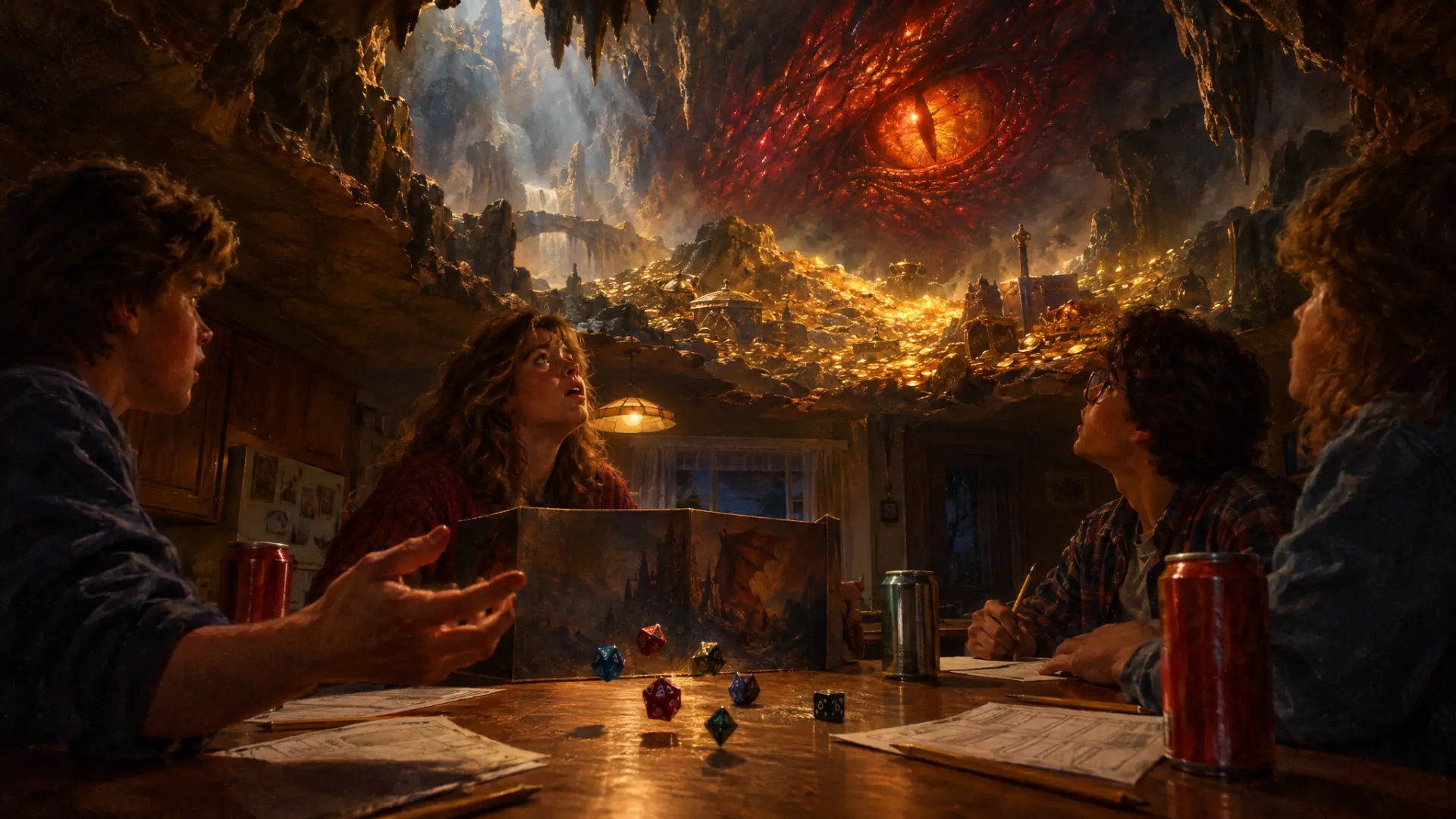
The folio made Gygax's playtest campaign D&D's default world and was among the first stand-alone, comprehensive settings published for the game, proving that players wanted a ready-made world to adventure in.
Overview
The World of Greyhawk, published by TSR, Inc. in August 1980, is the setting in which Gary Gygax playtested Dungeons & Dragons, packaged for everyone else. The product was modest in size — a 32-page gazetteer inside a folder emblazoned with heraldry, plus a two-part color map by Darlene Pekul that together measured 34 by 44 inches — but it did something new for D&D. It gave players a whole continent of kingdoms, empires, wildernesses and politics, ready to host their adventures.
Its subject is the Flanaess, the eastern portion of the continent of Oerik on the world of Oerth: a patchwork of realms such as the decadent Great Kingdom, the Free City of Greyhawk, and the evil empire of Iuz.
Origins
Greyhawk began underground. After Dave Arneson ran Gygax's group through Blackmoor — a visit now dated by Jon Peterson to February 1973, rather than the traditional late 1972 — Gygax built his own dungeon beneath the ruins of Castle Greyhawk and began playing it with his children Ernie and Elise, Don Kaye, and Rob and Terry Kuntz. The group grew beyond twenty players, and Rob Kuntz became co-Dungeon Master. Their characters, such as Ernie's Tenser and Rob's Robilar, are now legends of the hobby, and their exploits tested the rules published in Dungeons & Dragons. TSR's first D&D supplement, Greyhawk (1975), took its name from the campaign though it contained rules, not geography; it introduced the thief, the Beholder and variable weapon damage.
The world grew outward from the dungeon as the campaign expanded. When TSR's modules began to be set there, fans demanded to see the world itself, and Gygax agreed to publish it. The folio was ready by early 1979 — editor Allen Hammack's foreword is dated February of that year — but it did not reach shelves until August 1980.
How it plays
A campaign setting is not a game; it is a place for a game to happen. The folio gave a Dungeon Master a gazetteer of each state — its ruler's title, capital, population, resources and alignment — along with a brief history of the Flanaess's migrations and wars. It supplied the texture a referee needs to improvise: a calendar of twelve 28-day months with festival weeks (Needfest, Fireseek, Growfest, Sunsebb) and days of the week (Starday, Sunday, Moonday, Godsday, Waterday, Earthday, Freeday); travel times across the map; orders of knighthood; precedence among nobles; and a set of runes and glyphs for mysterious inscriptions.
The folio was deliberately vague in places, as TSR's Lawrence Schick explained in Dragon, so that each referee could put his own stamp on it. In practice a group would start in a town on the map, take adventures from published modules such as Tomb of Horrors or Gygax's Village of Hommlet that were keyed to Greyhawk locations, and let the political map suggest the rest: a border war to join, a tyrant to overthrow, a wilderness Hexcrawl to map.
Reception & impact
Reviewers were dazzled by the map and cramped by the booklet. Elisabeth Barrington in The Space Gamer admired the "beautiful" full-color map and the heraldic cover but found the small print headache-inducing, and noted the map was almost too big for a table. Dragon #46 carried two reviews, one rating it 9 out of 10. Designer Jim Bambra later judged the folio "disappointing" simply because 32 pages could not hold such a large world.
Legacy
Gygax expanded the setting in a series of Dragon articles from 1980 to 1983, including its first deities, and in 1983 TSR published the World of Greyhawk Fantasy Game Setting boxed set, quadrupling the text to 128 pages with pantheons, flora, populations and encounter tables. After Gygax was forced out of TSR at the end of 1985, he lost the rights to his world; TSR and later Wizards of the Coast continued it in Greyhawk Wars and From the Ashes (1992), and in the Living Greyhawk organized-play campaign launched in 2000. Although Forgotten Realms became TSR's flagship world from 1987, Greyhawk remained D&D's reference setting for years: its wizards — Mordenkainen, Tenser, Bigby, Otiluke — lent their names to spells still cast in every edition.
Marginalia
- Castle Greyhawk began as the dungeon Gygax built after playing in Arneson's Blackmoor; Jon Peterson's research dates its start to around March 1973.
- Gygax's children, the Kuntz brothers and friends were its first explorers; Rob Kuntz became co-Dungeon Master as the group passed twenty players.
- The folio was announced for early 1979 — its foreword is dated February 1979 — but reached stores only in August 1980.
- Days of the week include Starday, Moonday, Godsday and Freeday; months include Fireseek, Growfest and Sunsebb.
- Supplement I: Greyhawk (1975), a rules booklet not a setting, introduced the thief class, the Beholder and variable weapon damage.
- The Tomb of Horrors, the Temple of Elemental Evil and many classic TSR modules are set in Greyhawk.
Quick answers
- When was World of Greyhawk first released?
- World of Greyhawk was first released in 1980 (folio); 1983 (boxed set); home campaign from 1973.
- Who created World of Greyhawk?
- World of Greyhawk was made by Gary Gygax (creator and author).
- Who published or developed World of Greyhawk?
- TSR, Inc. and Wizards of the Coast.
- What kind of work is World of Greyhawk?
- World of Greyhawk is a campaign setting in the Tabletop Roleplaying Games tradition, released for 32-page folio gazetteer with two-piece color map.
- Why is World of Greyhawk important?
- The folio made Gygax's playtest campaign D&D's default world and was among the first stand-alone, comprehensive settings published for the game, proving that players wanted a ready-made world to adventure in.