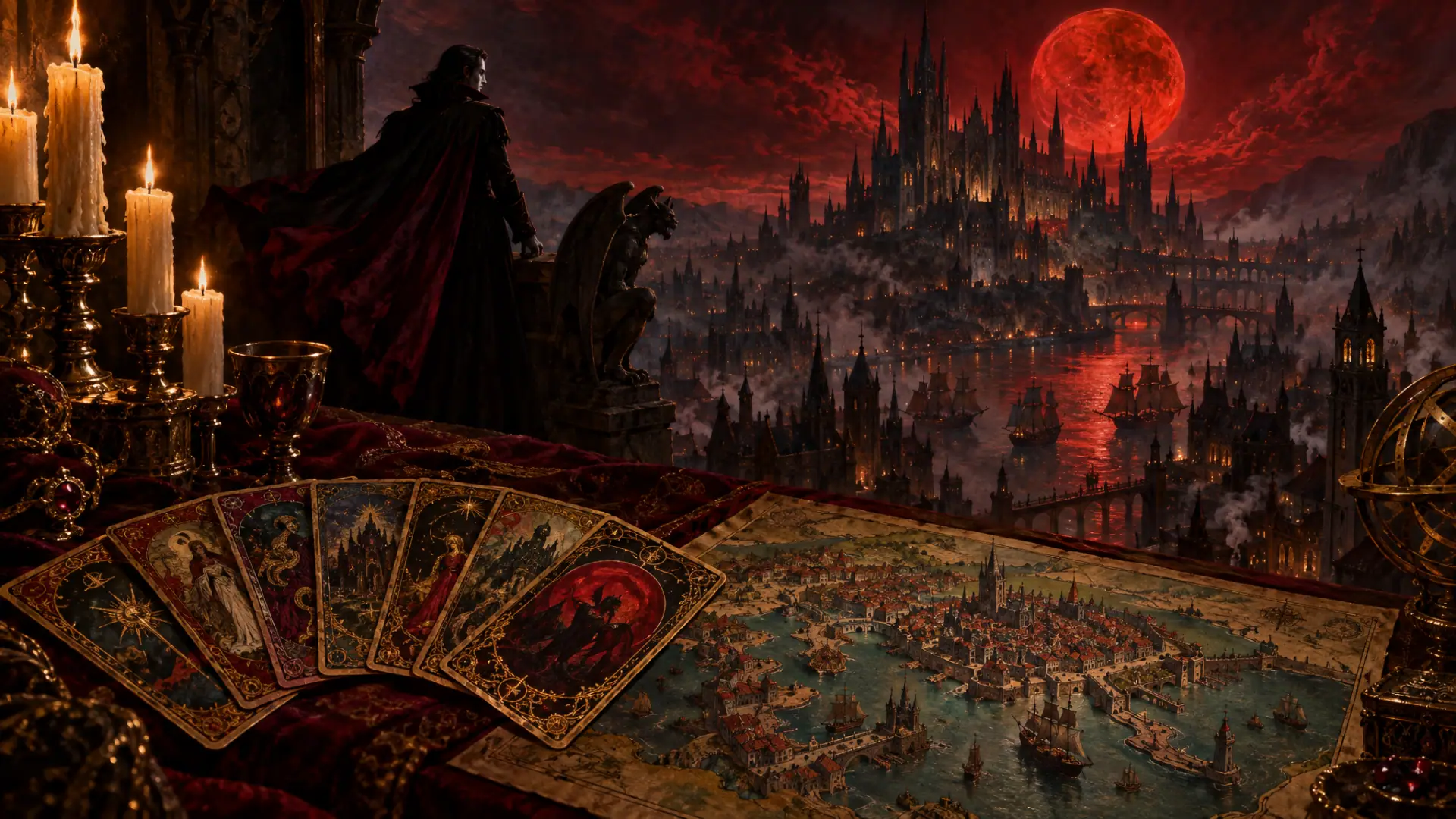
Planescape turned D&D's abstract cosmology into its most literary, visually distinctive setting, and it seeded Planescape: Torment, one of the most admired computer RPGs ever made.
Overview
Planescape is Dungeons & Dragons with a philosophy degree. Published by TSR, Inc. in 1994 for AD&D 2nd Edition, David "Zeb" Cook's Campaign setting took the game's map of the afterlife — the heavens, hells and elemental realms that had been sketched in rulebook appendices since first-edition AD&D — and made it a place to live. Its hub is Sigil, the City of Doors: a ring-shaped metropolis floating atop an infinitely tall Spire, where any archway might be a portal to another plane if a traveler carries the right key.
The setting's central idea is that belief shapes reality. On the planes, conviction strong enough can move a town from one realm to another or bring a god down. Adventures were as likely to turn on an argument as on a sword.
Origins
By the early 1990s, TSR supported many settings: Forgotten Realms, Dragonlance, Ravenloft, Dark Sun and others. Cook, a veteran TSR designer, was tasked with making the Outer Planes playable. He built on the "Great Wheel" cosmology — the ring of alignment-based planes around the neutral Outlands — and gave it a human scale by concentrating everything in one city.
Art made the line instantly recognizable. Dana Knutson's concept work, Robh Ruppel's painted covers and above all Tony DiTerlizzi's spidery, witty interior illustrations of tieflings, githzerai and bureaucrat-demons gave Planescape a look unlike anything else in D&D. The boxed set won the 1994 Origins Award for Best Graphic Presentation.
How it plays
Planescape used the standard AD&D 2nd Edition rules, but it changed what those rules were for. Player characters could join one of Sigil's fifteen factions, philosophical societies that also function as the city's government: the Harmonium police the streets, the Mercykillers run the prisons, the Dustmen (who believe everyone is already dead) keep the Mortuary, the Xaositects embrace chaos, the Athar deny the gods their divinity, and the Bleak Cabal insist that the multiverse has no meaning at all. Faction membership granted abilities and restrictions and, more importantly, a worldview to defend.
The city itself is watched by the Lady of Pain, a silent, masked figure with a halo of blades who bars gods from Sigil and punishes those who threaten it. Players talked in "the cant," the setting's slang, calling newcomers "clueless" and foolish people "berks," and learned that the planes change according to the beliefs of those who inhabit them. The eternal Blood War between two races of fiends — baatezu and tanar'ri, the renamed devils and demons of 2nd Edition — rumbled in the background, drawing mortals in as mercenaries.
The best Planescape adventures treated the multiverse as a puzzle box of ideas. A dungeon might be a god's corpse drifting in the Astral Plane; a mystery might hinge on a portal whose key is a particular song or emotion.
Reception & impact
Critics praised the line's distinctive graphic presentation and intellectual sophistication, and it developed a devoted following. But TSR's finances were deteriorating by the mid-1990s, and after Wizards of the Coast acquired the company in 1997 the line was wound down; the 1998 adventure Faction War effectively closed it.
Its most famous offspring arrived a year later. Black Isle Studios' Planescape: Torment (1999), led by Chris Avellone, used the setting to tell the story of an amnesiac immortal waking in Sigil's Mortuary. It sold modestly at first but became a cult classic celebrated for its writing, and in 2017 an Enhanced Edition brought it to modern systems.
Legacy
Pieces of Planescape never left D&D: Sigil, the Lady of Pain, the tiefling as a playable race and the cant all persisted into later editions. In October 2023 Wizards of the Coast published Planescape: Adventures in the Multiverse for Dungeons & Dragons 5th Edition, restoring the setting as an official product nearly three decades after its debut.
Its influence is also stylistic. Planescape showed that a fantasy roleplaying setting could be driven by ideas — what people believe and why — rather than by maps and monsters alone, and that ambition carried into a generation of narrative-heavy computer RPGs.
Marginalia
- Sigil is a torus-shaped city floating atop an infinitely tall Spire at the center of the Outlands.
- Fifteen philosophical factions — from the nihilist Bleak Cabal to the lawful Harmonium — contend for influence in Sigil.
- Tony DiTerlizzi's illustrations defined the look of the line; he later co-created The Spiderwick Chronicles.
- The setting won the 1994 Origins Award for Best Graphic Presentation.
- The 1998 adventure Faction War effectively closed the original product line.
- In October 2023 Wizards of the Coast revived the setting as Planescape: Adventures in the Multiverse for 5th Edition.
Quick answers
- When was Planescape first released?
- Planescape was first released in 1994.
- Who published or developed Planescape?
- TSR, Inc. and Wizards of the Coast.
- What kind of work is Planescape?
- Planescape is a campaign setting in the Tabletop Roleplaying Games and High / Epic Fantasy tradition, released for AD&D 2nd Edition boxed set and 5th Edition slipcase (2023).
- Why is Planescape important?
- Planescape turned D&D's abstract cosmology into its most literary, visually distinctive setting, and it seeded Planescape: Torment, one of the most admired computer RPGs ever made.