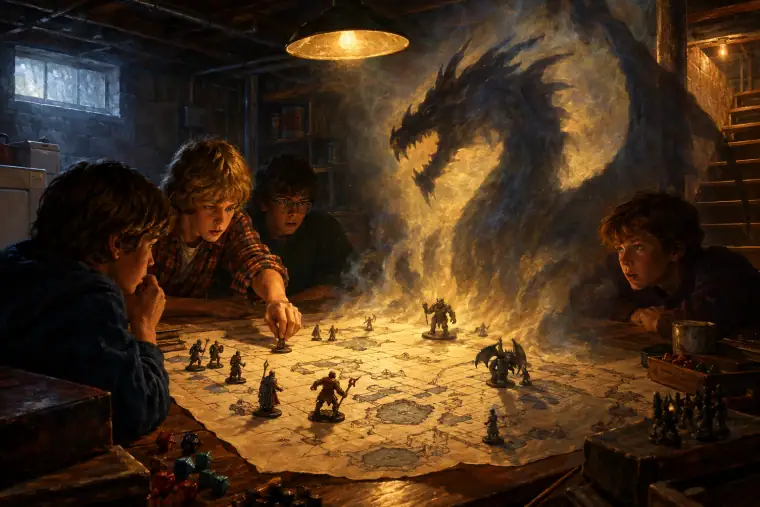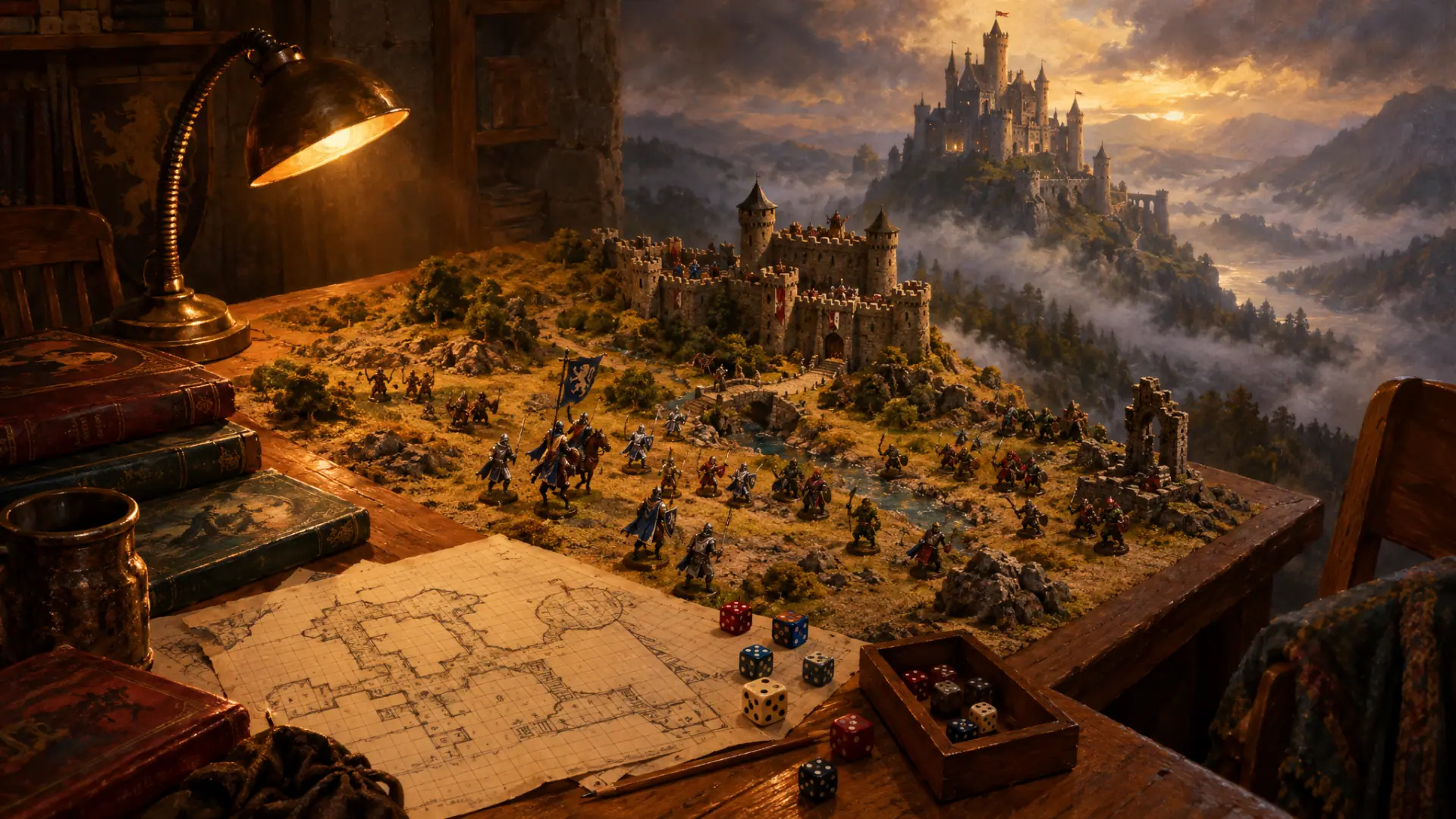
The tabletop RPG is the hinge of this museum: born from wargames and fantasy fiction, it gave rise to the computer RPG, the MUD, the MMORPG and actual-play entertainment. Its core ideas — hit points, levels, character classes, the party — are now the grammar of games.
Hallmarks
- Each player portrays one character who persists and changes across sessions
- A game master describes the world, plays everyone else and adjudicates outcomes
- An open action space: players may attempt anything they can describe
- Rules and dice resolve uncertain actions; much else is settled by conversation
- No fixed ending and usually no winner — campaigns can run for years
- Published settings, adventures and endless homebrew
What it is
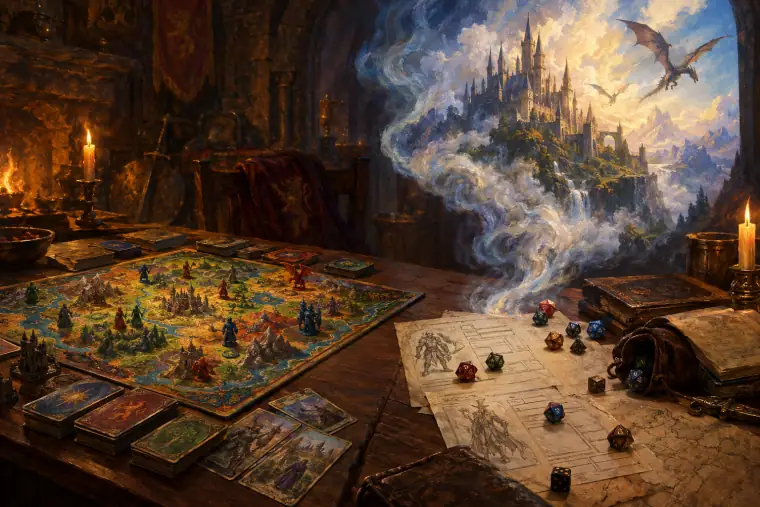
A tabletop roleplaying game (TTRPG) is a structured conversation. Each player takes on a single Player character and describes what that character does; one participant, the Game Master, describes the world, plays every Non-player character and decides what happens. When an action's outcome is uncertain, rules — usually involving Polyhedral dice — resolve it. There is no board and no fixed scenario, the game has no set end, and nobody wins in the usual sense: the goal is a shared story and the survival and growth of the characters, often across a campaign that lasts months or years.
"Tabletop" and "pen-and-paper" distinguish the form from computer RPGs and live-action roleplay; neither the table nor the paper is required, and online play over video became common during the COVID-19 pandemic.
Origins
The TTRPG was assembled from the Miniatures & Board Wargames hobby. In 1969 David Wesely, a Minnesota wargamer, ran Braunstein, a Napoleonic-era scenario in which each player took one individual role in a German town, with goals of their own; the result was chaotic, open-ended and unlike any wargame. Among the players was Dave Arneson, whose Blackmoor campaign, started in 1971 using the fantasy rules of Chainmail, added the elements that define the form: individual characters who persist and improve, a referee-run world, and underground dungeons to explore.
Arneson demonstrated Blackmoor to Gary Gygax in Lake Geneva, Wisconsin, and the two developed it into Dungeons & Dragons, published by TSR, Inc. in January 1974 in a first printing of 1,000 copies. The box described itself as rules for "Fantastic Medieval Wargames Campaigns," and it assumed buyers were wargamers. Instead it found a new audience, and within a few years the hobby had its own name: role-playing games.
Evolution
Competitors arrived within a year. Ken St. Andre's Tunnels & Trolls (1975) simplified the rules; M. A. R. Barker's Empire of the Petal Throne (1975) offered a deeply realized alien world; Traveller (1977) took roleplaying into space; RuneQuest (1978) introduced skills and a mythic setting; Call of Cthulhu (1981) made horror playable. The late 1970s and 1980s were D&D's golden age — Advanced Dungeons & Dragons, Gen Con crowds, and the Satanic Panic & D&D — while generic systems (see Universal & Generic RPG Systems) and story-centered games such as Vampire: The Masquerade (1991) diversified the field.
The 1990s brought a slump as computer games and Magic: The Gathering drew players away; TSR, overextended, was bought by Wizards of the Coast in 1997, and Hasbro bought Wizards in 1999. The Open Game License and Dungeons & Dragons 3rd Edition (2000) opened D&D's rules to other publishers, while online forums nurtured the indie design movement (see Narrative & Story Games (incl. Powered by the Apocalypse)) and the Old-School Renaissance (OSR). Dungeons & Dragons 5th Edition (2014), Actual Play shows such as Critical Role, Virtual Tabletops and crowdfunding produced a boom that continued into the 2020s.
Beyond fantasy, the form proved infinitely adaptable: horror, science fiction, superheroes, noir, romance and comedy all have their games, and the craft of running them spawned a vocabulary — Railroading, Sandbox, Homebrew, TPK — that this archive catalogs in its glossary.
How to tell it apart
This is the atlas's most important border; the Board Game, Wargame, or Roleplaying Game? tour walks it in detail.
- RPG vs. Miniatures & Board Wargames: in a wargame you command a force — regiments, squadrons, a warband — and the aim is to win a battle or campaign against an opponent. In an RPG you play one person, usually cooperating with other players, with no victory condition. Both may use a referee and miniatures; Braunstein and Blackmoor are exactly where one became the other.
- RPG vs. board game: a board game has a closed set of legal moves, fixed components and a defined end with a winner. An RPG's action space is open: anything a player can describe may be attempted, and a human referee adjudicates. TSR's own Dungeon! (1975) shows the difference — the same dungeon, but with a board, a finish line and a winner. HeroQuest, Talisman and Gloomhaven are adventure board games or dungeon crawlers that borrow RPG trappings, not RPGs.
- vs. Live-Action Roleplay (LARP): LARP is roleplaying performed physically, in costume, in real space; tabletop is described.
- vs. Western Computer RPGs (CRPG): a CRPG replaces the human game master with software, trading open-ended adjudication for automation.
- vs. Gamebooks & Interactive Books and Solo & Journaling RPGs: gamebooks pre-script every choice; solo RPGs use prompts and oracles to replace the GM.
Where to start
- Dungeons & Dragons — the three little brown books that began it.
- Dungeons & Dragons Basic Set — the classic introduction, especially the 1983 "Red Box."
- Call of Cthulhu — a different kind of RPG, where knowledge kills.
- Dungeons & Dragons 5th Edition — the modern entry point for most new players.
- Blades in the Dark — for a taste of contemporary indie design.
Marginalia
- David Wesely's Braunstein (1969), a Napoleonic-era game in which each player took one role in a town, is widely treated as a proto-roleplaying game.
- Dave Arneson's Blackmoor campaign (from 1971) combined individual characters, dungeon exploration and experience — the core of D&D.
- Dungeons & Dragons, by Gygax and Arneson, was published by TSR, Inc. in January 1974 in a first printing of 1,000 copies.
- M. A. R. Barker's Empire of the Petal Throne (TSR, 1975) was published as a standalone game and introduced critical hits.
- By its first major reprinting in 1977, D&D was being positioned as a roleplaying game rather than a wargame.
- Hasbro bought Wizards of the Coast, D&D's owner, in 1999 for an estimated $325 million.
- In 2023, after a community revolt over changes to the Open Game License, Wizards placed the D&D 5th Edition core rules document under a Creative Commons license.
Quick answers
- What is Tabletop Roleplaying Games?
- The game in which you play one person, in a world a friend describes, with no board, no fixed ending and no winner — invented in the Midwest in the early 1970s and descended from miniature wargames.
- What are the hallmarks of Tabletop Roleplaying Games?
- Each player portrays one character who persists and changes across sessions; A game master describes the world, plays everyone else and adjudicates outcomes; An open action space: players may attempt anything they can describe; Rules and dice resolve uncertain actions; much else is settled by conversation; No fixed ending and usually no winner — campaigns can run for years; Published settings, adventures and endless homebrew.
- When did Tabletop Roleplaying Games emerge?
- 1974 (Dungeons & Dragons); proto-roleplaying from 1969 (Braunstein).
- Where does the name “Tabletop Roleplaying Games” come from?
- D&D (1974) billed itself as rules for "Fantastic Medieval Wargames Campaigns"; "role-playing game" became the hobby's name over the following years.
- What are the key works of Tabletop Roleplaying Games?
- Braunstein, Blackmoor, Dungeons & Dragons, Empire of the Petal Throne, Tunnels & Trolls, RuneQuest, Call of Cthulhu and Vampire: The Masquerade.