Every tabletop roleplaying game descends from wargaming. The umpire, the hit point, the fantasy supplement and the first dungeon all came out of the hobby, and its fantasy branch built one of the largest tabletop businesses in the world.
Hallmarks
- Armies, not individuals: the player commands units and formations
- A map, table or hex grid that turns terrain into rules
- Simulation of real or imagined warfare, with victory conditions and a winner
- Painted miniatures or cardboard counters marked with combat and movement values
- Combat results resolved by dice and tables rather than narration
- An umpire in the oldest forms, dropped in most commercial board games
What it is
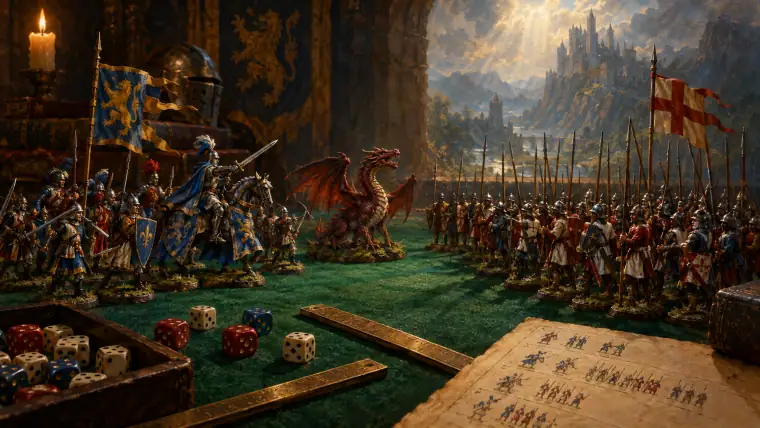
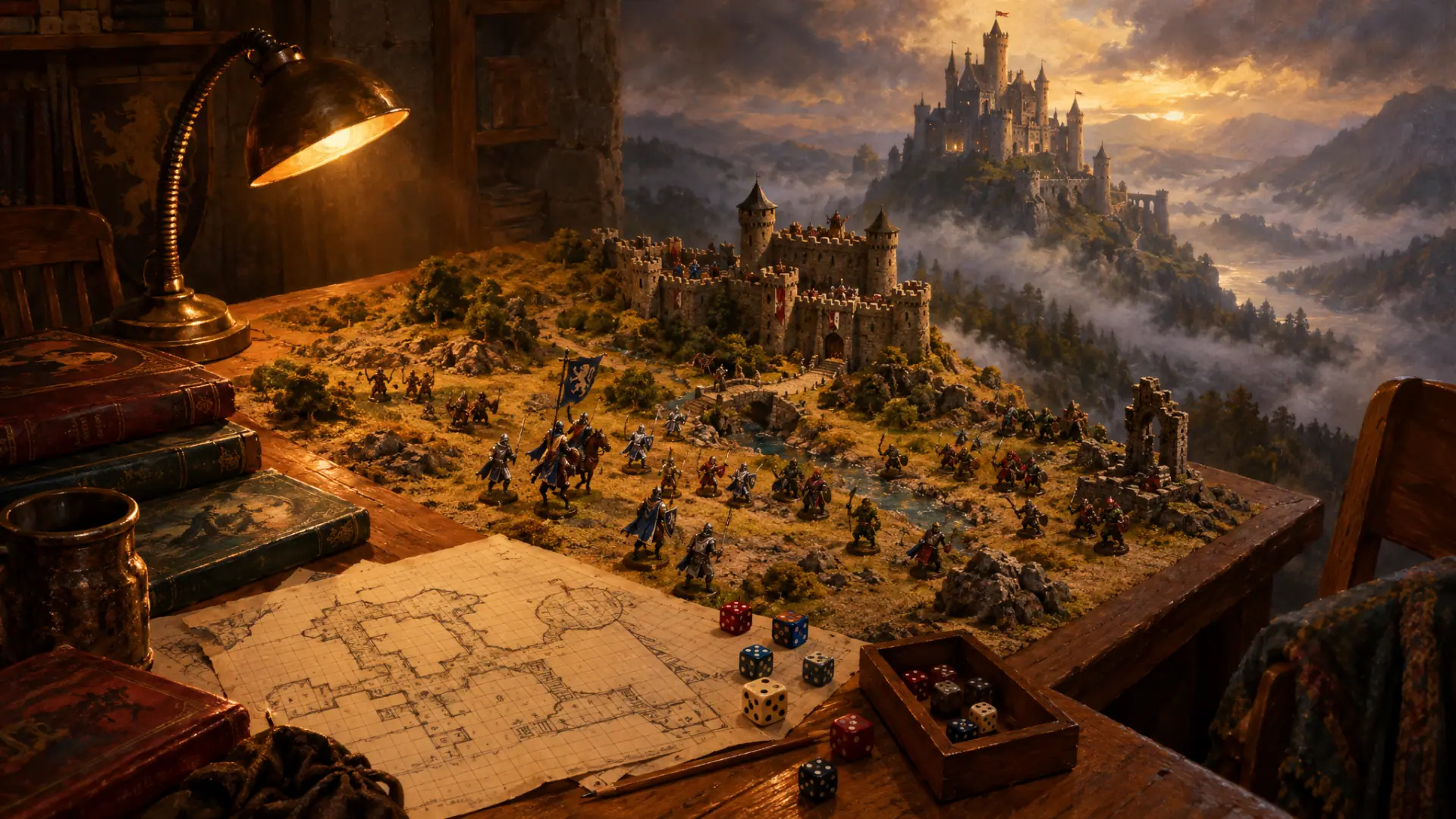
A wargame is a game of command. Its players are generals: they move regiments, batteries and fleets across a map or a tabletop landscape, and the rules convert terrain, morale and firepower into numbers. There are two great branches. Miniatures wargames are played on a table dressed with model hills, rivers and buildings, with painted figures measured across it by ruler or tape. Board wargames replace figures with printed cardboard counters and the table with a map, usually overlaid with a hexagonal grid; each counter carries its unit's attack, defense and movement values, and dice are rolled on a combat results table.
What unites them is scale and purpose. A wargame asks whether your army wins the battle, not what your soldiers feel about it. That single distinction explains why the moment a player began caring about one soldier, in a Minnesota game in 1969, something new was born.
Origins
The form began as military education. In Prussia, Georg Leopold von Reisswitz built a terrain table for the king around 1812, and in 1824 his son presented Kriegsspiel to the General Staff, a game of scaled maps, blocks for units and an umpire who hid information and judged outcomes. (Both men appear together in the museum as Georg von Reisswitz.) Kriegsspiel spread through European armies and, in 1873, to the first civilian club at Oxford.
Hobby wargaming followed toy soldiers into the nursery. Fred T. Jane published naval rules in 1898, and in 1913 H. G. Wells wrote Little Wars, a playful rulebook for battles on the floor with spring-loaded guns, which ended with a sketch of an umpired Kriegsspiel for adults. After the Second World War the board wargame arrived: Charles S. Roberts's Tactics (1954) sold by mail from Maryland, and his company, incorporated as Avalon Hill in 1958, produced Gettysburg (1958), the first board wargame based on a historical battle. Its 1961 re-release introduced the hex grid, which soon became the standard for regulating movement. In 1969 James Dunnigan founded Simulations Publications, Inc. (SPI) to keep Strategy & Tactics magazine alive, and the magazine began carrying a complete wargame in each issue.
Evolution
Fantasy entered through the miniatures side. In Lake Geneva, Wisconsin, Jeff Perren's medieval rules were expanded by Gary Gygax into Chainmail (1971), whose Fantasy Supplement let players field heroes, wizards and dragons drawn from Tolkien and Howard. Meanwhile in the Twin Cities, David Wesely had run Braunstein (c. 1969), a Napoleonic scenario in which each player controlled a single townsperson; the players ignored the battle and schemed instead. Dave Arneson took that idea into Blackmoor, and Blackmoor plus Chainmail became Dungeons & Dragons in 1974. The first D&D rules assumed the reader owned Chainmail.
The board wargame had its own fantasy phase: SPI published Sorcerer (1975) and War of the Ring (1977), and after SPI collapsed in 1982, TSR, Inc., the company Gygax co-founded to publish D&D, took over its properties. By then roleplaying had overtaken its parent. In Britain, Games Workshop answered with Warhammer Fantasy Battle (1983), rules designed around its own Citadel miniatures, and built a business in which painting, collecting and playing were one hobby. Its settings fed roleplaying (Warhammer Fantasy Roleplay) and dungeon games (Warhammer Quest). The line's arc shows how completely the fantasy wargame had become a world in its own right: Games Workshop ended it in 2015 by destroying the Old World in The End Times, replaced it with Age of Sigmar, and in January 2024 brought the original setting and its rank-and-file battles back as Warhammer: The Old World.
Digital games absorbed much of the counter-pushing audience from the 1980s onward, and the turn-based Tactical & Strategy RPGs inherited the grid. Yet the physical hobby persisted: veteran players proudly call themselves grognards, a word taken from Napoleon's old guard, and crowdfunding has revived lavish board wargames in the 2010s.
How to tell it apart
The line between a wargame and a Tabletop Roleplaying Games is the line Braunstein crossed. In a wargame you command many units toward a victory condition; in a roleplaying game you inhabit one Player character in an open-ended story, with a Game Master who adjudicates anything you try. Roleplaying kept the wargame's dice, its umpire and its damage points (Kriegsspiel units absorbed losses before removal, an ancestor of Hit points) but discarded the army and the finish line.
A wargame also differs from an Fantasy Adventure Board Games such as Talisman: the adventure game follows individual heroes who grow in power, while the wargame's units rarely improve and are expendable by design. And it differs from strategy board games like Risk or Diplomacy chiefly in its commitment to simulation: a wargame wants its terrain, logistics and combat odds to model something real, or at least something consistent within a fantasy world.
Where to start
- Kriegsspiel — the Prussian root of the umpire and of every referee since.
- Little Wars — Wells's charming invitation to play on the floor.
- Braunstein — the game where wargamers stopped fighting and started roleplaying.
- Chainmail — the fantasy supplement that became D&D's combat system.
- Warhammer Fantasy Battle — the miniatures juggernaut and the grim Old World.
- For context, follow the chapter From Kriegsspiel to Dungeons & Dragons and the tour Board Game, Wargame, or Roleplaying Game?.
Marginalia
- Kriegsspiel was presented to the Prussian General Staff in 1824 and adopted as officer training, not entertainment.
- Fred T. Jane's naval rules of 1898 are often cited as the first published miniature wargame.
- H. G. Wells's Little Wars (1913) fired wooden dowels from spring-loaded toy cannon.
- Charles S. Roberts's Tactics (1954) was the first commercially successful board wargame; it sold about 2,000 copies in six years.
- The 1961 re-release of Avalon Hill's Gettysburg introduced the hex grid that became the board wargame's signature.
- Chainmail's 1971 Fantasy Supplement gave wargamers dragons, wizards and fireballs three years before D&D.
Quick answers
- What is Miniatures & Board Wargames?
- Painted soldiers on sand tables, cardboard counters on hex maps: the game of generals that trained Prussian officers, amused H. G. Wells and, in a Minnesota basement, gave birth to the roleplaying game.
- What are the hallmarks of Miniatures & Board Wargames?
- Armies, not individuals: the player commands units and formations; A map, table or hex grid that turns terrain into rules; Simulation of real or imagined warfare, with victory conditions and a winner; Painted miniatures or cardboard counters marked with combat and movement values; Combat results resolved by dice and tables rather than narration; An umpire in the oldest forms, dropped in most commercial board games.
- When did Miniatures & Board Wargames emerge?
- 1812–24 Prussian Kriegsspiel; hobby rules 1913; commercial board wargames 1954.
- What are the key works of Miniatures & Board Wargames?
- Kriegsspiel, Little Wars, Chainmail, Braunstein and Warhammer Fantasy Battle.