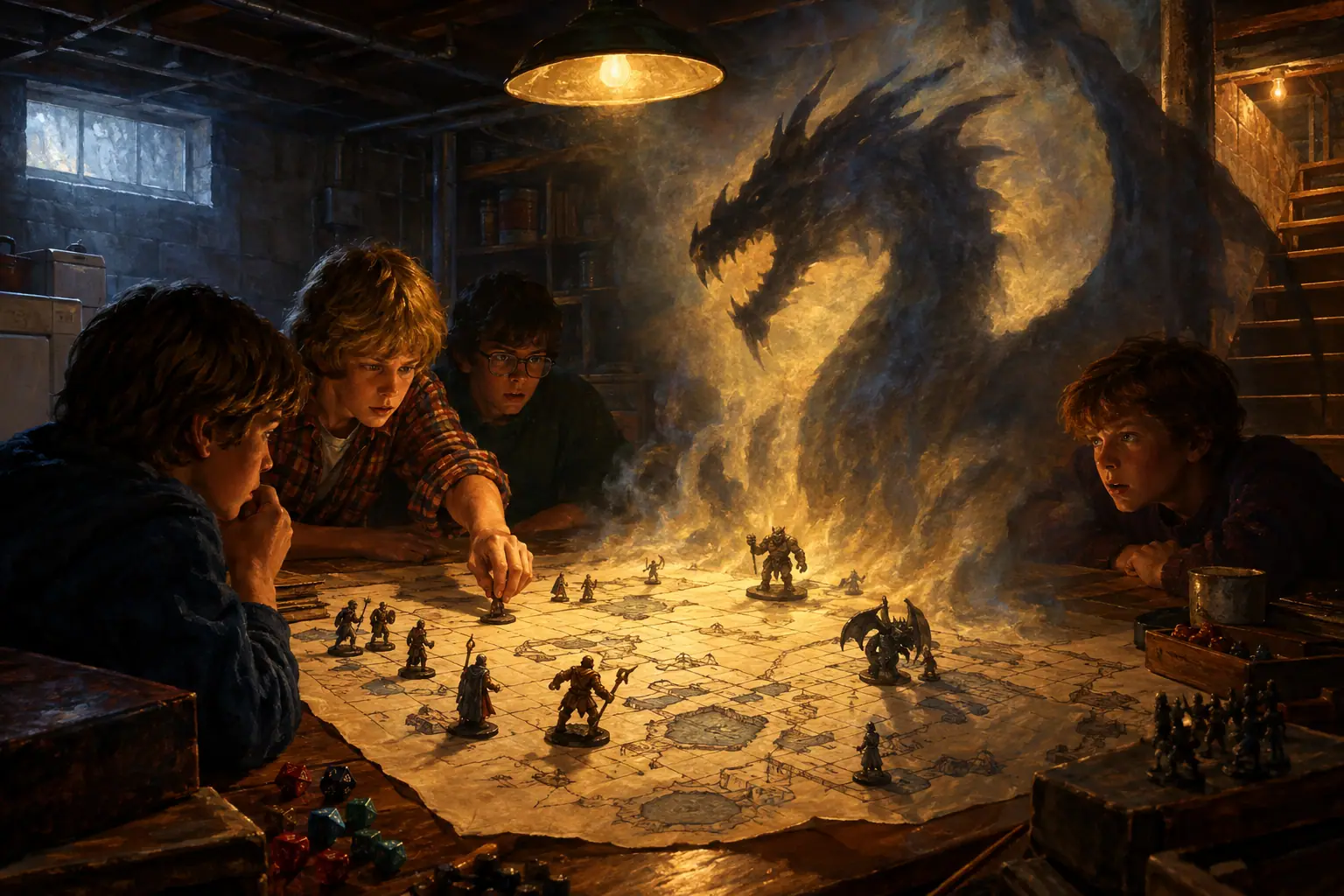
The Birth of D&D
Umpires, toy soldiers and a castle in a Twin Cities basement
Dungeons & Dragons was published in January 1974, but its ingredients took a century and a half to gather. This tour walks through them in order and shows where each piece came from.
The oldest ingredient is the referee. Kriegsspiel, a Prussian army training game, put an umpire between the players and the battlefield, a person who knew more than they did and decided what happened. H. G. Wells's Little Wars made wargaming a hobby for civilians. By the 1960s American wargamers had clubs, fanzines and conventions, Gen Con among them.
The second ingredient is the individual role. In David Wesely's Braunstein games, players took on single characters in a town rather than commanding armies, and found the talking more interesting than the fighting. Dave Arneson was one of those players. When he started his own campaign, Blackmoor, he set it in a fantasy world, sent his players into a dungeon under a castle, and let them keep their characters from week to week.
The third ingredient is the rulebook. Gary Gygax and Jeff Perren's Chainmail had given wargamers fantasy creatures and rules for individual heroes. When Arneson showed Gygax Blackmoor, Gygax recognized something new and wrote it up. Tactical Studies Rules published the result as Dungeons & Dragons.
The later stops show how quickly the game grew: through magazines, through the Dungeons & Dragons Basic Set that took it to toy shops, and through Advanced D&D, whose success led to a lawsuit over who deserved the credit. The tour ends on The Gygax–Arneson Disputes because the question it raises is a real one: D&D was not the work of one inventor, but of a whole community of players, referees and rule-writers, working from ideas that were already more than a century old.
- 1KriegsspielWargame · 1812
Start in Prussia in 1812 and 1824, with a training game of painted blocks and staff maps. Its crucial invention is the umpire, a referee who hides what the players cannot see and decides the outcome of their orders. Every Dungeon Master descends from this figure.
- 2Little WarsWargame · 1913
In 1913 H. G. Wells brought wargaming to the nursery floor with toy soldiers and spring-loaded guns, and wrote rules anyone could buy. The hobby of recreational wargaming, which would produce D&D's authors, begins here.
- 3Gen ConConvention · 1968
In 1968 Gary Gygax helped launch a small wargaming convention in Lake Geneva, Wisconsin. Conventions, fanzines and clubs made up the network through which the people and ideas on this tour met.
- 4BraunsteinWargame · c. 1969
In Minnesota around 1969 David Wesely gave each player a single townsperson, the mayor or the banker, with goals of their own. The players talked, schemed and dueled instead of fighting the battle. One player in these games was Dave Arneson.
- 5ChainmailWargame · 1971
Gygax and Jeff Perren's 1971 medieval wargame included a Fantasy Supplement with heroes, wizards, fireballs and dragons, and scaled combat down to single figures. D&D's 1974 rules would assume every player owned a copy.
- 6BlackmoorCampaign setting · 1971
The decisive stop. From 1971 Arneson ran a 'medieval Braunstein' in which each player kept one character across sessions, explored dungeons beneath a model castle and grew stronger. This was the kind of game D&D would describe.
- 7Dungeon!Board game · 1975
A Blackmoor player, David Megarry, built a dungeon board game, and when he and Arneson took it to Lake Geneva, Arneson ran Gygax's group through Blackmoor. The board game and the roleplaying game were born from the same trip; compare the two to see where they differ.
- 8Dungeons & DragonsTabletop RPG · 1974
January 1974: three booklets in a woodgrain box, written up by Gygax from his and Arneson's play and published by the new Tactical Studies Rules. It had a referee, characters, levels and no winner. The first printing was 1,000 copies.
- 9The Strategic Review & DragonPublication · 1975–2013
The Strategic Review (1975), soon replaced by The Dragon (1976), carried new classes, monsters and rules debates to a scattered audience. Early D&D grew as much through magazines as through rulebooks.
- 10Dungeons & Dragons Basic SetTabletop RPG · 1977–1994
In 1977 TSR hired neurologist J. Eric Holmes to write an introduction for newcomers, boxed for toy and book stores. D&D was leaving the wargaming hobby for the general public.
- 11Advanced Dungeons & DragonsTabletop RPG · 1977–1989
Gygax's hardcovers of 1977–79 codified the game into a canon. TSR treated AD&D as a new game and paid Arneson no royalties on it, which set up the last stop.
- 12The Gygax–Arneson DisputesControversy · 1979–1981
End with the argument. Arneson sued in 1979 and the 1981 settlement gave him a share of AD&D sales. The documentary record suggests neither man alone made D&D, and the credit question has been debated ever since.