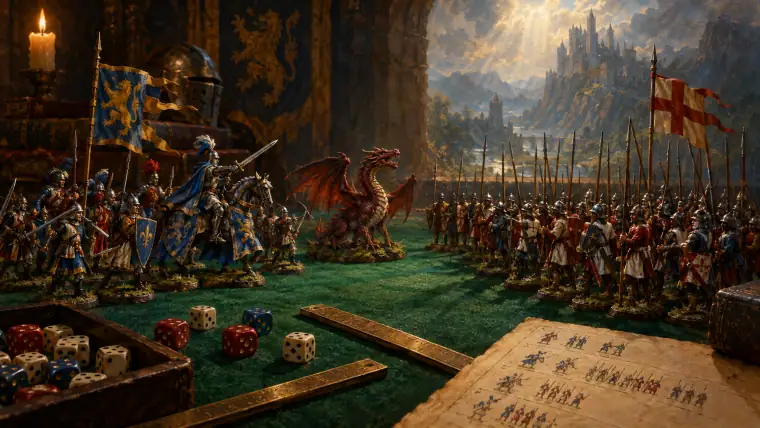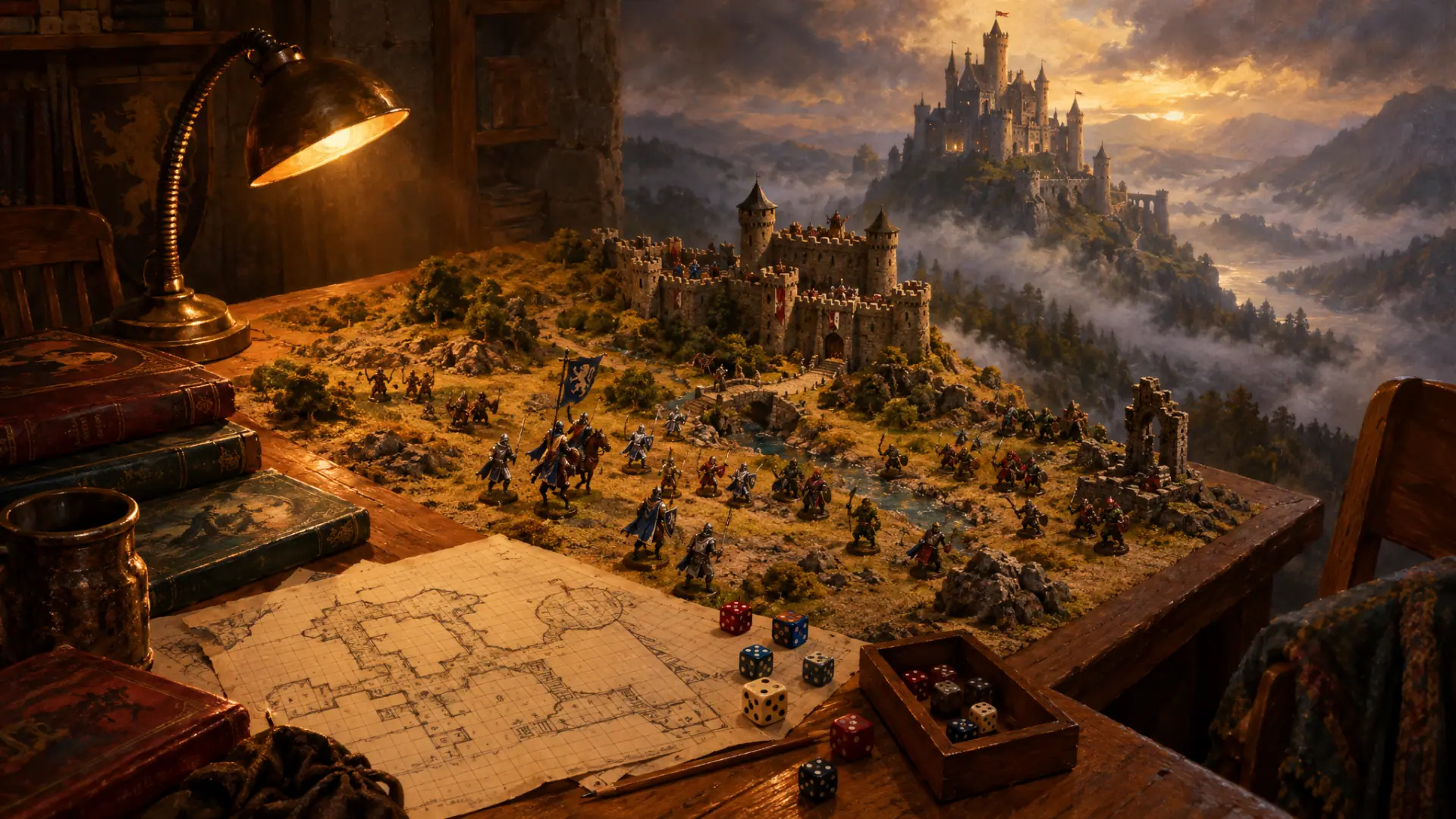
Wells took war games out of the general staff and onto the nursery floor. Little Wars gave hobbyists a model of written rules, measured movement and friendly competition that ran through twentieth-century miniatures gaming to Chainmail and D&D.
You have only to play at Little Wars three or four times to realise just what a blundering thing Great War must be.
Life
Herbert George Wells was born on September 21, 1866, in Bromley, Kent, the son of a shopkeeper and a lady's maid. His schooling was patchy, and he served unhappy apprenticeships as a draper's assistant before winning a scholarship to study science in London, where he was taught biology by T. H. Huxley. He worked as a teacher and science journalist until fiction made him famous.
That fame came fast. Between 1895 and 1898 he published The Time Machine, The Island of Doctor Moreau, The Invisible Man and The War of the Worlds, books that helped define science fiction. He was also a considerable writer of fantasy: The Wonderful Visit (1895), in which an angel is shot down by a country vicar; The Sea Lady (1902), about a mermaid on the Kent coast; and short stories such as "The Man Who Could Work Miracles," "The Magic Shop" and "The Door in the Wall." Later he turned increasingly to social prophecy, history and politics, and became one of the most widely read public intellectuals in the world. He died in London on August 13, 1946.
Work
Wells was also a father who played on the floor with his sons, and he wrote two books about it. Floor Games (1911) described building islands, cities and imaginary countries from bricks, planks and toy figures. Little Wars (1913), published by Frank Palmer, turned that play into a proper game with rules.
By Wells's own account, the game began at Sandgate on the Kent coast, where he was lunching with a friend he calls only "J. K. J.", generally identified as the humorist Jerome K. Jerome. J. K. J. picked up a toy spring-loaded gun, knocked over a soldier, and issued challenges. The question that followed, "suppose somehow one could move the men!", turned target practice into a game. Wells and other friends built a landscape of boards, bricks and twigs on a cork-carpeted nursery floor (evicting the children) and worked out rules: measured moves, limits on how often guns could fire, the requirement that a gun have crew nearby, rules for melee and capture. Their armies were ordinary toy soldiers of the kind made by W. Britains, and their guns fired small wooden projectiles.
The resulting book is funny, conversational and illustrated with scenes of battles in progress. It is also a document of its moment. Written the year before the First World War, Little Wars ends with a passage in which Wells, a lifelong critic of militarism, offers his game as a harmless substitute for the real thing ("How much better is this amiable miniature than the Real Thing!") and proposes that the statesmen and "scare-mongers" of Europe be shut away in a vast Temple of War with unlimited toy soldiers. His conclusion, that anyone who has played a few games will see "just what a blundering thing Great War must be," reads bleakly given what followed in 1914.
Legacy
Little Wars was not the first war game (the Prussian army had been playing Kriegsspiel since the 1820s, and Georg von Reisswitz's tradition had spread to Britain), but it was the first set of rules written for civilians who played for fun. It showed that a hobbyist could write rules, share them in print, and invite strangers to play: the pattern of every miniatures club, fanzine and published rule set that followed. The postwar miniatures hobby in Britain and the United States counted Wells as its founder, and the Lake Geneva and Twin Cities gamers who produced Chainmail and then Dungeons & Dragons were heirs to that culture of home-made rules and tabletop landscapes (see From Kriegsspiel to Dungeons & Dragons).
The book has stayed in print and is freely available through Project Gutenberg. For historians of fantasy it is a pleasing coincidence that the same writer shaped both halves of the story: the scientific romance that fed twentieth-century speculative fiction, and the tabletop game that would eventually let readers walk into such stories themselves.
Marginalia
- Little Wars (1913) was subtitled "a game for boys from twelve years of age to one hundred and fifty and for that more intelligent sort of girl who likes boys' games and books."
- Its artillery was a spring-loaded toy breech-loading gun that fired small wooden projectiles at the enemy's lead soldiers.
- Wells says the game began over lunch at Sandgate when a friend he calls "J. K. J." (usually identified as Jerome K. Jerome) fired a toy gun at some soldiers.
- His earlier Floor Games (1911) described imaginative play with blocks, boards and toy figures on the floor.
- He closed Little Wars by arguing that a few games show "just what a blundering thing Great War must be."
Quick answers
- Who was H. G. Wells?
- The author of The Time Machine and The War of the Worlds, who also wrote Little Wars (1913), the first published rules for hobby wargaming with toy soldiers.
- When was H. G. Wells born?
- H. G. Wells was born in 1866 in Bromley, Kent, England and died in 1946.
- What is H. G. Wells known for?
- H. G. Wells is best known for Little Wars.
- Why does H. G. Wells matter to fantasy and games?
- Wells took war games out of the general staff and onto the nursery floor. Little Wars gave hobbyists a model of written rules, measured movement and friendly competition that ran through twentieth-century miniatures gaming to Chainmail and D&D.