Braunstein is the missing link between the wargame and the roleplaying game. Wesely's referee-run, one-player-one-character scenarios led directly to Dave Arneson's Blackmoor and so to Dungeons & Dragons.
Life
David Wesely was born in 1945 and grew up to study physics at Hamline University in Saint Paul, Minnesota. In the late 1960s he was a leading figure among the Twin Cities miniatures wargamers who gathered as the Midwest Military Simulation Association, a group of students and young professionals who staged Napoleonic battles with painted figures and wrote their own rules. Among the younger members was a University of Minnesota history student named Dave Arneson.
Wesely's gaming career was interrupted in October 1970, when he entered Army service. By then, the experiment that would make his name had already left his hands.
Work
Wesely was a rules tinkerer with a scholarly streak. Reading back into the history of military simulation, he found Strategos (1880), a game by the American artillery officer Charles A. L. Totten, itself a descendant of the Prussian Kriegsspiel of Georg von Reisswitz. What caught Wesely's attention was Totten's referee: a neutral party who adjudicated what the players' forces did, rather than a rulebook that tried to anticipate everything. He built that idea into his own Napoleonic rules, Strategos N, drafted in 1968.
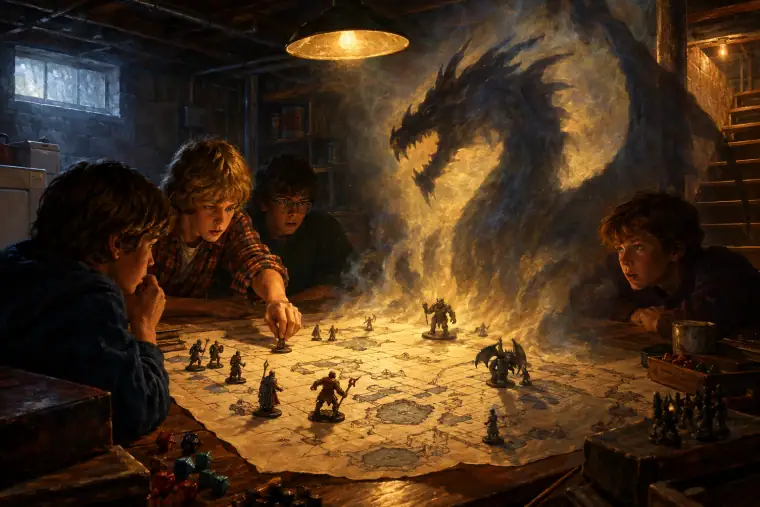
The breakthrough came in the game usually dated to 1969 (some accounts place it earlier) that Wesely called Braunstein, after the fictional German town in which it was set. Instead of assigning each player an army, he gave about twenty players individual roles in and around the town: the town's mayor, a banker, the university chancellor and other local figures. Each had private goals. Wesely intended the scenario to build up to a battle. It never got there. The players ignored the war to scheme, negotiate and plot among themselves, and when two of them decided to fight a duel, Wesely had no rules for it and had to invent some on the spot. He considered the evening chaotic, but the players loved it and demanded more.
Later Braunsteins moved to new settings, most famously a coup in the invented Latin American republic of Banania, which Wesely and Arneson took turns refereeing. When Wesely left for the Army, Arneson took over as referee, and in 1971 he transplanted the format into a medieval fantasy world, Blackmoor. Within three years that campaign had become Dungeons & Dragons. Arneson himself credited Braunstein as the model for Blackmoor, describing the fantasy campaign in interviews as a medieval Braunstein.
Wesely continued to design conventional wargames. He wrote Valley Forge (1976), a miniatures game published by TSR, Inc., and later the World War II computer air wargames Winged Samurai and Chennault's Flying Tigers for Discovery Games.
Legacy
For many years Wesely was a footnote in the story of D&D, remembered mainly through Arneson's interviews. That changed after designer Ben Robbins published a detailed history of Braunstein in 2008, and after Jon Peterson's Playing at the World (2012) examined the Twin Cities scene in detail. Historians now generally regard Braunstein as the first recorded instance of the structure at the heart of every tabletop roleplaying game: a referee who runs a world, and players who each inhabit a single character with goals of their own, free to do things the rules never imagined.
That structure has proved endlessly adaptable. It underlies the Tabletop Roleplaying Games and the live-action game, and, by way of D&D, the Western Computer RPGs (CRPG) and the MMORPGs. Every one of them descends from the evening in Minnesota when a wargame stopped being about armies and started being about people.
Marginalia
- Wesely studied physics at Hamline University in Saint Paul, Minnesota.
- His Napoleonic rules Strategos N (drafted in 1968) adapted the referee from Charles A. L. Totten's 1880 American wargame Strategos.
- The first Braunstein cast roughly 20 players as figures in a fictional German town, among them its mayor, a banker and a university chancellor.
- When two players unexpectedly challenged each other to a duel, Wesely had to improvise rules on the spot.
- After he entered Army service in October 1970, Dave Arneson took over as referee of the Braunstein games.
- He later designed Valley Forge (1976) for TSR, Inc..
Quick answers
- Who is David Wesely?
- The Minnesota physics student and miniatures referee whose Braunstein games of 1969 handed players individual roles instead of armies, and accidentally invented the roleplaying session.
- When was David Wesely born?
- David Wesely was born in 1945.
- What is David Wesely known for?
- David Wesely is best known for Braunstein.
- Why does David Wesely matter to fantasy and games?
- Braunstein is the missing link between the wargame and the roleplaying game. Wesely's referee-run, one-player-one-character scenarios led directly to Dave Arneson's Blackmoor and so to Dungeons & Dragons.