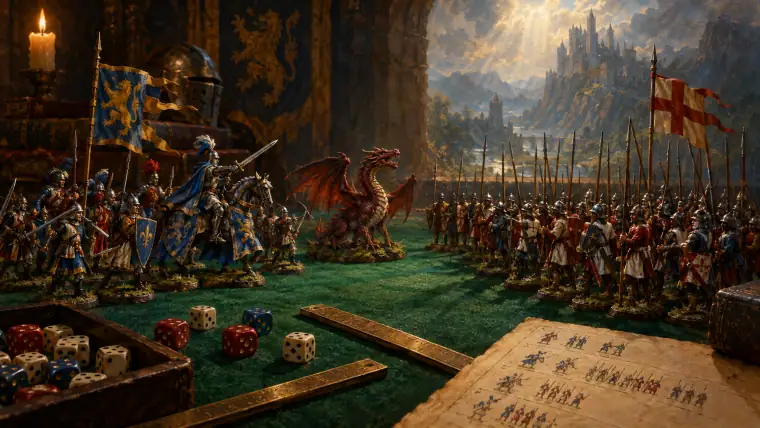
Jon Peterson calls Blackmoor the most significant precursor of Dungeons & Dragons. Its referee-run dungeon, persistent characters and growing power were the model of play that D&D's rules were written to capture.
Overview
Blackmoor is two things: a campaign that Dave Arneson refereed for his friends in Minneapolis–Saint Paul from 1971, and the fictional barony, castle and dungeon in which it took place. It was never designed as a product. It was a game Arneson ran week after week, improvising rules and tables as his players pushed further into the dark. Yet almost everything that separates a roleplaying game from a wargame — a single persistent character, a referee who plays the world, a dungeon mapped room by room, treasure, experience and growing power — was being played at Arneson's table before any of it was printed.
Origins
Arneson was a regular in the Twin Cities miniatures scene and a player and referee of David Wesely's Braunstein games. He was also an early member of the Castle & Crusade Society, the medieval wing of the International Federation of Wargamers run out of Lake Geneva by Gary Gygax. The Society had created a shared imaginary "Great Kingdom," and Arneson took charge of its far northern reaches.
His fanzine Corner of the Table announced the start: "There will be a medieval 'Braunstein' April 17, 1971, at the home of Dave Arneson." It would feature "mythical creatures and a Poker game under the Troll's bridge." His players cast themselves as figures of the Barony of Blackmoor — bandit chiefs, a village priest who became a bishop, a wizard who chose the side of evil. Arneson later described what he was reacting against: a weekend of monster movies on television, several Conan books, popcorn and graph-paper doodles, and fatigue with his rule-bound Napoleonic campaign.
He borrowed the fantasy creatures of Chainmail's Fantasy Supplement but, after a short trial, found its combat table unsatisfying for individual heroes and mixed in his own rules, including ideas adapted from his naval wargaming. The campaign also drew on The Lord of the Rings and the gothic soap opera Dark Shadows.
How it plays
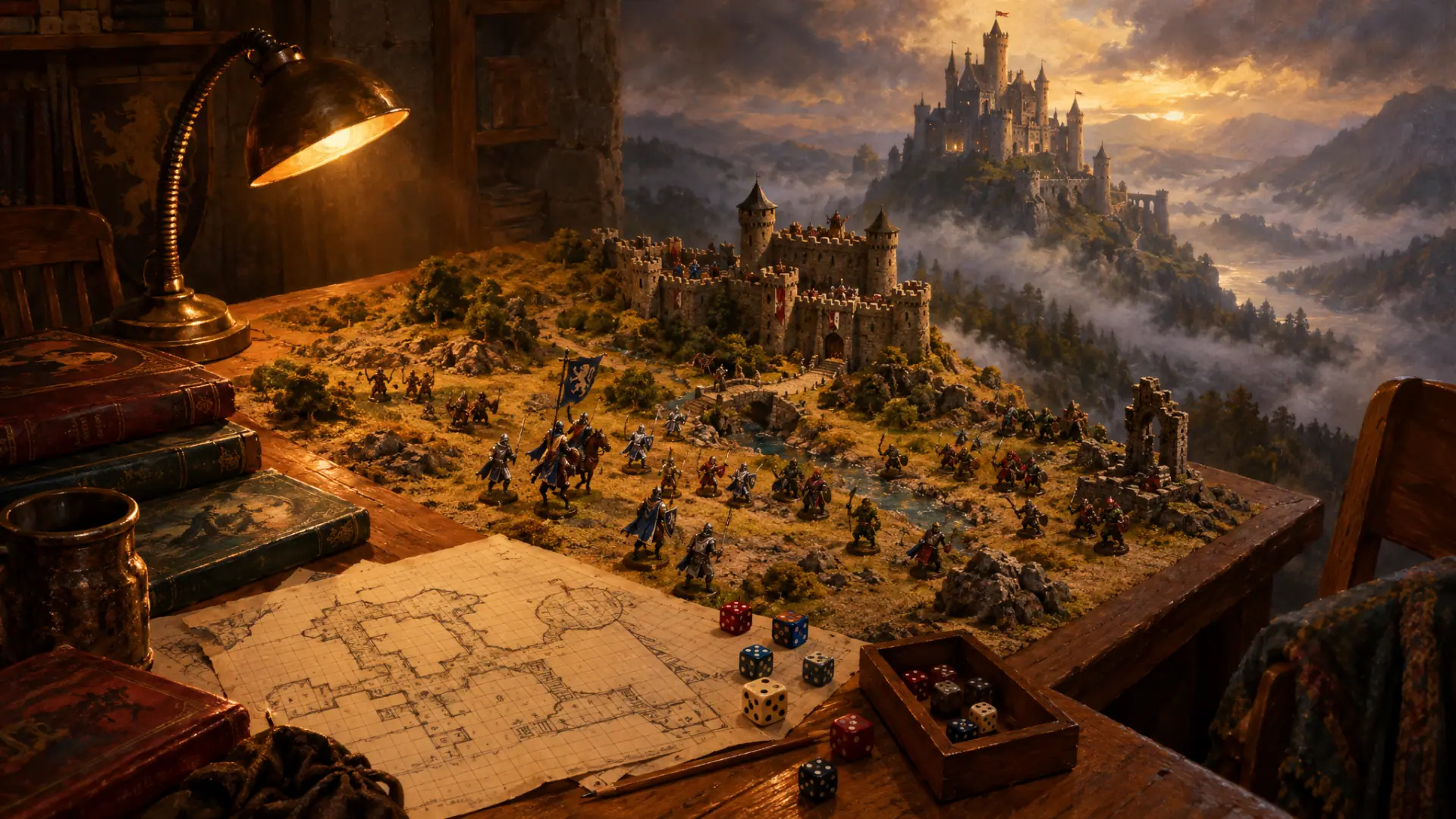
Blackmoor began as a Braunstein with a fantasy veneer, but it quickly became something new. The players' recurring characters quested for magic and gold, escorted caravans and led armies. And they went underground. The dungeons beneath Castle Blackmoor — the castle on the table was a plastic Kibri model kit of Branzoll Castle — became, by 1972, the heart of the game. Arneson, as referee, knew the map; the players knew only what their characters saw and had to describe where they went and what they did. He played every monster and townsperson, rolled in secret, and decided what happened.
This is the essential shape of a roleplaying session. Rather than two sides meeting on an open battlefield, a small cooperating The party explored hidden spaces controlled by a neutral referee, and characters survived from one session to the next, growing in ability. Blackmoor's games are credited with pioneering the tracking of individual Hit points and Armor Class, Experience points and the Dungeon crawl itself. As demand grew, Arneson handed some refereeing to others in his circle.
Reception & impact
In summer 1972 Arneson described the campaign in an article, "Facts about Black Moor," for the Castle & Crusade Society's Domesday Book #13. Soon afterward Gygax wrote asking about his Chainmail modifications, and Arneson offered some of his campaign's "chance tables." Then Arneson and his player David Megarry — who hoped to sell his own board game, Dungeon! — drove to Lake Geneva. Arneson ran the Lake Geneva players through Blackmoor. Rob Kuntz later summarized their adventure: a troll, a fireball, a flight outdoors, four balrogs and sixteen ogres destroyed with a wish from a sword taken from the troll.
The date of that visit is a live historical question. Many accounts, including Jon Peterson's Playing at the World (2012), placed it around November 1972. In Game Wizards (2021) and on his blog, Peterson revised this: correspondence now indicates the visit happened in the second half of February 1973. Either way, Gygax was captivated. He began his own Greyhawk campaign and proposed the collaboration that became Dungeons & Dragons.
Legacy
TSR published Supplement II: Blackmoor in 1975, under Arneson's name. It added new rules, the monk and assassin classes, monsters, and "The Temple of the Frog," the first published adventure scenario meant for other referees to run. The campaign itself received its fullest treatment in The First Fantasy Campaign (Judges Guild, 1977), which preserved maps, price lists and "Facts about Black Moor." In the 1980s Blackmoor was folded into the deep past of TSR's Mystara setting through the DA module series (1986–87), and later revived in Arneson's d20-era Dave Arneson's Blackmoor (2004).
The credit for D&D became a dispute between its two authors (see The Gygax–Arneson Disputes), and for years Blackmoor was treated as a footnote to Gygax's rules. Recent scholarship has pushed it back to the center. Arneson kept playing the original campaign in Minnesota for the rest of his life; he died in 2009.
Marginalia
- Arneson's fanzine billed the first session as "a medieval 'Braunstein'" with "mythical creatures and a Poker game under the Troll's bridge."
- The dungeons lay beneath Castle Blackmoor, represented by a Kibri plastic model kit of Branzoll Castle in Italy.
- Arneson recalled preparing by watching monster movies, reading Conan stories and doodling on graph paper, tired of his rigid Napoleonic campaign.
- Rob Kuntz's first Blackmoor party fought a troll, was fireballed by a magic-user, battled four balrogs and destroyed sixteen ogres with a wish from a captured sword.
- Supplement II: Blackmoor (1975) contained "The Temple of the Frog," the first published roleplaying adventure written for others to run.
- Arneson's campaign mixed in steam power, gunpowder and even a crashed starship — later the basis of the module DA3 City of the Gods (1987).
Quick answers
- When was Blackmoor first released?
- Blackmoor was first released in 1971 (campaign begins); 1975 (TSR supplement); 1977 (The First Fantasy Campaign).
- Who created Blackmoor?
- Blackmoor was made by Dave Arneson (creator and referee).
- Who published or developed Blackmoor?
- TSR, Inc..
- What kind of work is Blackmoor?
- Blackmoor is a campaign setting in the Tabletop Roleplaying Games tradition, released for Home campaign, D&D supplement (1975) and Judges Guild sourcebook (1977).
- Why is Blackmoor important?
- Jon Peterson calls Blackmoor the most significant precursor of Dungeons & Dragons. Its referee-run dungeon, persistent characters and growing power were the model of play that D&D's rules were written to capture.