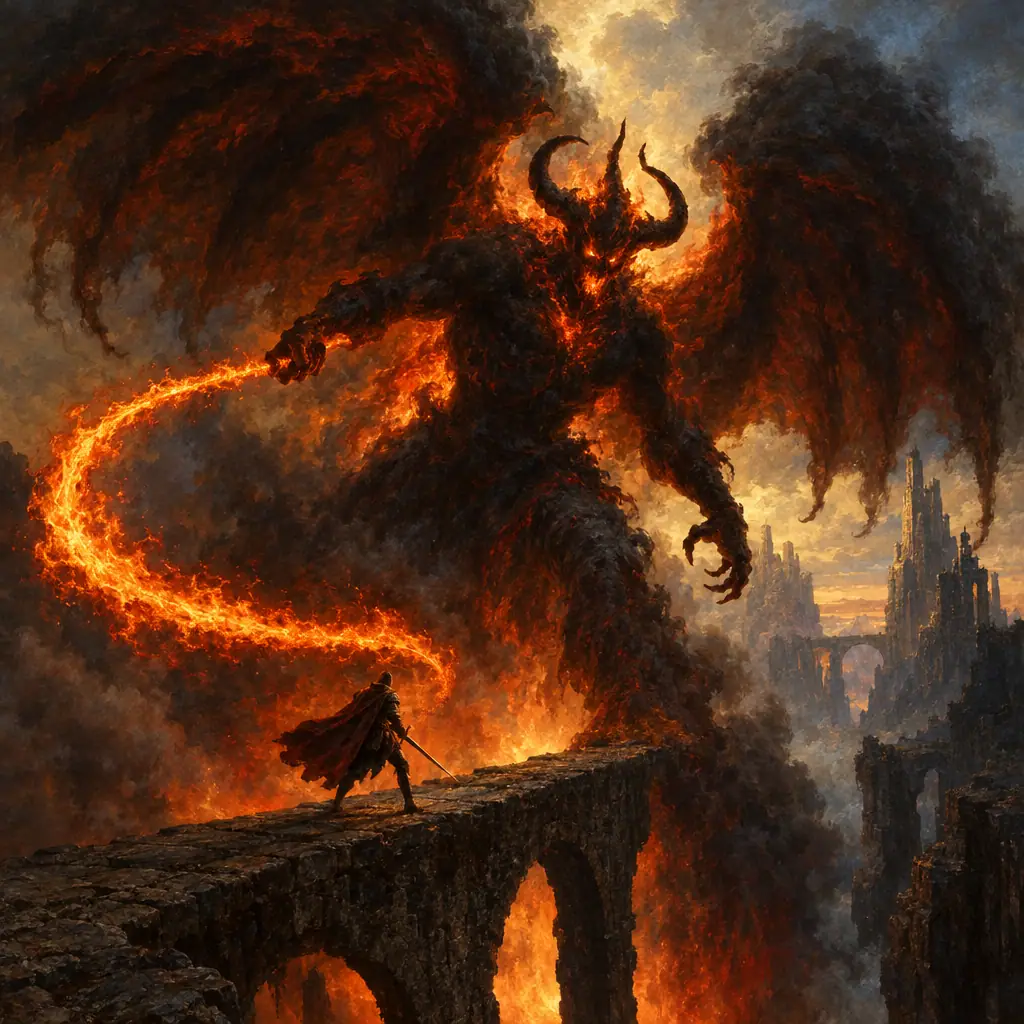
The Balrog is the model for the great fire demon of fantasy games, and its renaming — from Tolkien's word to a figure of Irish myth — is one of the clearest records of how the Tolkien rights dispute reshaped D&D's bestiary.
Origins
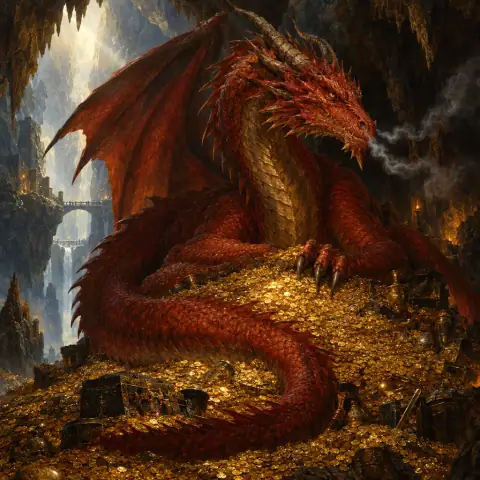
The Balrog is one of the oldest things in Tolkien's imagined world. The name appears in The Fall of Gondolin, which Tolkien drafted in the late 1910s, while recovering from the trench fever he caught on the Somme; there, hosts of Balrogs storm the hidden elven city alongside dragons of iron and fire. His ideas about them changed for fifty years. In the early tales they were numerous and could be slain in their hundreds; in the mature legendarium, described in The Silmarillion, they were few and terrible — Maiar, angelic spirits of fire whom Melkor corrupted before the world was made. Tolkien's final etymology makes Balrog the Sindarin form of Quenya Valarauko, "Demon of Might".
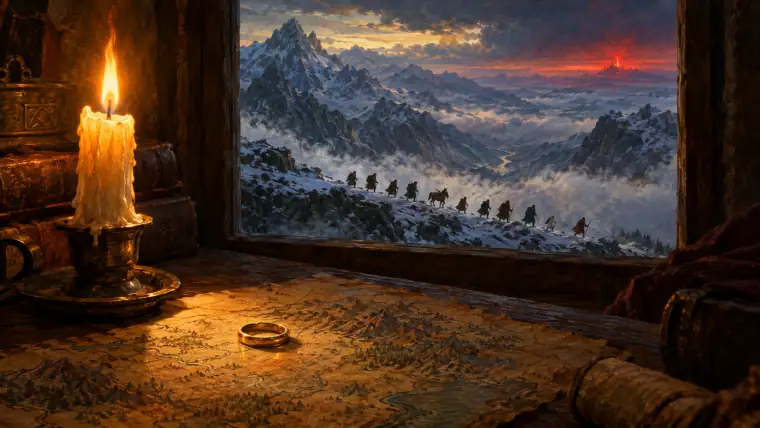
Most readers meet only one. In The Fellowship of the Ring (1954), the first volume of The Lord of the Rings, the Fellowship crossing the Mines of Moria is pursued by a figure of shadow and flame with a sword and a many-thonged whip. Gandalf holds the Bridge of Khazad-dûm against it — "You cannot pass" — and falls with it into the abyss. Whether that Balrog had wings, and whether they were real or only shadow, has been argued by readers ever since. Peter Jackson's film (2001) gave it great wings and made the scene one of the most famous in fantasy cinema.
Into the dungeon
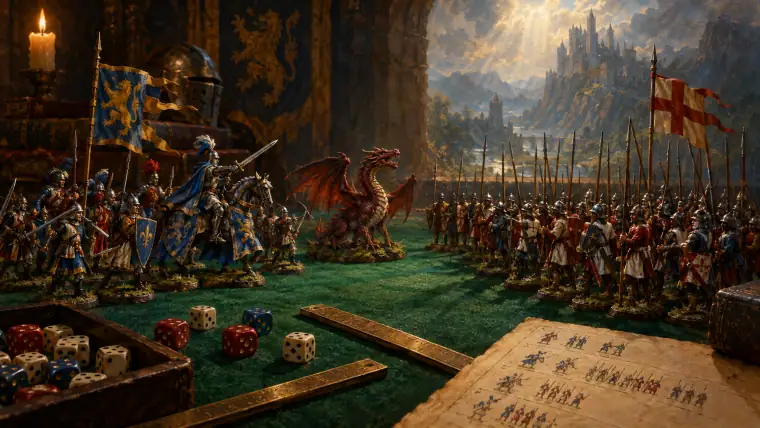
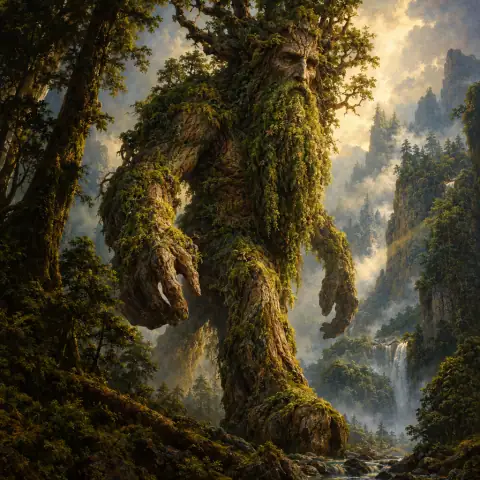
Balrogs were among the first monsters of fantasy gaming. Gary Gygax's Fantasy Supplement to Chainmail (1971) fielded them with hobbits and ents, and when Dave Arneson ran the Lake Geneva players through Blackmoor, Rob Kuntz's party fought four of them. After Tolkien Enterprises objected to TSR's use of Middle-earth names in the later 1970s (see The Tolkien Rights Saga), the balrog vanished from D&D under its own name — but not in substance. Eldritch Wizardry (1976) introduced six numbered types of demon, and the mightiest, Type VI, was a huge, bat-winged, highly intelligent demon plainly modeled on Tolkien's creature. The first-edition Monster Manual (1977) of Advanced Dungeons & Dragons armed it with a large sword and a many-tailed whip, wreathed it in flame, and attached to it the name Balor — borrowed from Balor of the Evil Eye, the one-eyed Fomorian king of Irish myth slain by his grandson Lugh. Later editions made "balor" the name of the whole species.
When the Satanic Panic & D&D led TSR to strip demons from the second edition, the balor returned in the Monstrous Compendium – Outer Planes Appendix (1991) as one of the tanar'ri; third edition restored the word "demon", and the balor has remained a top-tier fiend in every edition since. In fiction, R. A. Salvatore's balor Errtu hounds Drizzt through The Icewind Dale Trilogy from The Crystal Shard (1988) on.
Variations
Computer games kept the original name longer. Richard Garriott's Akalabeth: World of Doom made a Balrog the final monster on Lord British's list; later Ultima games changed it to the Balron. Robert Alan Koeneke's roguelike Moria (1983) ended with the Balrog of Moria, and its descendant Angband (1990) carried the creature into the long Roguelikes tradition. Across these works the fire demon splits into three figures: Tolkien's fallen spirit, tragic and ancient; D&D's balor, a general of the Abyss who explodes in flame when slain; and the generic final boss of a hundred dungeons, a burning giant waiting at the bottom of the map. It is not strictly a monstrosity in any rulebook's sense — Tolkien's Balrogs are spirits and D&D's are fiends — but it has become the archetype of the demon at the end of the dungeon.
Migration
How the creature traveled from story to story.
- 1917The Fall of GondolinTolkien's earliest Middle-earth tale, drafted in the late 1910s, sends Balrogs against the elven city; it was published only in 1984.
- 1954The Fellowship of the RingDurin's Bane meets Gandalf on the Bridge of Khazad-dûm: 'You cannot pass.'
- 1971Chainmail Fantasy SupplementBalrogs join hobbits and ents on the wargame table.
- 1976Supplement III: Eldritch WizardrySix numbered types of demon appear; the mightiest, Type VI, is modeled on the balrog.
- 1977Monster ManualThe Type VI entry now carries the name Balor, borrowed from the one-eyed Fomorian king of Irish myth.
- 1980AkalabethA Balrog is the last monster Lord British sends the player to slay; later Ultimas call it a Balron.
- 1983Moria (roguelike)Robert Alan Koeneke's dungeon game makes the Balrog of Moria its final foe.
- 1988The Crystal ShardR. A. Salvatore's Errtu, a balor, begins a long feud with Drizzt Do'Urden.
Marginalia
- The name Balrog appears in The Fall of Gondolin, one of Tolkien's earliest Middle-earth texts, written around 1917–18.
- Tolkien's final etymology makes Balrog the Sindarin form of Quenya Valarauko, 'Demon of Might'.
- Whether Balrogs have wings — and can fly — is one of the longest-running arguments in Tolkien fandom; the text is ambiguous.
- Rob Kuntz's first party in Arneson's Blackmoor fought four balrogs in a single adventure.
- The 1977 Monster Manual's Type VI demon wields a large sword and a many-tailed whip to drag foes into its flames.
- Balor, the source of D&D's new name, was the one-eyed king of the Fomorians in Irish myth, slain by his grandson Lugh.
Quick answers
- Where does the Balrog / Balor come from?
- Tolkien's legendarium (The Fall of Gondolin, drafted c. 1917); renamed 'balor' by D&D after Irish myth.
- When did the Balrog / Balor first appear?
- 1917, in The Fall of Gondolin.
- How did the Balrog / Balor get into games?
- Key appearances: Chainmail Fantasy Supplement (1971), Monster Manual (1977) and Akalabeth (1980).
- Why is the Balrog / Balor significant?
- The Balrog is the model for the great fire demon of fantasy games, and its renaming — from Tolkien's word to a figure of Irish myth — is one of the clearest records of how the Tolkien rights dispute reshaped D&D's bestiary.