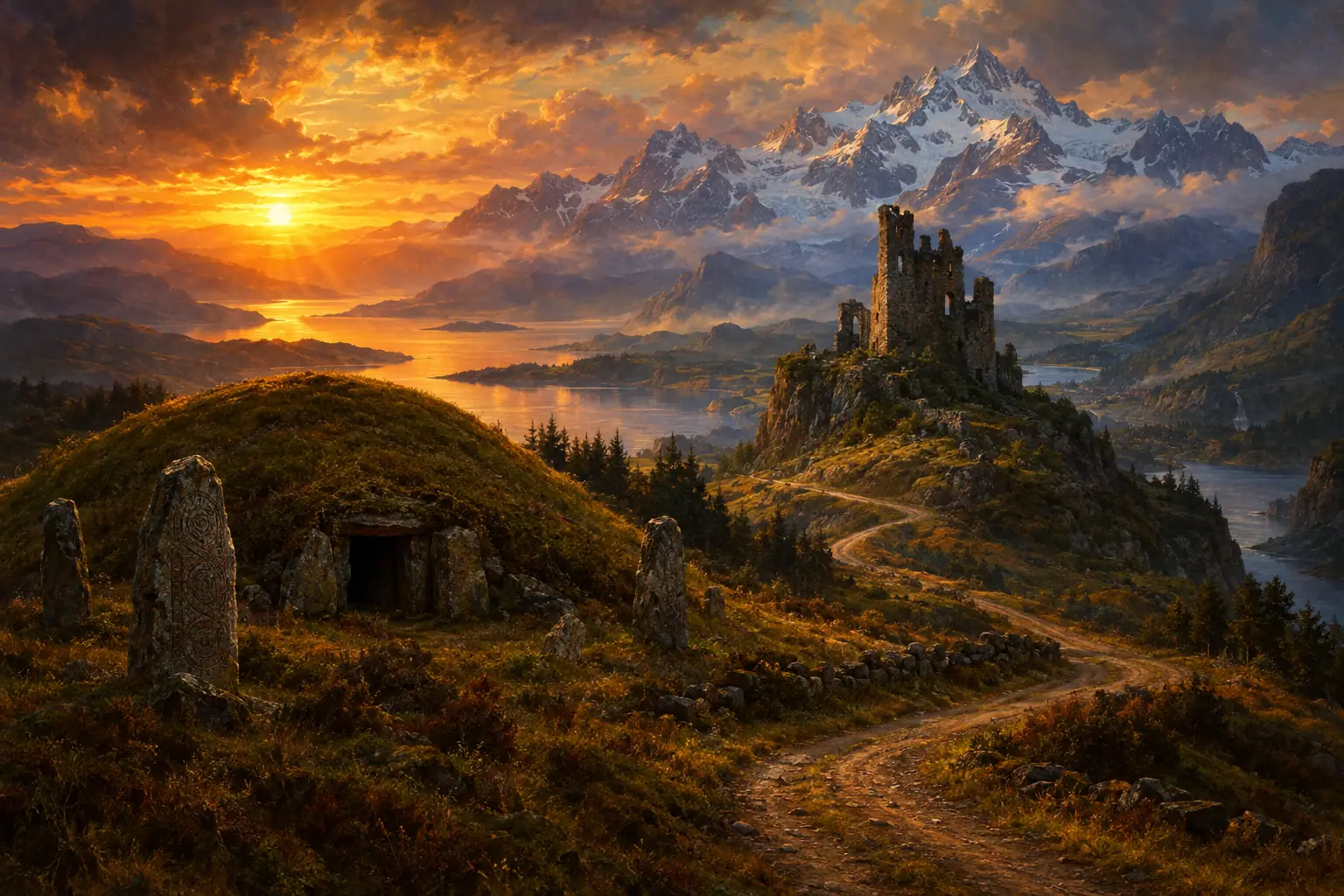
The Tolkien Road
From Beowulf's barrow to Baldur's Gate
J. R. R. Tolkien was a professor of Old English before he was a novelist, and his fiction grew from what he taught. This tour follows his road in both directions: backward into the poems he loved, and forward into the games that inherited his world.
The first stops are the old North. Beowulf gives us the dragon in the barrow, woken by a thief and furious at the theft of one cup. The Eddas give us the dwarves, their names copied into The Hobbit, and the elves of Norse myth. William Morris, in The Well at the World's End, shows how a whole invented world could carry a long romance. Then The Inklings in Oxford, the friends who listened to The Lord of the Rings as it was written.
The middle of the tour is Middle-earth itself, and the moment in 1965 when paperbacks carried it into American dorm rooms and the slogan "Frodo Lives!" onto the walls. Among the readers were wargamers. In Chainmail and then the original Dungeons & Dragons, they turned hobbits, orcs, ents and balrogs into rules.
The last stops show the road dividing. The Tolkien Rights Saga forced D&D to rename its borrowings, which is why halflings and treants populate a thousand games. Licensed games like Middle-earth Role Playing took the other path and paid for the names. And Baldur's Gate, the stop at the end of this road, shows how completely Tolkien's creatures had become the common furniture of fantasy, recognizable on the Sword Coast even without his name on the box.
Take the tour slowly. Each stop is a place where an old story was picked up, changed, and handed on.
- 1BeowulfEpic poem · c. 700
Tolkien's 1936 lecture on this poem changed how scholars read it, arguing that its monsters were the point. Here is the dragon woken by a stolen cup, a model for Smaug and for every dragon disturbed by a thief. Keep the monster-in-the-barrow in mind.
- 2The EddasMyth cycle · 1220
The Norse cosmos, and a list of dwarf names in the Völuspá that supplied Thorin, Fili, Kili, Bombur and even Gandalf. Tolkien read Old Norse from his student days, and the Eddas' elves, dwarves and doom-haunted gods run under Middle-earth like bedrock.
- 3The Well at the World's EndNovel · 1896
William Morris's prose romances of the 1890s were set in wholly invented worlds, with no dream-frame or portal. Tolkien and Lewis both read Morris closely. Notice the archaic diction and the long road through an imagined landscape, two habits Middle-earth inherited.
- 4The InklingsCommunity · c. 1933–1949
In Oxford rooms and a pub back room, a circle of friends heard chapters of The Lord of the Rings read aloud through the 1940s. C. S. Lewis was Tolkien's most important early reader and encourager. This is where the book survived its long composition.
- 5The HobbitNovel · 1937
Published in 1937 and sold out by Christmas, The Hobbit fused the barrow-dragon of Beowulf and the dwarves of the Edda into a children's adventure. It also gave fantasy its map. Its burglar and his hired party are the ancestors of every adventuring party.
- 6The Lord of the RingsNovel · 1954–1955
The 1954–55 epic turned philology into a world: languages, histories, genealogies and appendices. It is the source of the fantasy races as games know them, and of the ranger, the fellowship and the Dark Lord. Everything further down this road borrows from it, with or without permission.
- 7"Frodo Lives!"Phenomenon · 1965
Cheap 1965 paperbacks made the book a campus and counterculture phenomenon; the slogan appeared as graffiti and on buttons. The readers of those paperbacks included the wargamers of the Midwest.
- 8ChainmailWargame · 1971
In 1971 a Fantasy Supplement to a medieval wargame let players field Tolkien's heroes, wizards, elves and dragons. Its roster included hobbits and orcs beside the wizards. Middle-earth's battles had become rules.
- 9Dungeons & DragonsTabletop RPG · 1974
The 1974 game offered hobbits as a player race and stocked its dungeons with orcs, ents and balrogs. The first great adoption of Tolkien by games was an unlicensed one, and it would not stay that way for long.
- 10The Tolkien Rights SagaControversy · 1969
Legal pressure in the 1970s, usually attributed to Saul Zaentz's Tolkien Enterprises (accounts differ on the date), is why D&D's hobbits became halflings and its ents treants. Here the road forks: games that renamed Tolkien's creatures, and games that paid for the real names.
- 11Middle-earth Role PlayingTabletop RPG · 1984–1999
The licensed branch. Iron Crown's 1984 game, set in the age of the Witch-king, gave players Middle-earth itself, and its maps and Angus McBride paintings became many players' picture of Arda.
- 12Baldur's GateComputer RPG · 1998
The unlicensed branch arrives at its destination. BioWare's 1998 adventure on the Forgotten Realms' Sword Coast has no hobbits, only halflings, dwarves, elves and a quest that began, some seventy years earlier, in an Oxford study. Tolkien's influence reached here through the D&D rules.