Tolkien defined modern high fantasy and the secondary world. Dungeons & Dragons borrowed his races and monsters so directly that his estate's lawyers forced renamings, and his Middle-earth has been adapted into games for more than four decades.
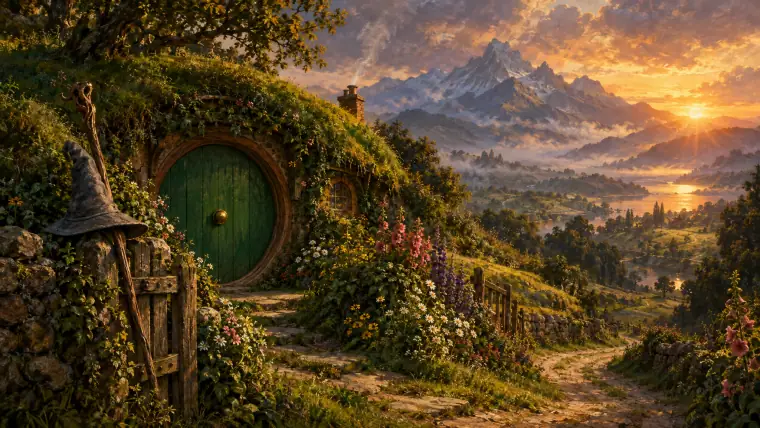
In a hole in the ground there lived a hobbit.
Life
John Ronald Reuel Tolkien was born on 3 January 1892 in Bloemfontein, where his English father managed a bank. Taken to England at three, he lost his father to rheumatic fever in 1896 and his mother, Mabel, who had converted to Catholicism, in 1904. He and his brother were raised as wards of Father Francis Morgan of the Birmingham Oratory. At King Edward's School, Birmingham, Tolkien discovered Gothic, Old English and Finnish, formed a close-knit literary society with three friends, and met Edith Bratt, whom he married in 1916.
He took a first in English at Exeter College, Oxford, and went to war as a signals officer with the Lancashire Fusiliers, serving at the Somme until trench fever invalided him home in late 1916. Two of his three closest friends were killed. In convalescence he began "The Book of Lost Tales," the first form of the mythology that became The Silmarillion. After work on the Oxford English Dictionary and a professorship at Leeds, he returned to Oxford as Rawlinson and Bosworth Professor of Anglo-Saxon in 1925, moving to the Merton chair of English Language and Literature in 1945. His 1936 lecture "Beowulf: The Monsters and the Critics" transformed the study of the poem. With C. S. Lewis he was at the heart of The Inklings, and his son Christopher joined them. Retiring in 1959, he lived to see his books become a global phenomenon, was appointed CBE in 1972, and died in Bournemouth on 2 September 1973.
Work
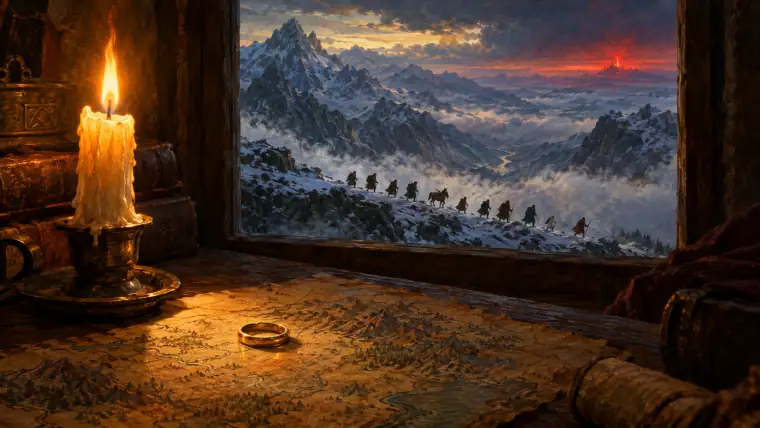
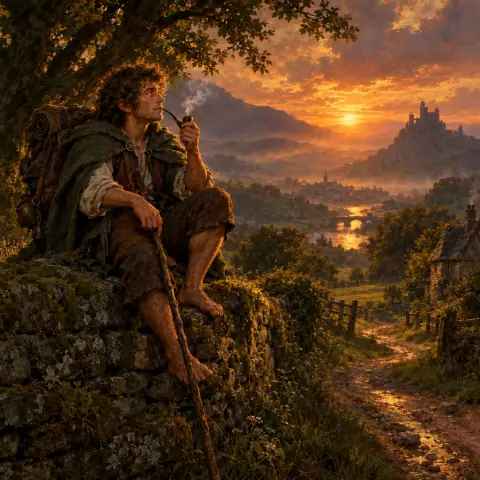
Tolkien said his stories grew out of his invented languages, which needed a history and a people to speak them. The Hobbit (1937), begun as a story for his children, sent the comfortable Bilbo Baggins with thirteen dwarves — named from the Norse dwarf-list preserved by Snorri Sturluson — to reclaim a treasure from the dragon Smaug. Its success led his publisher, George Allen & Unwin, to ask for a sequel. Twelve years of writing later came The Lord of the Rings (1954–55), a vast romance of the War of the Ring set against the deep history of Middle-earth, with appendices, maps and languages that made it feel less invented than recovered.
In the essay "On Fairy-Stories" (lecture 1939, published 1947) Tolkien set out his theory of the Secondary world and coined "Eucatastrophe," the sudden joyous turn. Its insistence on coherent Worldbuilding became the defining principle of High / Epic Fantasy.
Legacy
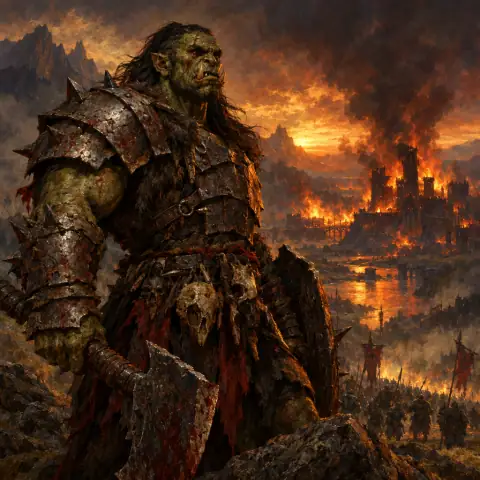
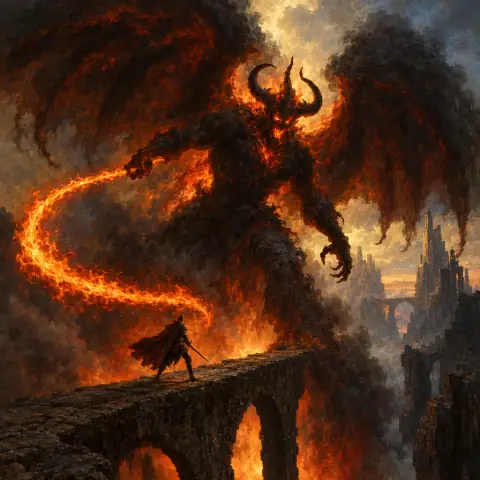
Tolkien's influence on fantasy is total, and on roleplaying games it is foundational, if long disputed. The 1974 Dungeons & Dragons offered hobbits, ents, balrogs and orcs alongside elves and dwarves; after a cease-and-desist letter, dated by most accounts to 1977, from the company holding film and merchandising rights, TSR renamed hobbits and ents as halflings and treants, and the fiery Balrog / Balor was later reborn as the balor, a towering demon of flame and whip. Gary Gygax listed The Hobbit and the "Ring Trilogy" on Appendix N — but in Dragon #95 (March 1985) he argued that Tolkien's effect on the game was superficial, the familiar races having been included largely to please the many Tolkien fans among players. Many historians regard that as understated, since the booming 1960s paperback readership that The Ace Paperback Affair and "Frodo Lives!" reflect was the audience D&D found.
Direct adaptations followed. Iron Crown Enterprises took a tabletop license in 1982 and launched Middle-earth Role Playing in 1984; Melbourne House's text adventure The Hobbit (1982) was a hit on the ZX Spectrum; Turbine's MMO The Lord of the Rings Online launched in 2007; and The One Ring Roleplaying Game arrived in 2011. On screen, Rankin/Bass's The Hobbit, Ralph Bakshi's 1978 film and Peter Jackson's The Lord of the Rings film trilogy carried Middle-earth to billions. The complicated ownership of those rights is its own story, told in The Tolkien Rights Saga.
Marginalia
- Tolkien was born in Bloemfontein in 1892; his father died when he was four and his mother when he was twelve, leaving him the ward of a Catholic priest.
- He fought at the Battle of the Somme in 1916 as a signals officer; by 1918 all but one of his closest school friends had been killed.
- He was Rawlinson and Bosworth Professor of Anglo-Saxon at Oxford from 1925 and Merton Professor of English Language and Literature from 1945 to 1959.
- The Hobbit was published by George Allen & Unwin on 21 September 1937; The Lord of the Rings followed in three volumes in 1954–55.
- After a cease-and-desist in the 1970s, D&D renamed its hobbits 'halflings' and its ents 'treants'; the balrog later resurfaced as the demonic 'balor'.
- Gygax listed The Hobbit and the 'Ring Trilogy' on Appendix N, but in Dragon #95 (1985) he argued Tolkien's influence on D&D was superficial.
Quick answers
- Who was J. R. R. Tolkien?
- An Oxford philologist who invented languages, then a world for them to be spoken in — and, with The Hobbit and The Lord of the Rings, supplied the elves, dwarves, orcs and halflings of every roleplaying game since.
- When was J. R. R. Tolkien born?
- J. R. R. Tolkien was born in 1892 in Bloemfontein, Orange Free State (now South Africa) and died in 1973.
- What is J. R. R. Tolkien known for?
- J. R. R. Tolkien is best known for The Hobbit, The Lord of the Rings and The Silmarillion.
- Why does J. R. R. Tolkien matter to fantasy and games?
- Tolkien defined modern high fantasy and the secondary world. Dungeons & Dragons borrowed his races and monsters so directly that his estate's lawyers forced renamings, and his Middle-earth has been adapted into games for more than four decades.