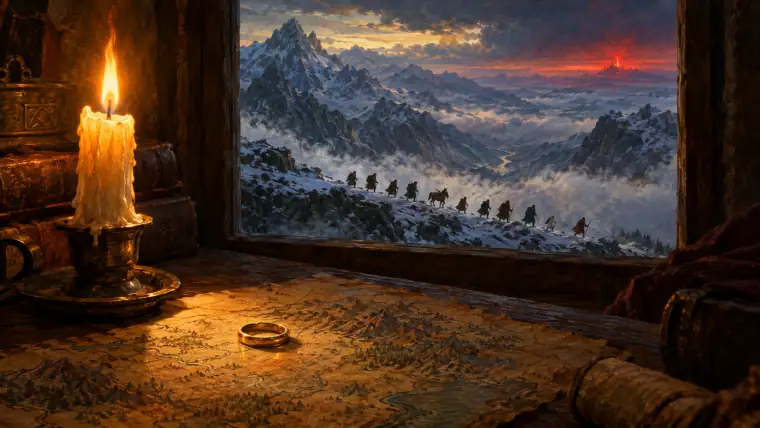
Without Allen & Unwin there would be no Hobbit in 1937, no sequel request that became The Lord of the Rings, and no Silmarillion in 1977: it was the first commercial home of the modern fantasy canon.
History
The firm's roots go back to 1871, when George Allen, an engraver, began publishing the works of John Ruskin with the critic's backing. After Allen died in 1907 his sons carried on, merging with Swan Sonnenschein in 1911. The company that fantasy readers know was born on 4 August 1914, when a young publisher named Stanley Unwin bought a controlling interest and added his name. From offices in Museum Street, near the British Museum in London, George Allen & Unwin built a serious, eclectic list: Bertrand Russell, Arthur Waley's translations from Chinese, Thor Heyerdahl, and, later, Roald Dahl.
Its most famous decision came in 1936. Susan Dagnall, a member of the staff, heard about a children's story by an Oxford professor of Anglo-Saxon and borrowed the typescript. Stanley Unwin handed it to his ten-year-old son, Rayner, who was paid a shilling per reader's report, and the boy judged it good. The Hobbit was published on 21 September 1937 with Tolkien's own maps and drawings; the 1,500-copy first printing sold out by December. Unwin at once asked for a sequel. Tolkien offered the mythology that became The Silmarillion; the firm's reader found it baffling, and Unwin asked for more hobbits instead. In December 1937 Tolkien began "a new Hobbit."
That book took twelve years. When it was done, Tolkien spent 1949–52 trying to place it, with The Silmarillion, at Collins, then returned to Allen & Unwin. Rayner Unwin, now grown and working in the firm, wrote to his father that they might lose £1,000 on it; Sir Stanley replied that if Rayner thought it a work of genius, then they might lose a thousand pounds. The company offered no advance. Instead Tolkien took a share of the profits once costs were covered, a deal that proved one of the best an author ever made. Paper was costly and the risk large, so the firm divided The Lord of the Rings into three volumes: The Fellowship of the Ring (29 July 1954), The Two Towers (11 November 1954) and The Return of the King (20 October 1955).
The firm guarded its author through the 1965 American copyright fight (see The Ace Paperback Affair), in which Tolkien revised the text to secure a new U.S. copyright for Ballantine's authorized paperbacks. At home, Allen & Unwin's Unwin Books paperbacks and its 1970s Unicorn list, which added Lord Dunsany and other fantasists to the Tolkien titles, fed the boom. After Tolkien's death in 1973 it published Christopher Tolkien's edition of The Silmarillion on 15 September 1977, followed by Unfinished Tales (1980).
Rayner Unwin retired at the end of 1985. In 1986 the firm merged with Bell & Hyman to form Unwin Hyman, and in 1990, over Rayner Unwin's objections as its largest shareholder, it was sold to HarperCollins, which has published Tolkien in Britain ever since. The Australian subsidiary, founded in 1976, bought itself out and still trades as Allen & Unwin.
Notable work
Allen & Unwin's fantasy fame rests on Tolkien: The Hobbit (1937), Farmer Giles of Ham (1949), The Lord of the Rings (1954–55), The Adventures of Tom Bombadil (1962), Smith of Wootton Major (1967) and the posthumous Silmarillion (1977). Outside fantasy it was known for philosophy, politics and translation, a list whose seriousness lent the Oxford professor's romance a certain dignity.
Legacy
The house's influence is almost impossible to overstate. Its caution produced the three-volume format that helped make the trilogy the customary shape of epic fantasy. Its request for a sequel produced the book that later inspired Gygax's hobbits and orcs, Middle-earth Role Playing and every quest since. And the Unwin family's long loyalty to one difficult, perfectionist author is a reminder that the fantasy genre began with a publisher willing to wait.
Marginalia
- Stanley Unwin acquired control of George Allen & Co. on 4 August 1914, the day Britain entered the First World War.
- Unwin paid his ten-year-old son Rayner a shilling a report to read children's manuscripts; Rayner's verdict on The Hobbit decided its fate.
- The Hobbit appeared on 21 September 1937 in a first printing of 1,500 copies, sold out by December.
- Asked for a sequel, Tolkien offered his mythology; the firm declined it and asked for more about hobbits.
- Rayner Unwin reckoned The Lord of the Rings might lose £1,000; his father replied that if Rayner thought it a work of genius, they could risk it. Tolkien took a profit share, not an advance.
- The firm split The Lord of the Rings into three volumes (1954–55) to spread the cost and the risk.
- Rayner Unwin, the largest shareholder, opposed the 1990 sale of Unwin Hyman to HarperCollins, which went ahead over his objections.
Quick answers
- What was George Allen & Unwin?
- The London house that took The Hobbit on a ten-year-old's recommendation, gambled on The Lord of the Rings with a profit-sharing deal, and published Tolkien for more than half a century.
- When was George Allen & Unwin founded?
- George Allen & Unwin was founded in 1914 and was based in London (Museum Street); it closed in 1990.
- Who founded George Allen & Unwin?
- Sir Stanley Unwin, who bought a controlling interest in George Allen & Co. in 1914; the older firm had been founded by George Allen with John Ruskin's backing in 1871.
- What is George Allen & Unwin known for?
- The Hobbit, The Lord of the Rings and The Silmarillion.
- What happened to George Allen & Unwin?
- Merged with Bell & Hyman as Unwin Hyman in 1986 and sold to HarperCollins in 1990; the former Australian branch continues independently as Allen & Unwin.