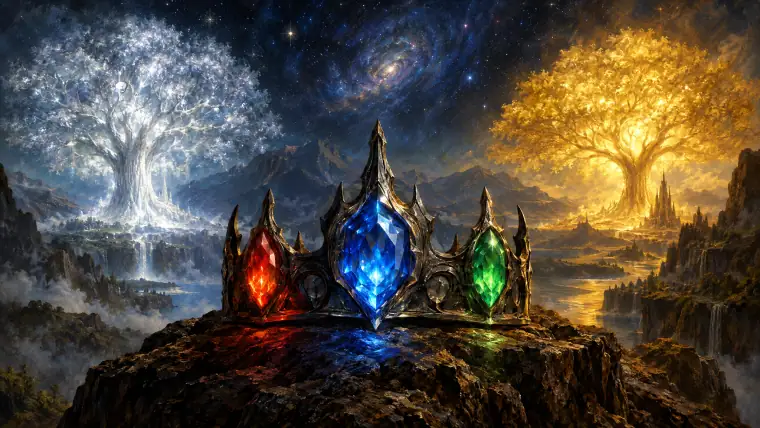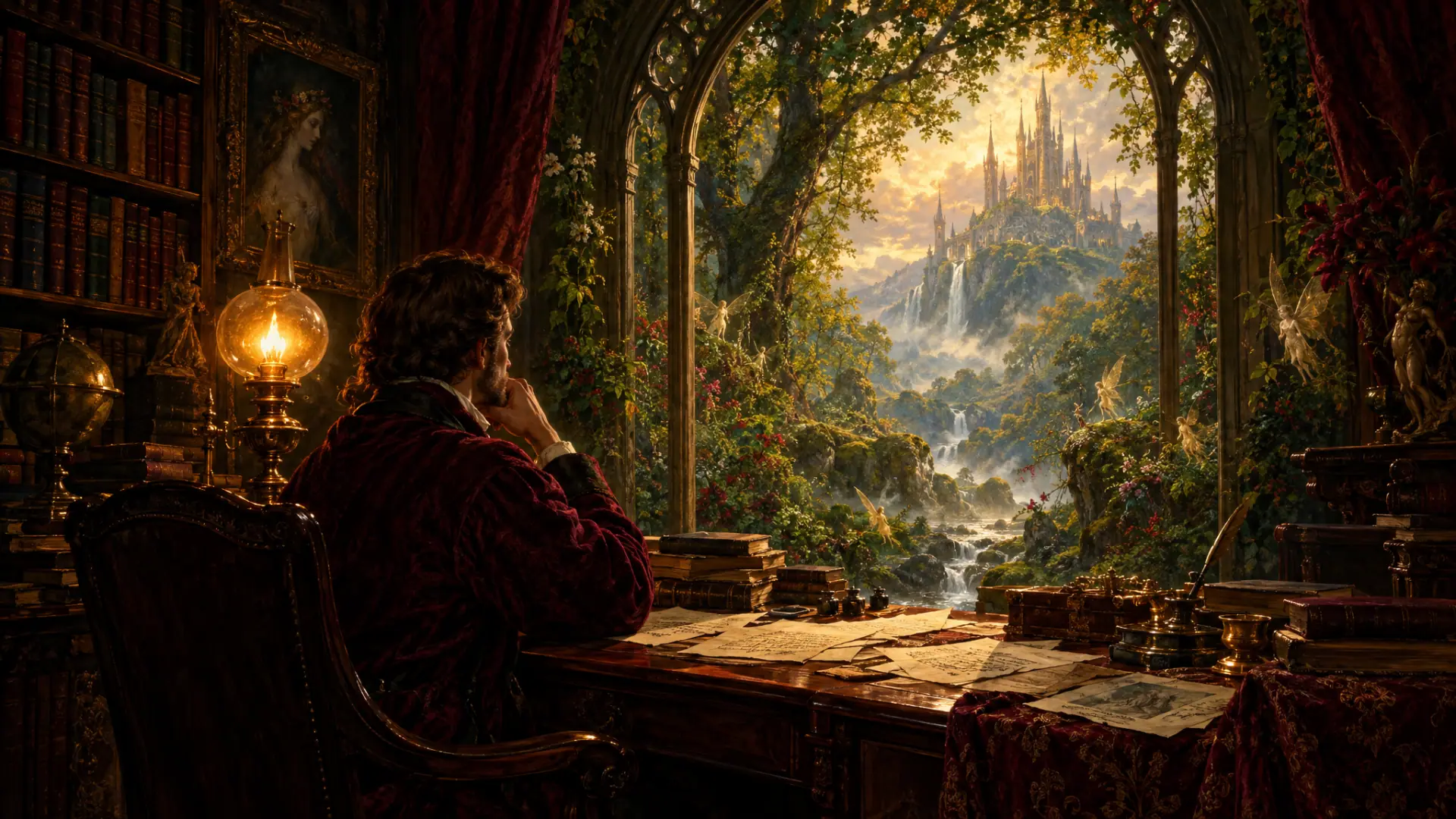
Dunsany created one of the first wholly invented mythologies in modern fiction and a lyrical, ironic style that shaped weird fiction and high fantasy alike. Gygax named him on Appendix N.
Life
Edward John Moreton Drax Plunkett was born in London on 24 July 1878 and became the 18th Baron of Dunsany in 1899, inheriting Dunsany Castle in County Meath, one of the oldest continuously inhabited houses in Ireland. He was educated at Cheam, Eton and the Royal Military College at Sandhurst, served with the Coldstream Guards in the Second Boer War, and spent much of his life hunting, shooting, playing cricket and writing — famously with a quill pen, often in a single draft.
He served again in the First World War as a captain in the Royal Inniskilling Fusiliers. During the Easter Rising of 1916 he drove into Dublin to offer help, and was shot in the head; he survived. Dunsany was also a formidable chess player: he was president of the Irish Chess Union, invented a lopsided variant now called Dunsany's Chess, and drew with José Raúl Capablanca in a simultaneous exhibition. He was an early patron of the Irish Literary Revival, knew Yeats and Lady Gregory, and wrote plays for Dublin's Abbey Theatre, and in 1940 he took up the Byron chair of English literature at the University of Athens. He died in Dublin on 25 October 1957.
Work
Dunsany's debut, The Gods of Pegāna (1905), was something new: a bible for a mythology he had invented, with MĀNA-YOOD-SUSHĀĪ, the god who sleeps and whose dreams are the world, and a drummer who must beat forever lest he wake. Time and the Gods (1906), The Sword of Welleran (1908), A Dreamer's Tales (1910) and The Book of Wonder (1912) followed, many illustrated by the eerie pen drawings of Sidney Sime. These short tales mix King James cadence with deadpan irony. "The Fortress Unvanquishable, Save for Sacnoth" is a hero's assault on a sorcerer's stronghold; "The Hoard of the Gibbelins" tells of a knight who breaks into a treasure-house guarded by man-eating creatures, and ends with a joke at the expense of anyone expecting a happy ending. Read today, it looks remarkably like a Dungeon crawl in miniature.
His best-known novel, The King of Elfland's Daughter (1924), tells of a lord of Erl who marries a princess from Elfland, and of the uneasy border between the mortal fields and a timeless, perilous faerie. The Charwoman's Shadow (1926) and dozens of plays followed, as did the long-running Jorkens tall tales, told by a club bore who has been everywhere. His output ran to more than ninety books in his lifetime.
Legacy
Dunsany is one of the great fountainheads of both Weird Fiction and High / Epic Fantasy. H. P. Lovecraft heard him lecture in Boston in 1919 and spent the next several years writing Dunsanian dream fantasies — "The White Ship," "The Doom That Came to Sarnath" and the rest of what became his Dream Cycle — and Clark Ashton Smith and the Weird Tales circle inherited the same jeweled vocabulary. Tolkien, Ursula K. Le Guin and later Neil Gaiman all acknowledged his influence, and Lin Carter brought him back into print in the Ballantine Adult Fantasy Series series: The King of Elfland's Daughter, forgotten for decades, was the series' second volume in June 1969 and has been regarded as a classic ever since.
For games, Dunsany's significance is precise: he is one of the authors named on Gygax's Appendix N, the "Inspirational and Educational Reading" list in the 1979 Dungeon Masters Guide for Advanced Dungeons & Dragons. Gygax listed him without singling out a title. There is no single rule or monster that can be traced to Dunsany with confidence, but his imprint is visible in the texture of early D&D — in invented gods with invented names, in treasure-houses guarded by things that eat intruders, and in the ironic, cautionary humor of stories where the adventurer does not always get the loot. Through Lovecraft, his invented pantheon style also passed into the Cthulhu Mythos and thus into Chaosium's Call of Cthulhu. The debt is still being paid: Gavin Norman of Necrotic Gnome, publisher of Old-School Essentials, has reportedly cited The King of Elfland's Daughter as an inspiration for his fairy-haunted forest setting Dolmenwood.
Marginalia
- His first book, The Gods of Pegāna (1905), invented an entire pantheon from scratch and was illustrated by Sidney Sime, who worked with him for decades.
- He was wounded in the head by a bullet during the 1916 Easter Rising in Dublin, while serving as a British Army officer.
- A strong chess player, he once drew with José Raúl Capablanca in a simultaneous exhibition and was president of the Irish Chess Union.
- H. P. Lovecraft heard him lecture in Boston in 1919 and afterward wrote a string of 'Dunsanian' dream stories.
- He published more than ninety books in his lifetime: stories, novels, plays, poems and memoirs.
- Gygax listed 'Dunsany, Lord' in Appendix N of the 1979 Dungeon Masters Guide, without naming specific books.
Quick answers
- Who was Lord Dunsany?
- An Anglo-Irish peer who wrote with a quill in a castle, invented his own gods in 1905 and taught Lovecraft, Tolkien and Le Guin that fantasy could sound like scripture.
- When was Lord Dunsany born?
- Lord Dunsany was born in 1878 in London, England and died in 1957.
- What is Lord Dunsany known for?
- Lord Dunsany is best known for The King of Elfland's Daughter.
- Why does Lord Dunsany matter to fantasy and games?
- Dunsany created one of the first wholly invented mythologies in modern fiction and a lyrical, ironic style that shaped weird fiction and high fantasy alike. Gygax named him on Appendix N.