Vance's The Dying Earth (1950) is the source of 'Vancian magic', the fire-and-forget spellcasting at the heart of D&D for decades. Gygax named him among AD&D's most immediate influences.
Life
John Holbrook Vance was born in San Francisco on 28 August 1916 and grew up largely on his grandfather's ranch near Oakley in the Sacramento–San Joaquin delta, reading Oz, Burroughs, Lord Dunsany and the pulps. The Depression interrupted his schooling; he worked at a cannery and a gold dredge before spending six years at the University of California, Berkeley, drifting through mining engineering, physics, journalism and English. During the war he worked as an electrician at the Pearl Harbor navy yard, leaving shortly before the Japanese attack, and then, having memorized the eye chart to get past his poor vision, served in the Merchant Marine.
After the war he worked as a carpenter and at other trades while he sold stories. In 1946 he married Norma Ingold, who typed and edited his manuscripts for the rest of her life, and the couple traveled the world — often for months at a time, often on a shoestring — gathering the landscapes and customs that fill his books. At home in the Oakland hills, Vance built much of his own house, played jazz on cornet, ukulele and kazoo, and built a houseboat with his friends Frank Herbert and Poul Anderson. Glaucoma left him legally blind from the 1980s, but he kept writing with the help of special software and Norma's assistance. He died at home in Oakland on 26 May 2013, aged 96.
Work
The Dying Earth (1950), published as a cheap paperback by Hillman, was a collection of linked stories set in the unimaginably distant future, when the sun is a guttering red ember and Earth is a haunted place of ruined cities, decadent sorcerers and bizarre creatures bred in vats. Its magicians — Turjan of Miir, Mazirian the Magician — practice a magic that is part science, part scholarship: spells are complex formulas that the mind can hold only a few at a time, and each one vanishes from memory when used. Spells bear grandiloquent names such as the Excellent Prismatic Spray and the Spell of Forlorn Encystment.
Vance returned to the setting with The Eyes of the Overworld (1966), a picaresque about the unscrupulous rogue Cugel the Clever, then Cugel's Saga (1983) and Rhialto the Marvellous (1984). Beyond the Dying Earth, he wrote dozens of science fiction novels celebrated for their invented cultures, ironic dialogue and elaborate diction — the Demon Princes and Planet of Adventure series, The Dragon Masters (Hugo, 1963) and The Last Castle (Hugo and Nebula) — as well as mysteries, one of which, The Man in the Cage, won an Edgar Award. His late fantasy trilogy Lyonesse (1983–89) retold the legendary lands off Cornwall. He was named an SFWA Grand Master in 1997, and his memoir This Is Me, Jack Vance! won a Hugo in 2010.
Legacy
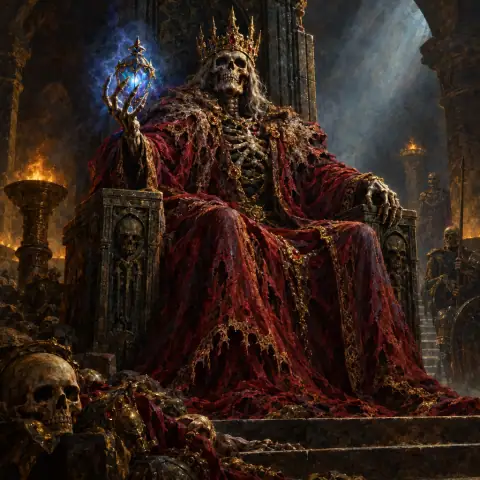
For roleplaying games, Vance's legacy is a single, enormous idea. Gary Gygax took the Dying Earth's memorize-and-forget magic as the model for spellcasting in Dungeons & Dragons, and the approach — a magic-user preparing a limited set of spells each day, each lost once cast — became known among players simply as Vancian magic. It governed wizards through every edition of D&D into the twenty-first century and passed into computer games built on its rules, from the Gold Box series to Baldur's Gate. Spells such as prismatic spray carry Vancian names. In Appendix N, Gygax listed The Eyes of the Overworld and The Dying Earth and named Vance among the "most immediate influences" on AD&D. The lich-god Vecna, first seen in the 1976 supplement Eldritch Wizardry as the source of two terrible artifacts, bears a name widely recognized as an anagram of Vance's own.
The Dying Earth was licensed directly in Pelgrane Press's Dying Earth Roleplaying Game (2001), designed by Robin Laws, and the setting inspired the tribute anthology Songs of the Dying Earth (2009). Cugel, the amoral, ingenious rogue who is always one scheme from disaster, remains the patron saint of the self-interested adventurer at every gaming table.
Marginalia
- Vance began writing the Dying Earth stories while serving as a merchant seaman during World War II; the book was published by Hillman in 1950.
- To get into the Merchant Marine despite poor eyesight, he memorized the eye chart.
- In The Dying Earth, magicians can hold only a few spells in their minds at once, and forget each spell as soon as it is cast — the model for D&D's wizards.
- The D&D arch-lich Vecna, introduced in 1976 via the Hand and Eye of Vecna artifacts, is widely noted as an anagram of 'Vance'.
- He won Hugo Awards for The Dragon Masters and The Last Castle, an Edgar Award for the mystery The Man in the Cage, and a Hugo for his 2009 memoir This Is Me, Jack Vance!
- Gygax listed The Eyes of the Overworld and The Dying Earth on Appendix N.
Quick answers
- Who was Jack Vance?
- A sardonic Californian stylist whose Dying Earth, written aboard a wartime merchant ship, gave Dungeons & Dragons its spell-memorizing wizards — and whose name, scrambled, became the lich-god Vecna.
- When was Jack Vance born?
- Jack Vance was born in 1916 in San Francisco, California and died in 2013.
- What is Jack Vance known for?
- Jack Vance is best known for The Dying Earth.
- Why does Jack Vance matter to fantasy and games?
- Vance's The Dying Earth (1950) is the source of 'Vancian magic', the fire-and-forget spellcasting at the heart of D&D for decades. Gygax named him among AD&D's most immediate influences.