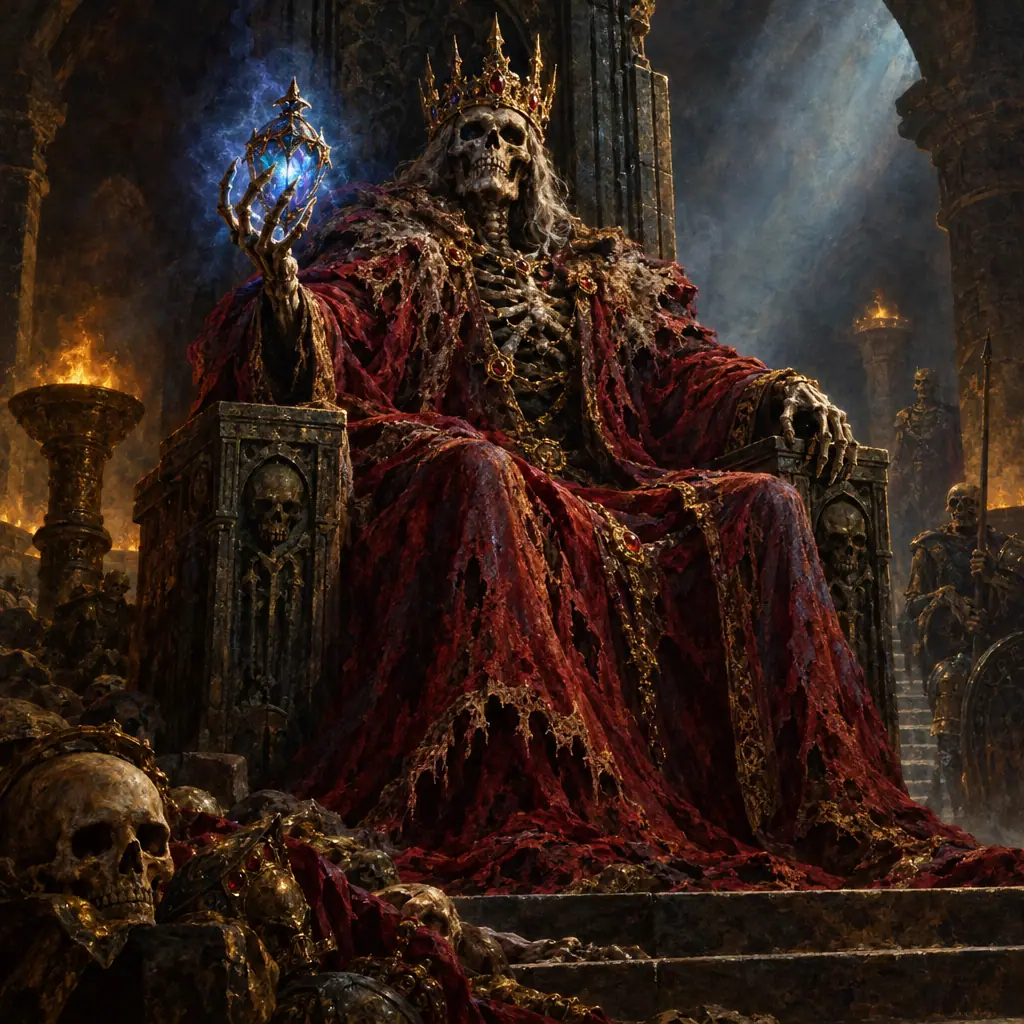
The lich shows D&D acting as a myth-maker rather than a borrower: a 1975 game term that became the standard fantasy name for an immortal undead sorcerer across novels, cartoons and video games.
Origins
Unlike the Vampire or the Ghoul, the lich has no folklore of its own. Its name is simply an old English word for a body: Old English līc, "corpse", which survives in "lychgate", the roofed churchyard gate where coffins once rested, and in German Leiche. Ambrose Bierce and H. P. Lovecraft used the word in its archaic sense, and so did Clark Ashton Smith in "The Empire of the Necromancers" (1932), one of his Weird Tales stories of sorcerers raising the dead.
The idea — a sorcerer who outlives his own flesh — came from the same pulp shelves. Robert E. Howard's Skull-Face (1929) and Smith's many necromancers kept shriveled, ageless bodies moving by will and magic alone, and Fritz Leiber's early story "Thieves' House" supplied a jeweled skull that later shaped the demilich. But the direct source, according to Gary Gygax, was a single story: Gardner Fox's "The Sword of the Sorcerer" (1969).
Into the dungeon
The lich as a named monster was born in Supplement I: Greyhawk (1975), the first expansion to Dungeons & Dragons, by Gygax and Rob Kuntz. It was described in a sentence or two: a skeletal creature, formerly a magic-user or magic-user/cleric, that kept its spellcasting and could send weaker characters fleeing in fear. In 1976 Eldritch Wizardry added the Hand and Eye of Vecna, relics of a lich destroyed long ago; Brian Blume, who invented them, took the name as an anagram of Jack Vance, whose Dying Earth had given D&D its spell system.
The first-edition Monster Manual (1977) of Advanced Dungeons & Dragons said the lich kept its existence "by certain conjurations, enchantments, and a phylactery" — and explained nothing more. The word, borrowed from the small boxes of scripture worn in Jewish prayer, took on its gaming meaning over the next decade: Len Lakofka's article "Blueprint for a Lich" in Dragon #26 (1979) described a ritual that stored the soul in a jar, and by the second edition the phylactery was explicitly the vessel of the lich's life force. Destroy the body and the lich returns; find and destroy the phylactery first, and the adventure can end.
That structure — a villain who cannot die until a hidden object is found — made the lich a natural campaign boss. Gygax's Tomb of Horrors (1978) ended with Acererak, a demilich reduced to a jeweled skull. Vecna rose from legend to demigod in the 1990 adventure Vecna Lives!, and Ravenloft's Demiplane of Dread gave the lich Azalin a whole domain. Computer games followed the tabletop: liches are optional high-level bosses in Baldur's Gate II, recruitable undead in Heroes of Might and Magic, and in Blizzard's Warcraft saga the fallen prince Arthas becomes the Lich King, the villain of the 2008 World of Warcraft expansion Wrath of the Lich King.
Variations
D&D itself has spun off a small taxonomy. The demilich, first seen with Acererak, is a lich so ancient that only its skull and soul-gems remain. The dracolich is an undead Dragon; the baelnorn is a good-aligned elven lich guarding its people's ruins in the Forgotten Realms; the archlich is another good-aligned variant. Outside D&D the lich spread wherever D&D's vocabulary did — into Pathfinder, Warhammer, the cartoon Adventure Time and countless roguelikes. Readers have also noticed the family resemblance in Harry Potter, whose Voldemort splits his soul into hidden horcruxes; the books never use the word "lich", but the logic of the phylactery is unmistakable.
Migration
How the creature traveled from story to story.
- 1932Clark Ashton Smith, "The Empire of the Necromancers"Weird Tales writers use 'lich' in its archaic sense of a corpse, amid sorcerers who cheat death.
- 1969Gardner Fox, "The Sword of the Sorcerer"The sword-and-sorcery tale Gygax later named as his model for the lich's description.
- 1975Supplement I: GreyhawkGygax and Rob Kuntz introduce the lich: a skeletal former magic-user who keeps its spells after death.
- 1976Supplement III: Eldritch WizardryBrian Blume invents the Hand and Eye of Vecna, relics of a destroyed lich whose name is an anagram of Vance.
- 1977Monster ManualThe lich gains its mysterious 'phylactery', left unexplained for years.
- 1978S1 Tomb of HorrorsThe demilich Acererak, reduced to a jeweled skull, waits at the bottom of Gygax's killer dungeon.
- 2008World of Warcraft: Wrath of the Lich KingArthas Menethil, the Lich King, becomes the face of an MMO expansion.
Marginalia
- 'Lich' comes from Old English līc, 'corpse', cognate with German Leiche; before D&D, pulp writers used it only to mean a dead body.
- Gygax said he based the lich on Gardner Fox's 1969 story "The Sword of the Sorcerer", not on any folklore creature.
- The 1977 Monster Manual mentioned a lich's 'phylactery' without explaining it; Dragon #26 (1979) first described storing the soul in a jar.
- Vecna, D&D's most famous lich, began in 1976 as two artifacts, a hand and an eye; his name is an anagram of Jack Vance.
- The demilich, a lich worn down to a floating skull, first appeared with Acererak in Tomb of Horrors (1978).
- The Ravenloft setting's domain of Darkon is ruled by the lich Azalin.
Quick answers
- Where does the Lich come from?
- Dungeons & Dragons, Greyhawk supplement (1975); name from Old English līc, 'corpse'
- When did the Lich first appear?
- 1975, in Supplement I: Greyhawk.
- How did the Lich get into games?
- Key appearances: Supplement I: Greyhawk (1975), Monster Manual (1977), S1 Tomb of Horrors (1978) and World of Warcraft: Wrath of the Lich King (2008).
- Why is the Lich significant?
- The lich shows D&D acting as a myth-maker rather than a borrower: a 1975 game term that became the standard fantasy name for an immortal undead sorcerer across novels, cartoons and video games.