Gygax co-designed the first commercial roleplaying game with Dave Arneson, published it through the company he co-founded, and codified it in Advanced Dungeons & Dragons, the rules and vocabulary that computer RPGs and later tabletop games inherited.
Life
Ernest Gary Gygax was born in Chicago on July 27, 1938, and grew up near Wrigley Field until he was eight. In 1946 his father, Ernst, a Swiss immigrant and former violinist with the Chicago Symphony Orchestra, moved the family to Lake Geneva, Wisconsin, the resort town where his mother's family had roots. Lake Geneva would be his home, and the center of his gaming world, for the rest of his life. He was an indifferent student who read voraciously in pulp fantasy and science fiction; he left high school in 1956 after his father's death, had a brief stint in the Marines that ended with a medical discharge after walking pneumonia, and took classes in anthropology at the University of Chicago while working as a shipping clerk and then as an insurance underwriter. In 1958 he married Mary Jo Powell, with whom he had five children; he later married Gail Carpenter, with whom he had a sixth.
His passion was wargaming. In 1967 he helped found the International Federation of Wargamers, and in 1968 he rented the Horticultural Hall in Lake Geneva for $50 to host a weekend gathering of hobbyists: the first Gen Con. Around the same time he formed the Lake Geneva Tactical Studies Association with friends including Don Kaye, and the Castle & Crusade Society, a circle of medievalists within the IFW. Laid off from insurance work, he repaired shoes in his basement to support his family while writing and editing games on the side.
Work
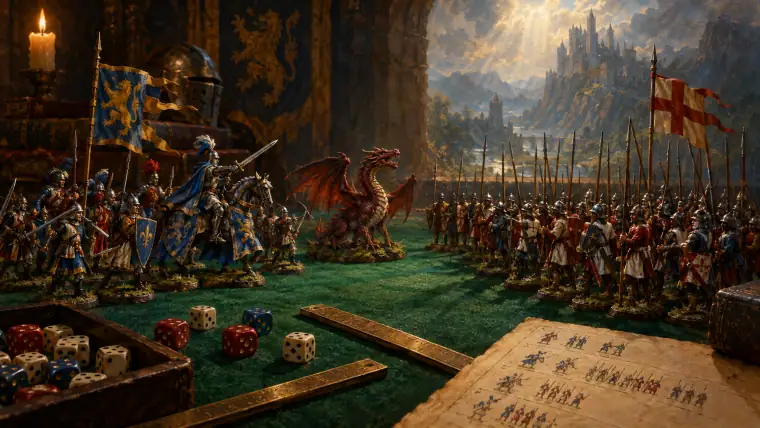
Gygax's first important design was Chainmail, published by Guidon Games in March 1971. It began as four pages of medieval miniatures rules by fellow club member Jeff Perren, which Gygax expanded and printed in club newsletters before the commercial edition. Its final section, a fantasy supplement, let players field hobbits, elves, wizards and dragons drawn from Tolkien, Robert E. Howard, Poul Anderson and Michael Moorcock. He had met Dave Arneson at the second Gen Con in 1969, and the two wrote the naval rules Don't Give Up the Ship! together.
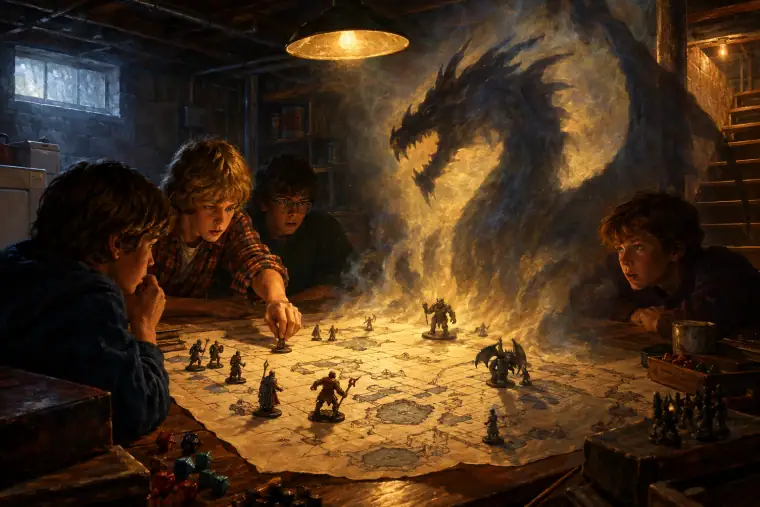
The turning point came in the winter of 1972–73, when Arneson visited Lake Geneva to run his Blackmoor campaign, a fantasy game in which each player controlled a single hero exploring the dungeons beneath a castle. Gygax immediately began his own campaign, Greyhawk, playtesting with his children Ernie and Elise and a widening circle of local players, and asked Arneson for his notes. Over the following year the two exchanged material by mail and phone while Gygax drafted the manuscript. Guidon Games and Avalon Hill both passed on it. So in October 1973 Gygax and Don Kaye founded Tactical Studies Rules (TSR, Inc.), each putting in $1,000; Brian Blume's investment later that year paid for the printing. Dungeons & Dragons appeared in January 1974 as three booklets in a box, credited to Gygax and Arneson, in a run of 1,000 copies.
Gygax was the game's great systematizer and publicist. He wrote the Greyhawk supplement (1975) and Eldritch Wizardry (1976), launched The Strategic Review and then hired Tim Kask to edit The Dragon (The Strategic Review & Dragon), and between 1977 and 1979 produced the three hardcovers of Advanced Dungeons & Dragons: the Monster Manual, the Players Handbook and the Dungeon Masters Guide. The last contained Appendix N, his list of the fantasy authors who had shaped the game, from Jack Vance, whose The Dying Earth stories inspired its fire-and-forget spells (Vancian magic), to Fritz Leiber and H. P. Lovecraft. His adventures, including Tomb of Horrors, The Keep on the Borderlands and the Temple of Elemental Evil, defined what a published Adventure module could be, and his home campaign became the World of Greyhawk setting (1980).
Business proved harder than design. Kaye died suddenly in January 1975, and when his widow's shares passed to the Blume family, Gygax became a minority owner of the company he had started. TSR grew explosively (D&D sales reportedly reached $29 million in 1985) even as the Satanic Panic & D&D made Gygax the public face of a game accused of corrupting teenagers; in 1985 he defended it on 60 Minutes. In the early 1980s he was sent to Hollywood to run TSR Entertainment and co-produced the CBS Dungeons & Dragons. Returning to find the company deep in debt, he briefly regained control, but in October 1985 Lorraine Williams, whom he had brought in to manage the firm, acquired the Blumes' shares and replaced him as president. He left TSR entirely in 1986, keeping only the rights to his character Gord the Rogue and a few name-play characters such as Zagyg.
The following decades were a restless search for a second act. His company New Infinities Productions released the Cyborg Commando RPG (1987) before failing in 1989. Dangerous Journeys (1992), published by Game Designers' Workshop, drew an immediate TSR lawsuit alleging it derived from D&D; the litigation drained him until TSR bought the rights outright in 1994. He followed with the deliberately simple Lejendary Adventure and, with Troll Lord Games, the Castle Zagyg project, an attempt to publish his original Greyhawk dungeons. Two strokes in 2004 slowed him, and he later declined surgery for a diagnosed abdominal aortic aneurysm. He died at home in Lake Geneva on March 4, 2008, aged 69.
Legacy
Gygax's name is inseparable from D&D because he wrote most of its published text, and because that text supplied the vocabulary of a medium: classes, Alignment, saving throws, the Dungeon Master as impartial arbiter. The first computer RPGs on the PLATO, and later Wizardry: Proving Grounds of the Mad Overlord and Ultima, drew directly on D&D, and his Monster Manual remains the ancestor of creatures from the Beholder to the Mind Flayer (Illithid) that still populate games such as Baldur's Gate 3.
The credit question has always shadowed that legacy. In later interviews Gygax tended to play down Arneson's share of the finished rules, while Arneson and his Twin Cities players argued that the essentials of roleplaying were already present in Blackmoor. The royalty lawsuits Arneson filed from 1979, settled in 1981, are recounted in The Gygax–Arneson Disputes. Historians such as Jon Peterson, working from the letters and drafts, have since shown the game emerging from both men and from the wider wargaming community around them. What is not in dispute is that without Gygax's energy as writer, editor, publisher and convention host, Arneson's campaign might have stayed a local legend.
He was honored in his lifetime and after: induction into the Academy of Adventure Gaming Arts & Design Hall of Fame in 1980, a cameo on Futurama, and, after his funeral, a game session in Lake Geneva's American Legion hall that grew into the annual Gary Con. His name now stands for the whole founding generation of the hobby, which is both his achievement and the reason historians continue to widen the frame around him.
Marginalia
- Born Ernest Gary Gygax on July 27, 1938, in Chicago; his father Ernst was a Swiss immigrant who had played violin in the Chicago Symphony Orchestra.
- He rented Lake Geneva's Horticultural Hall for $50 to host the 1968 gathering that became Gen Con.
- Chainmail (1971), written with Jeff Perren, carried a 14-page fantasy supplement with heroes, wizards, elves and dragons.
- TSR's first print run of Dungeons & Dragons in January 1974 was 1,000 hand-assembled boxed sets.
- He voiced himself in the 2000 Futurama episode "Anthology of Interest I."
- The annual Gary Con convention in Lake Geneva grew out of the games mourners played after his funeral in March 2008.
Quick answers
- Who was Gary Gygax?
- The Lake Geneva insurance underwriter and wargamer who co-created Dungeons & Dragons, co-founded TSR, and wrote the rulebooks that taught a generation how to be a Dungeon Master.
- When was Gary Gygax born?
- Gary Gygax was born in 1938 in Chicago, Illinois and died in 2008.
- What is Gary Gygax known for?
- Gary Gygax is best known for Dungeons & Dragons, Chainmail, Advanced Dungeons & Dragons, Tomb of Horrors, The Keep on the Borderlands and World of Greyhawk.
- Why does Gary Gygax matter to fantasy and games?
- Gygax co-designed the first commercial roleplaying game with Dave Arneson, published it through the company he co-founded, and codified it in Advanced Dungeons & Dragons, the rules and vocabulary that computer RPGs and later tabletop games inherited.