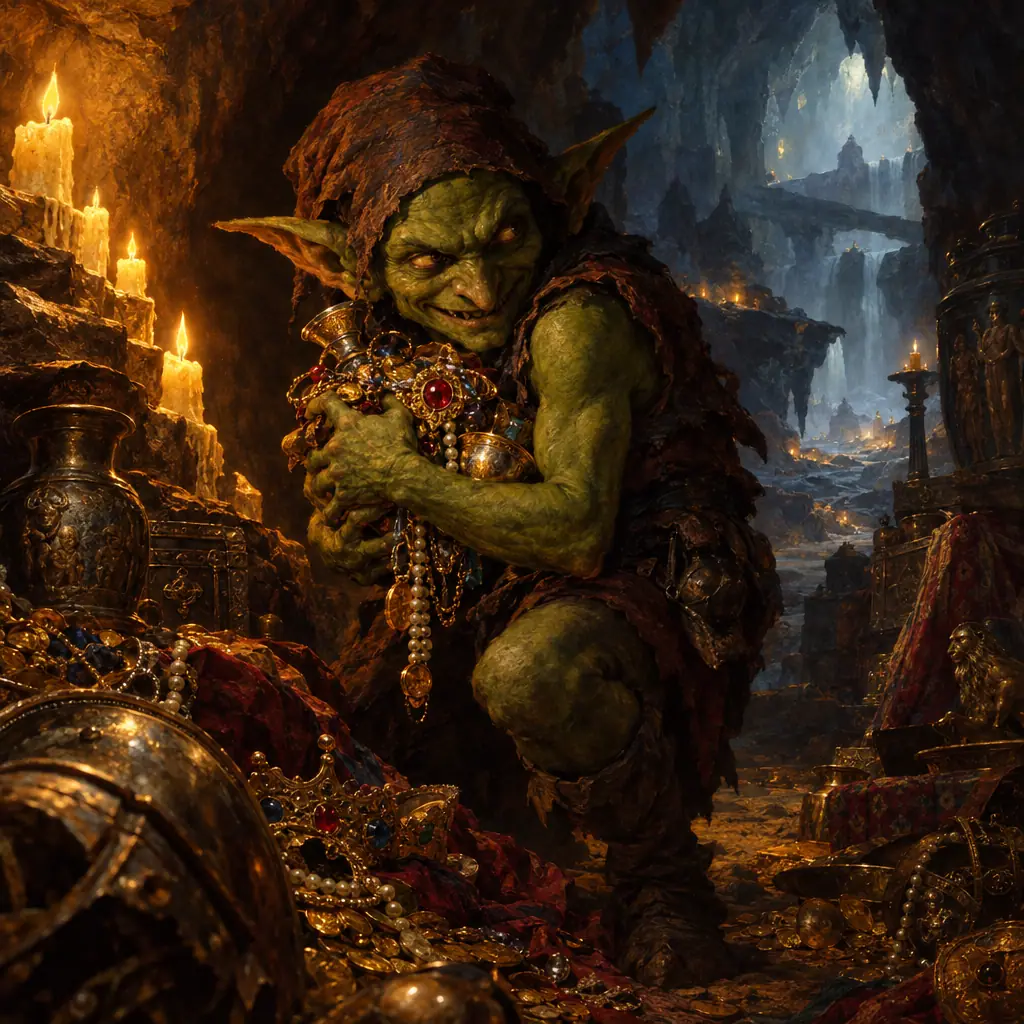
Goblins are the entry-level enemy of fantasy games — the first creatures a new party fights — and the proof that one word can mean a household sprite, an orc, a banker or a comic mascot depending on who is telling the story.
Origins
The goblin came to English from Normandy. Around 1140 the chronicler Orderic Vitalis described a demon called Gobelinus driven out of a church at Évreux, and Old French gobelin is attested by the end of the twelfth century; English writers were using "gobelyn" by the fourteenth. The word may derive from Greek kobalos, a rogue or sprite, and it has cousins in the German Kobold and the Welsh coblyn. For centuries "goblin" was a loose word for any small, ugly, mischievous spirit — a brownie gone bad, a household imp, a bogey in the dark — rather than a species.
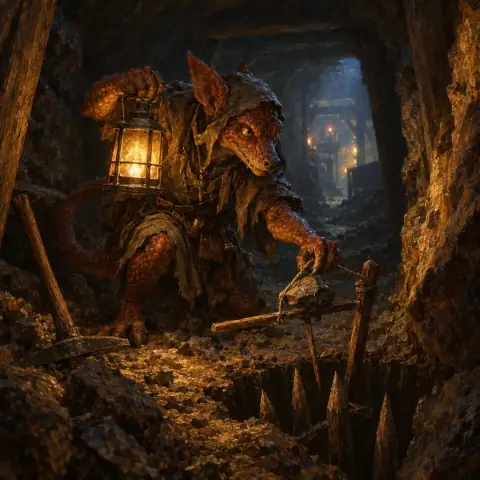
The Victorians gave the goblin its literary shape. Christina Rossetti's poem Goblin Market (1862) imagined animal-faced goblin men selling enchanted fruit. George MacDonald's children's novel The Princess and the Goblin, serialized from 1870 and published in 1872, put goblins underground: a race of misshapen miners, banished long ago, tunneling beneath a mountain kingdom to kidnap its princess, and defeated by a miner's boy who stamps on their soft feet. That image — a hostile society in the tunnels, organized, spiteful and numerous — is the one that fed J. R. R. Tolkien. His early poem "Goblin Feet" (1915) still used the word for twee dancing sprites, but in The Hobbit (1937) the goblins of the Misty Mountains are cruel artisans of war who capture Thorin's company and whom Gandalf fights with the sword Glamdring. Tolkien later told Naomi Mitchison that his orcs owed something to MacDonald's goblins, and in The Lord of the Rings the same creatures are mostly called orcs.
Into the dungeon
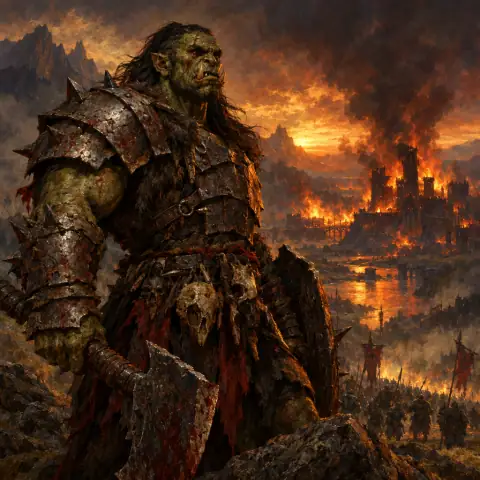
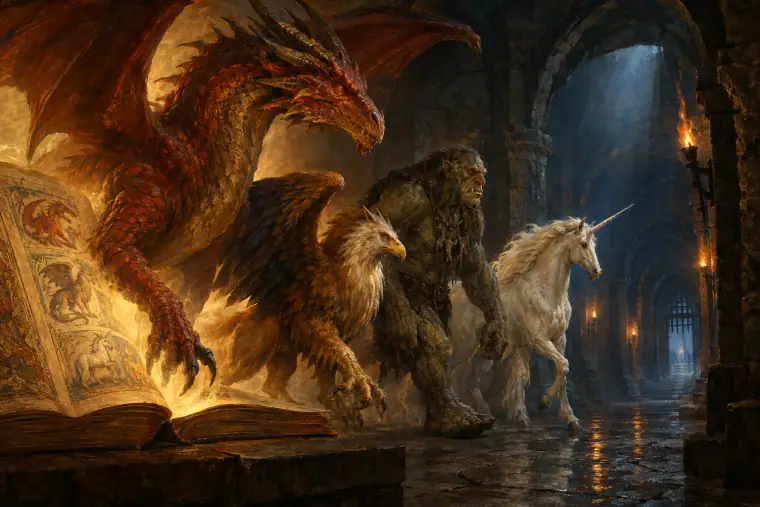
Games split Tolkien's single people in two. Goblins appeared in Chainmail's Fantasy Supplement (1971) and then in the white box of Dungeons & Dragons (1974) as small, weak monsters, separate from and inferior to orcs. AD&D's 1977 Monster Manual gave them tribes and dismal lairs and placed them in a family of "goblinoids" with the larger hobgoblin and the hairy bugbear. Goblins became the first thing a new The party kills: they infest the Caves of Chaos in Gygax's The Keep on the Borderlands (1979), the module that taught a generation how to run a Dungeon crawl. Games Workshop brigaded them with orcs in Warhammer Fantasy Battle (1983), and Magic: The Gathering made reckless goblins an icon of its red cards.
Video games adopted both the underfoot enemy and the comic schemer. Goblins are fodder in countless dungeon crawlers and roguelikes, from NetHack onward; in Blizzard's Warcraft series they became greedy engineers and merchants, eventually playable in World of Warcraft. The screen gave them charm: Jim Henson's Labyrinth (1986) filled its Goblin City with shaggy puppets ruled by David Bowie's Jareth, and J. K. Rowling's Harry Potter (1997–2007) made goblins proud, prickly bankers and smiths with their own views on who really owns what they make.
Variations
The goblin has become fantasy's most elastic creature. In The Elder Scrolls IV: Oblivion and its siblings goblins are a cave-dwelling beast race; in Dwarf Fortress they are a whole civilization raiding from dark fortresses; in many modern tabletop games they are a playable, chaotic people rather than a monster. The etymological knot remains too: in some books goblins are orcs, in some they are imps, in some they are something else again. What unites them is size and appetite — the goblin is always the small thing with sharp teeth that turns up in numbers, the first fight of the adventure and, just as often, its comic relief.
Migration
How the creature traveled from story to story.
- 1140Orderic Vitalis, Historia ecclesiasticaA demon called Gobelinus is expelled from a church at Évreux in Normandy — the earliest trace of the name.
- 1862Goblin MarketChristina Rossetti's goblin men hawk enchanted fruit that ruins those who taste it.
- 1872The Princess and the GoblinGeorge MacDonald's goblins tunnel beneath a mountain kingdom and plot to steal a princess; their feet are their weak spot.
- 1937The HobbitTolkien's goblins of the Misty Mountains capture Thorin's company; they are the same creatures he later calls orcs.
- 1974Dungeons & DragonsGoblins become small, weak monsters, the first foes of first-level characters.
- 1979B2 The Keep on the BorderlandsThe Caves of Chaos pack goblins, hobgoblins, orcs and kobolds into one ravine — the classic beginner's dungeon.
- 1986LabyrinthJim Henson's puppet goblins serve David Bowie's Goblin King, Jareth.
- 1997Harry PotterRowling's goblins are shrewd bankers and master smiths who run Gringotts.
Marginalia
- The earliest trace of the name is 'Gobelinus,' a demon Orderic Vitalis describes around 1140 as haunting Évreux in Normandy.
- MacDonald's The Princess and the Goblin was serialized from November 1870 and published as a book in 1872.
- Tolkien's first notable published work was the 1915 poem 'Goblin Feet' — about tiny, dancing elves, not goblins.
- The Hobbit's goblins and The Lord of the Rings' orcs are the same creatures; Thorin's sword Orcrist is glossed 'Goblin-cleaver.'
- D&D treats goblins as one of the 'goblinoids,' a family that also includes the hobgoblin and the bugbear.
- In Harry Potter, goblins run Gringotts Wizarding Bank and forged the sword of Gryffindor.
Quick answers
- Where does the Goblin come from?
- Norman-French folklore (Medieval Latin gobelinus, c. 1140; Old French gobelin); Victorian fairy tale; Tolkien's The Hobbit (1937)
- When did the Goblin first appear?
- c. 1140, in Orderic Vitalis, Historia ecclesiastica.
- How did the Goblin get into games?
- Key appearances: Dungeons & Dragons (1974) and B2 The Keep on the Borderlands (1979).
- Why is the Goblin significant?
- Goblins are the entry-level enemy of fantasy games — the first creatures a new party fights — and the proof that one word can mean a household sprite, an orc, a banker or a comic mascot depending on who is telling the story.