Magic created the collectible card game, rescued and reshaped the tabletop industry — its profits bought TSR and Dungeons & Dragons — and remains one of the most successful games of any kind.
Overview
Magic: The Gathering is a game about wizards, and a business about scarcity. Released by Wizards of the Coast on August 5, 1993, Richard Garfield's design cast two players as dueling spellcasters called planeswalkers, each armed with a deck of cards representing lands, creatures and spells. The twist was that no two players owned the same cards. Decks were built from randomized starter decks and booster packs, so the game was also a hobby of collecting, trading and deck-building — the first Collectible & Trading Card Games.
It became a phenomenon almost instantly, and it has never stopped. More than three decades later Magic remains one of the most commercially successful games in the world; Hasbro reported it had passed $1 billion in annual revenue in 2022.
Origins
Garfield, then a doctoral student in combinatorial mathematics at the University of Pennsylvania, had been designing games since his teens; his Five Magics (1982), inspired by the board game Cosmic Encounter, already imagined rival schools of magic. Around 1991 he pitched his board game RoboRally to Peter Adkison, founder of the small Seattle-area publisher Wizards of the Coast. Adkison liked it but could not afford to produce it, and asked instead for something cheap to make, fast to play and portable enough for game conventions.
Garfield's answer fused the idea of a customizable deck with the collector appeal of baseball cards. The first set, later called Alpha, was printed in a run of 2.6 million cards and illustrated by a roster of mostly freelance fantasy artists. It sold out quickly. Beta followed in October 1993 with a print run of about 7.3 million and sold out as fast.
How it plays
Each player starts at 20 life and wins by reducing the opponent to zero. The engine is Mana. Land cards are played one per turn and "tapped" — turned sideways — to produce mana, which pays for spells. That simple rule creates the game's rhythm: early turns are cheap and scrappy, later turns explosive, and a hand with too few or too many lands can doom a player.
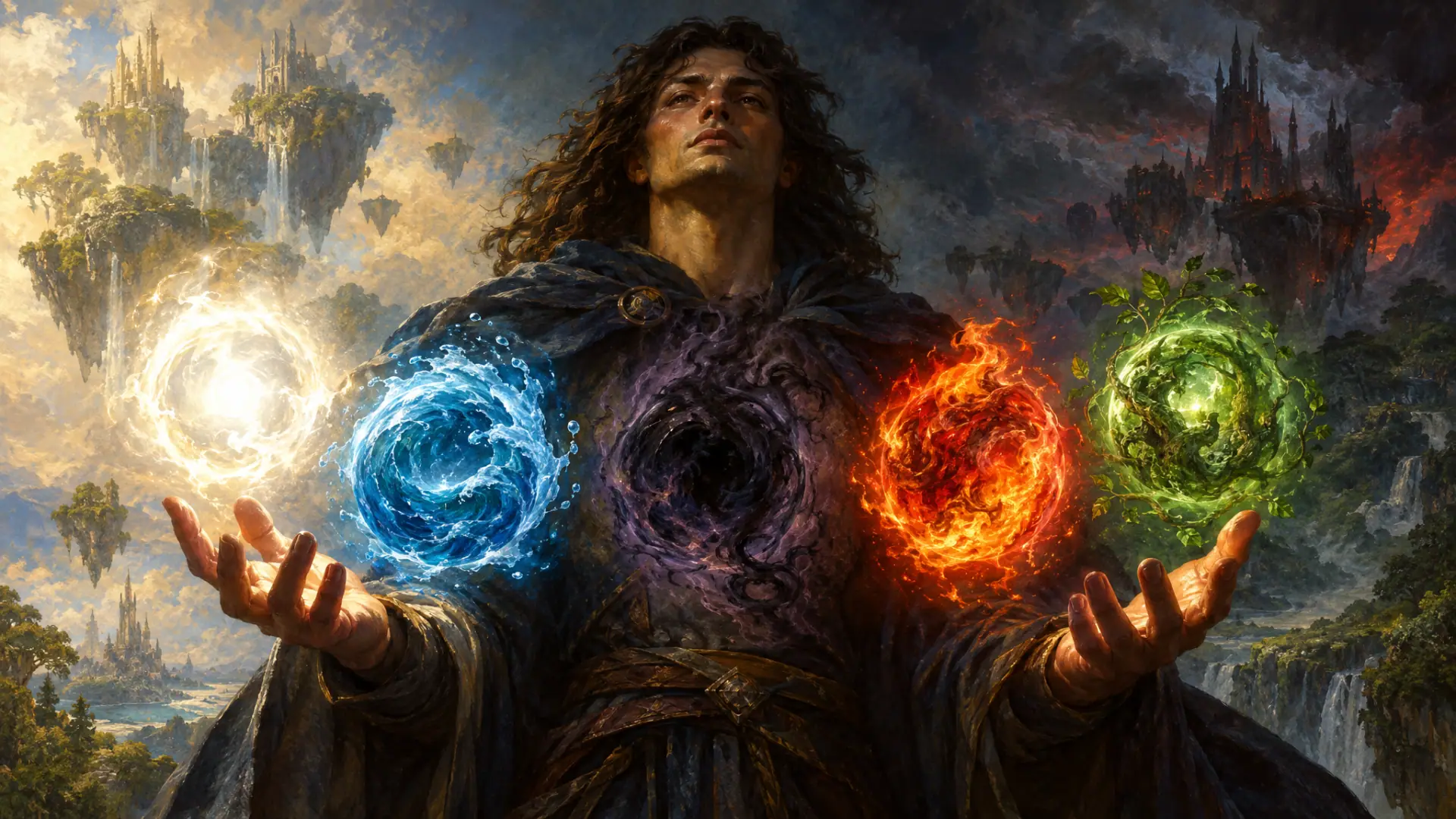
Magic's mana comes in five colors, and the "color pie" is the heart of its design. White favors order, protection, healing and armies of small soldiers. Blue is knowledge, illusion and control, the color of counterspells and card draw. Black trades life and morality for power, with death, sacrifice and ambition. Red is fire, impulse and speed — direct damage and aggressive creatures. Green is nature and growth, with huge beasts and mana acceleration. Each color does some things well and others poorly, so combining colors in one deck is a trade-off, and the pie gives every new card a place in a philosophical map.
Creatures attack and block in combat; instants and sorceries produce one-off effects; enchantments and artifacts linger on the battlefield. Players build constructed decks of at least 60 cards from their collections, or draft and build 40-card decks on the spot in "limited" formats — the format that most rewards skill in reading an unfamiliar pool of cards.
Reception & impact
Magic's success reshaped the tabletop industry. Dozens of publishers rushed out collectible card games in 1994–95, among them Wizards' own Jyhad (also by Garfield), set in White Wolf Publishing's Vampire: The Masquerade, and, in 1995, Legend of the Five Rings. Many roleplaying companies suffered as players' money flowed to cards. Wizards, meanwhile, grew rich enough to buy the ailing TSR, Inc. in 1997, bringing Dungeons & Dragons under the same roof; Hasbro bought Wizards in 1999 for $325 million.
Competitive play institutionalized the game. The Pro Tour began in 1996, a Hall of Fame followed in 2005, and players such as Jon Finkel and Kai Budde became minor celebrities. Digital versions extended its reach: Magic: The Gathering Online launched in 2002 and Magic: The Gathering Arena a generation later.
Legacy
Magic's vocabulary — tapping, mana curves, metagames, booster drafts — spread into board games and digital card games alike. Its Universes Beyond line brought licensed worlds into the color pie, including a 2023 set based on The Lord of the Rings, closing a loop between Tolkien's fiction and the games it inspired.
Above all, Magic demonstrated that a fantasy game could be a living system rather than a finished product: a rules engine that changes every few months as new cards arrive, supported by collectors, tournaments and a shared language of color. Wizards printed more than 20 billion Magic cards between 2008 and 2016 alone.
Marginalia
- Garfield's earlier design Five Magics (1982), inspired by Cosmic Encounter, was an ancestor of Magic's colored schools of magic.
- Peter Adkison asked Garfield for a fast game with minimal equipment that could be played at conventions.
- Alpha's 2.6 million cards sold out quickly; Beta, roughly three times larger, sold out just as fast.
- Magic's success funded Wizards of the Coast' 1997 purchase of TSR, Inc., owner of Dungeons & Dragons.
- Hasbro bought Wizards of the Coast in 1999 for $325 million.
- Garfield also designed Jyhad (1994), a Magic-style card game set in the world of Vampire: The Masquerade.
- The 2023 Universes Beyond set The Lord of the Rings: Tales of Middle-earth brought The Lord of the Rings to Magic.
Quick answers
- When was Magic: The Gathering first released?
- Magic: The Gathering was first released in 1993 (August 5).
- Who created Magic: The Gathering?
- Magic: The Gathering was made by Richard Garfield (designer) and Peter Adkison (publisher; founder and CEO of Wizards of the Coast).
- Who published or developed Magic: The Gathering?
- Wizards of the Coast.
- What kind of work is Magic: The Gathering?
- Magic: The Gathering is a card game in the Collectible & Trading Card Games tradition, released for Trading cards, Magic: The Gathering Online (2002) and Magic: The Gathering Arena.
- Why is Magic: The Gathering important?
- Magic created the collectible card game, rescued and reshaped the tabletop industry — its profits bought TSR and Dungeons & Dragons — and remains one of the most successful games of any kind.