Talislanta was the first cult hit to prove a fantasy RPG could sell on sheer strangeness of setting, and its single-roll resolution table anticipated the lean, setting-first design of later decades.
Overview
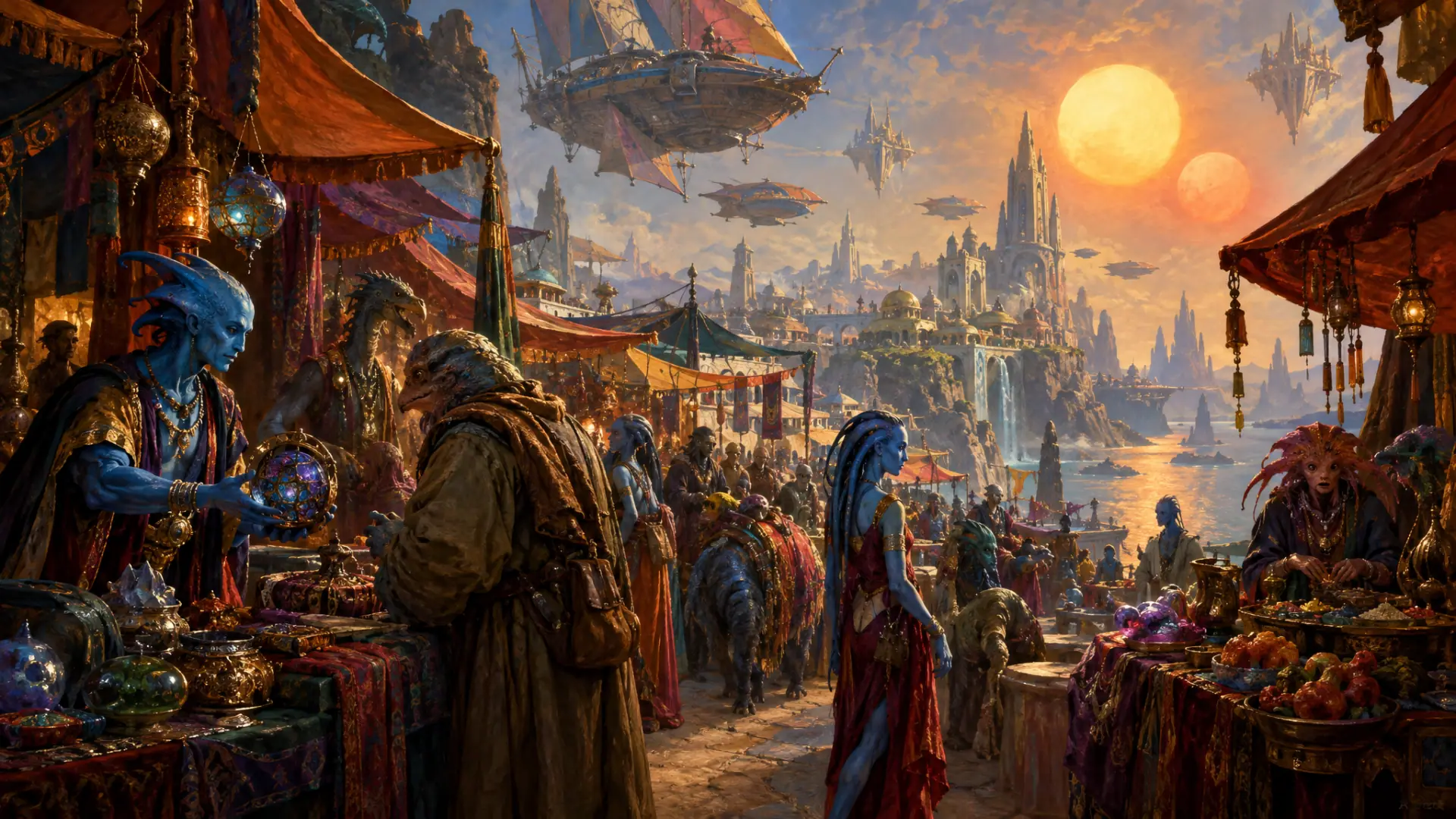
Talislanta is a fantasy roleplaying game created by Stephan Michael Sechi and first published by Bard Games in 1987. Its setting is a single sprawling continent on the world of Archaeus, and its selling point was announced in magazine advertisements with two words: "No Elves!" In place of the elves, dwarves and orcs that most fantasy games had inherited from Tolkien by way of D&D, Talislanta offered dozens of invented peoples — scheming merchant-sorcerers, ascetic mystics, reptilian warriors, plant-folk, beast-men — in a world that reads like a caravan journal from a stranger planet.
Few 1980s games were so frankly about place. The rules were deliberately thin; the books were thick with cultures, cities, creatures, religions, languages and trade goods, all bound together by P. D. Breeding-Black's distinctive illustrations.
Origins
Sechi had co-founded Bard Games in 1982 and led its D&D-flavored The Atlantean Trilogy (1984–86). After personal and financial disagreements with his partners he left in 1986, then reacquired the company to publish something wholly his own. He has described the idea simply: "keep the system as simple as possible, and put all the detail into developing an original milieu" — which, he noted, was "almost exactly the opposite of what D&D was doing at the time."
The setting's chief debt is to Jack Vance, whose The Dying Earth stories of ornate, amoral wizards in a decadent far future are everywhere in Talislanta's tone. Sechi has also cited Lovecraft's Dreamlands, the travels of Marco Polo, Richard Burton's Arabian Nights and Flaubert's Salammbô; for mechanics, he pointed to TSR's 1985 Conan roleplaying game.
The line launched in 1987 with The Chronicles of Talislanta, an 88-page, rules-free travelogue written in the voice of the wizard Tamerlin, and The Talislantan Handbook, which held the rules. A Naturalist's Guide to Talislanta (1987) catalogued its beasts and plants, and the Talislanta Sorcerer's Guide (1988) expanded its magic. A combined Talislanta Handbook & Campaign Guide followed in 1989 as the second edition.
How it plays
In a roleplaying game, one player — the Game Master — describes the world and plays everyone in it, while each other player controls a single Player character and describes what that character attempts. No board, no winner: just a shared, ongoing story with dice to settle uncertainty.
Talislanta's dice work is unusually lean. Every action — swinging a sword, casting a spell, haggling in a bazaar — uses one roll of a twenty-sided die on the Action Table. The character's attribute and skill are combined, the difficulty of the task is subtracted, the result is added to the roll, and the total lands in one of five bands: Mishap, Failure, Partial Success, Full Success or Critical Success. The same table governs everything, so a newcomer learns one procedure and plays the whole game. Reviewers noticed: Dragon's Jim Bambra praised a system that does "an admirable job of handling all kinds of tests without interrupting the flow of the game."
Character creation was equally distinctive. Rather than rolling up an anonymous fighter, players chose one of more than 80 ready-made archetypes — each defined by race, nation, abilities, skills, gear and background — then personalized it by raising one attribute by three, lowering another by one and adding a skill. Choosing a character meant choosing a culture, which pushed play toward travel, intrigue and encounter rather than dungeon crawling. Critic Rick Swan called it "an inspired system, one of the best of any fantasy RPG."
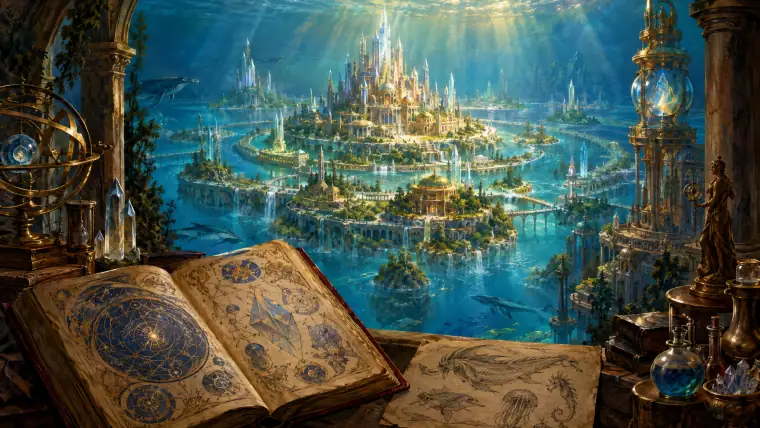
The world itself is haunted by the past. Talislanta was once ruled by the Archaens, decadent sorcerers who lived in floating cities; their reckless magic ended in the Great Disaster, which shattered their civilization and left the continent strewn with wastelands, relics and warring successor states.
Reception & impact
Talislanta won devoted admirers. Stewart Wieck gave it 9 out of 10 in White Wolf #11 (1988); Bambra's long review in Dragon #143 (March 1989) called it "something out of the ordinary." Swan, rating it 3.5 of 4 in The Complete Guide to Role-Playing Games (1990), reached for a memorable image, describing it as though "H. P. Lovecraft had written Alice in Wonderland."
Bard Games did not survive long enough to profit. Poor sales of the Cyclopedia Talislanta series and heavy retail returns on its Atlantis books pushed the company to close around 1990. Sechi kept the rights, and in 1992 a young Seattle company, Wizards of the Coast, licensed the game. Sechi and Jonathan Tweet, co-designer of Ars Magica, produced the third-edition Talislanta Guidebook (1992), which advanced the timeline and rebuilt the magic system — a year before Magic: The Gathering turned Wizards into an industry giant.
Legacy
Few games have had so many homes. After Wizards came an abandoned tenth-anniversary edition at Pharos Press (1997); a fourth edition in 2001 from Shootingiron, designed and written largely by John Harper, later the creator of Blades in the Dark, who rebuilt magic and made the game purely skill-based; a d20 version and a fifth edition (2006–07) from Morrigan Press, whose Omni System, derived from Talislanta's rules, also powered Atlantis: The Second Age; the prequel Talislanta: The Savage Land (2018–19) from Nocturnal Media; and a sixth "Epic Edition" from Everything Epic in the 2020s, which Sechi called "the last edition of Talislanta ever." French, German and Italian translations carried it abroad.
In 2010 Sechi released the entire line, first through fifth editions, as free downloads under a Creative Commons license — an early instance of a creator opening a commercial RPG catalog to everyone. The game's influence is diffuse rather than direct, but its insistence that an original world could be the whole point anticipated the setting-first and rules-light movements of later decades, and its "No Elves!" slogan remains one of the hobby's great one-line manifestos.
Marginalia
- Bard Games' launch ads in Dragon magazine shouted 'No Elves!' — a pitch to players tired of look-alike fantasy games.
- The first book, The Chronicles of Talislanta (1987), is a systemless travelogue presented as the notes of the wandering wizard Tamerlin, touring 29 countries and kingdoms.
- Characters were chosen from more than 80 archetypes, then tweaked: raise one attribute by 3, lower one by 1, add a skill.
- Wizards of the Coast published Talislanta's third edition in 1992, a year before Magic: The Gathering made the company famous.
- The fourth edition (2001) was designed largely by John Harper, who would go on to create Blades in the Dark.
- In 2010 Sechi put the entire Talislanta line, first through fifth editions, online for free under a Creative Commons license.
- Sechi has named Jack Vance, Lovecraft's Dreamlands, Marco Polo and the Arabian Nights among the setting's inspirations.
Quick answers
- When was Talislanta first released?
- Talislanta was first released in 1987 (Bard Games).
- Who created Talislanta?
- Talislanta was made by Stephan Michael Sechi (creator & designer), Jonathan Tweet (co-author, 3rd edition (Wizards of the Coast, 1992)) and John Harper (designer, 4th edition (Shootingiron, 2001)).
- Who published or developed Talislanta?
- Bard Games and Wizards of the Coast.
- What kind of work is Talislanta?
- Talislanta is a tabletop RPG in the Tabletop Roleplaying Games, Science Fantasy and Dying Earth tradition, released for Softcover books and Free PDFs (Creative Commons, 2010).
- Why is Talislanta important?
- Talislanta was the first cult hit to prove a fantasy RPG could sell on sheer strangeness of setting, and its single-roll resolution table anticipated the lean, setting-first design of later decades.