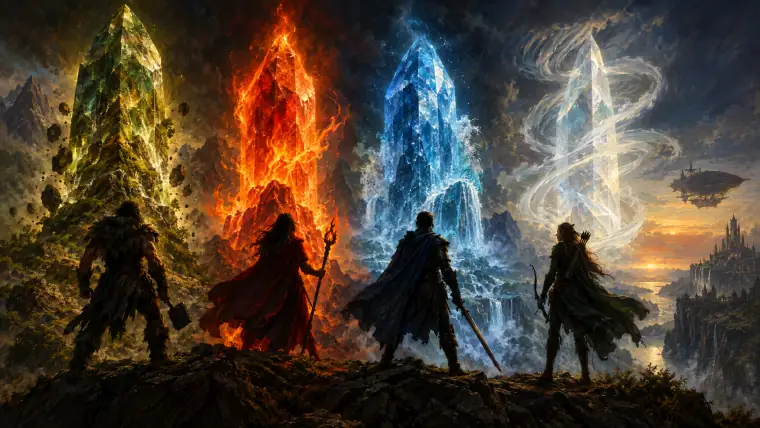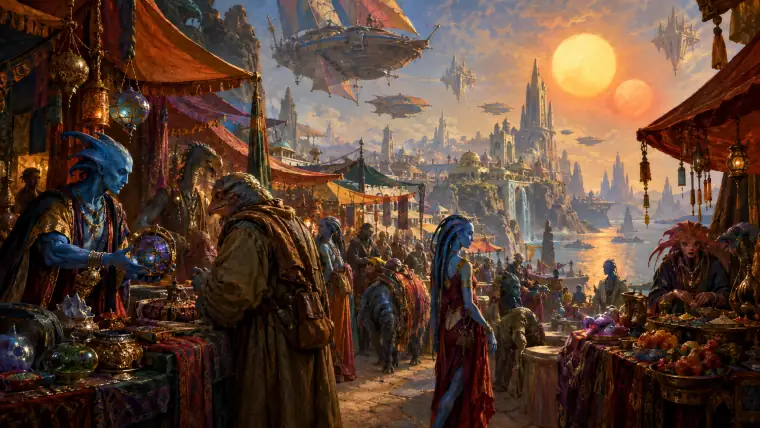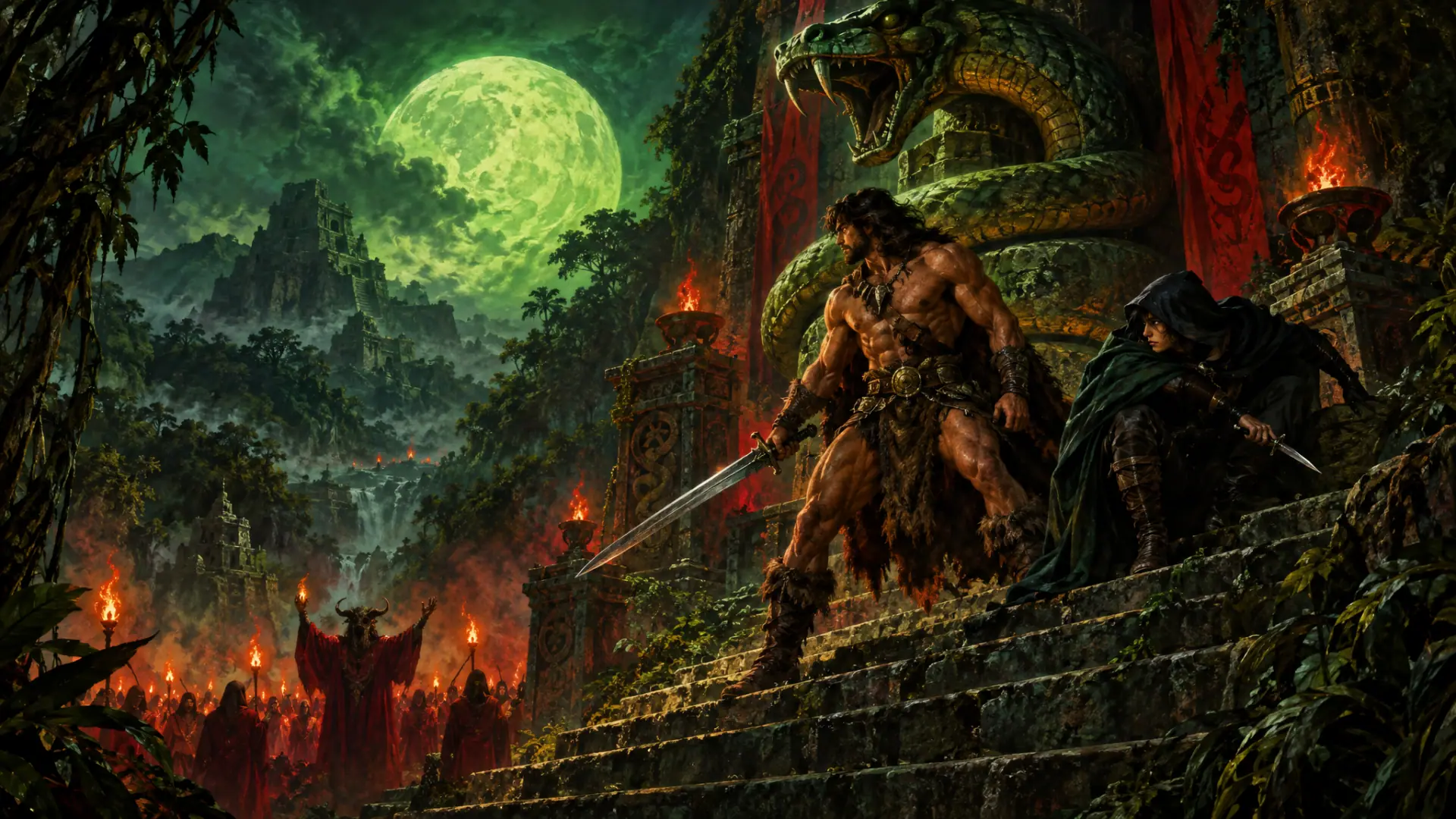
Science fantasy is the genre's great hybrid. It shaped some of the earliest and strangest RPG worlds — Tékumel, Gamma World, Rifts — and much of the Japanese RPG tradition, where magic and machines share every map.
Hallmarks
- Tropes of science fiction and fantasy in the same world — starships beside sorcery
- Magic given quasi-scientific explanations, or technology old enough to be magic
- Far futures and alien planets that feel mythic and medieval
- Swordplay, psychic powers, lost super-science and ruined civilizations
- Romance and wonder prized over scientific plausibility
What it is
Science fantasy is the deliberate blend of science fiction and fantasy: worlds where laser pistols and enchanted swords, psychic powers and spaceships, dragons and genetic engineering coexist. Rod Serling's famous distinction held that science fiction is "the improbable made possible" and fantasy "the impossible made probable"; science fantasy happily does both. Sometimes its magic receives a scientific explanation — the telepathic dragons of Pern turn out to be bioengineered — and sometimes its technology is so ancient that it has become magic, a mood Arthur C. Clarke captured in 1973 when he wrote that any sufficiently advanced technology is indistinguishable from magic.
Origins
The pulps were science fantasy before anyone named it. Edgar Rice Burroughs's A Princess of Mars (1912) sent a Civil War veteran to Barsoom to swing swords among four-armed Martians, radium pistols and dying cities. C. L. Moore's Northwest Smith stories, beginning with "Shambleau" in Weird Tales in 1933, put a space smuggler up against creatures out of myth and nightmare. Planetary romances by Leigh Brackett and others kept the mode alive through the 1940s.
The name had a slippery start. Forrest J Ackerman used "science fantasy" in 1935 simply as another word for science fiction; in 1948 the young Marion Zimmer, later Marion Zimmer Bradley, used it in Startling Stories for a mixture of the two. In John W. Campbell's Unknown, writers such as L. Sprague de Camp and Fletcher Pratt applied science fiction's rigor to fairyland. The Encyclopedia of Science Fiction notes that the label "has never been clearly defined" and was most commonly used between 1950 and 1966 — the lifetime of the British magazine Science Fantasy, where Michael Moorcock's first Elric story appeared in 1961.
Evolution
After mid-century, science fantasy became a home for writers who found hard SF too narrow. Jack Vance's The Dying Earth (1950) blended sorcery and forgotten science under a failing sun (see Dying Earth). Anne McCaffrey's Dragonriders of Pern (from 1968) looked like pure fantasy until it revealed a lost colony and engineered dragons. Roger Zelazny fused gods and technology in Lord of Light (1967) and made reality itself a shifting shadow in The Chronicles of Amber. Star Wars (1977), with its knights, sorcerous Force and princesses, is widely described as science fantasy.
Roleplaying games made the hybrid a specialty. M. A. R. Barker's Tékumel (Empire of the Petal Throne, 1975) is a far-future colony world whose decayed technology reads as magic. TSR's Gamma World (1978) turned post-apocalyptic America into a mutant fantasy; Gary Gygax's module Expedition to the Barrier Peaks (1980) dropped a crashed starship into D&D. Palladium's Rifts (1990) mixed cyborgs, dragons and dimensional invaders, and FASA's Shadowrun (1989) put magic into cyberpunk. In Japan, science fantasy became almost the default: Phantasy Star (1987) roamed a star system with swords and spells, and the Final Fantasy series, with its airships, ancient machines and, in Final Fantasy VI, magitek armor, made technology and magic two faces of the same lost past.
Television and toys spread the hybrid through 1980s childhoods. Ruby-Spears' Thundarr the Barbarian (1980–81) sent a sword-swinging hero across a post-apocalyptic America ruled by wizards who used the ruined technology of the old world, and Masters of the Universe mixed laser guns, sorcery and barbarian heroes in its cartoons and toy line. Such hybrids proved that audiences had no trouble with swords and starships in the same frame.
How to tell it apart
- Science fantasy vs. science fiction: SF insists its marvels could be explained by science; science fantasy does not care, and freely admits the supernatural.
- vs. Dying Earth: dying earth is a sub-genre of science fantasy with a specific setting — the exhausted far-future Earth. All dying-earth stories are science fantasy; not all science fantasy is dying earth.
- vs. High / Epic Fantasy: high fantasy's secondary world has no spaceships in its past. If the elves turn out to be colonists, you have crossed into science fantasy.
- vs. Sword & Sorcery: the pulps often mixed them — "sword and planet" stories like Barsoom are science fantasy with a sword-and-sorcery hero.
- vs. Urban Fantasy: urban fantasy puts magic in today's city; science fantasy usually needs a far future, an alien world or technology beyond our own.
Where to start
- A Princess of Mars (Edgar Rice Burroughs, 1912) — the pulp origin.
- The Dying Earth — Vance's baroque far future.
- Dragonriders of Pern — Dragonflight (1968).
- Empire of the Petal Throne — the deepest science-fantasy world in tabletop gaming.
- Final Fantasy and Phantasy Star — how science fantasy became the grammar of the JRPG.
Marginalia
- Anne McCaffrey's Pern dragons are revealed to be bioengineered creatures on a human colony world — fantasy's most famous beasts given a science-fiction origin.
- In M. A. R. Barker's Tékumel, the world of Empire of the Petal Throne (1975), human colonists stranded in a pocket dimension have seen their technology decay into a world of sorcery and gods.
- Gygax's 1980 D&D module Expedition to the Barrier Peaks hid a crashed spaceship full of robots and laser pistols in a fantasy mountain range.
- Palladium's Rifts (1990) set its game on a post-apocalyptic future Earth torn open by "rifts" to other dimensions, times and realities.
- The Encyclopedia of Science Fiction notes the label "has never been clearly defined" and was most used between 1950 and 1966.
- Michael Moorcock's first Elric story appeared in 1961 in the British magazine Science Fantasy.
Quick answers
- What is Science Fantasy?
- Swords and starships, psionics and sorcery, dragons bred on colony worlds: the hybrid of science fiction and fantasy that runs from Barsoom and Pern to Tékumel, Rifts and Final Fantasy's airships.
- What are the hallmarks of Science Fantasy?
- Tropes of science fiction and fantasy in the same world — starships beside sorcery; Magic given quasi-scientific explanations, or technology old enough to be magic; Far futures and alien planets that feel mythic and medieval; Swordplay, psychic powers, lost super-science and ruined civilizations; Romance and wonder prized over scientific plausibility.
- When did Science Fantasy emerge?
- Burroughs's Barsoom (1912); named in the 1930s–40s pulps.
- Where does the name “Science Fantasy” come from?
- Forrest J Ackerman used "science fantasy" in 1935 as a synonym for science fiction; Marion Zimmer (Bradley) described it as a blend of the two genres in 1948.
- What are the key works of Science Fantasy?
- The Dying Earth, Dragonriders of Pern, The Chronicles of Amber, Empire of the Petal Throne, Rifts, Phantasy Star and Final Fantasy.