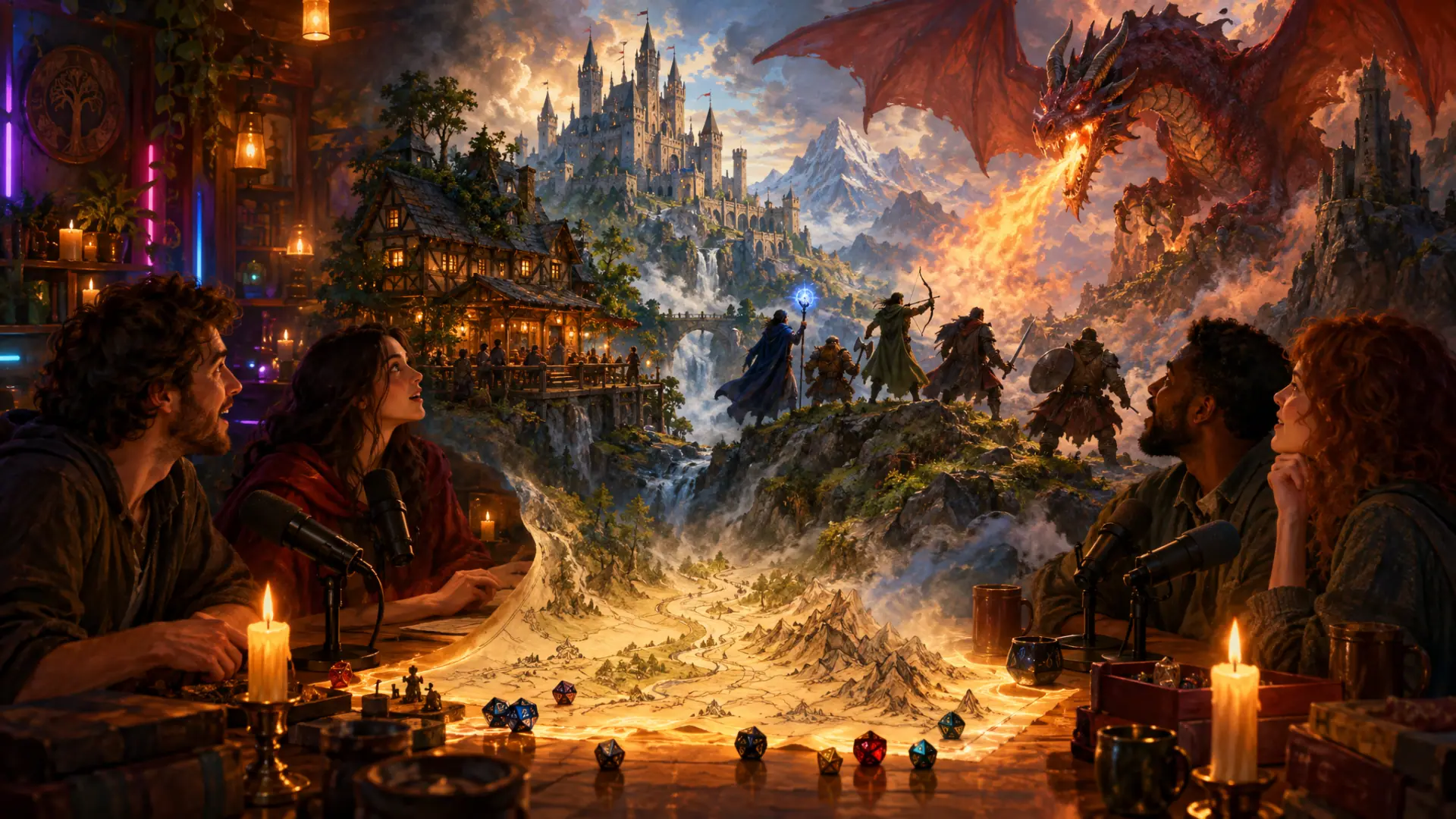
Television's long serial form suited fantasy's sprawling sagas better than film ever could. Animation kept the genre alive on screen through lean decades, and Game of Thrones made epic fantasy the prestige drama of its era.
Hallmarks
- Serial storytelling long enough for sprawling casts, politics and multi-book sagas
- Animation as a home for fantasy long before live-action budgets could manage it
- Saturday-morning cartoons built to sell toys and games, from He-Man to Dungeons & Dragons
- Syndicated sword-and-sorcery adventure in the 1990s, then prestige cable and streaming epics
- Adaptation of novels, games and, lately, actual-play campaigns
- Budgets per episode that now rival feature films
What it is
Fantasy television is any series, miniseries or TV film built on magic, myth or invented worlds, from live-action epics to cartoons. It overlaps with its cinematic sibling, fantasy film, in subject but differs in shape. A film must close its story in two or three hours; a series can run for dozens of hours across years, which is exactly the scale of the doorstop fantasy novel and the long-running tabletop campaign.
For most of its history the genre lived at the margins of the schedule: children's animation, comedies about witches and genies, syndicated adventure shows. Its modern identity was forged in two places. Animation kept fantasy on screen when live-action effects were too expensive, and prestige cable and then streaming, beginning with Game of Thrones, turned it into the most lavishly funded drama on television.
Origins
Early television flirted with the fantastic through anthology series such as The Twilight Zone (1959) and sitcoms like Bewitched (1964), in which magic intruded on suburbia. Secondary-world fantasy arrived through animation. On November 27, 1977, NBC aired Rankin/Bass's The Hobbit, animated in Tokyo by Topcraft, as a Sunday-night special; its teleplay won a Peabody Award.
The 1980s turned Saturday morning into fantasy territory. Filmation's He-Man and the Masters of the Universe (1983) sold barbarians and sorcerers alongside a toy line, and the same year CBS launched the Dungeons & Dragons animated series, co-produced by TSR and Marvel with Gary Gygax as a co-producer, in which six children are pulled into the Realm and each given a D&D class. It ran until 1985, amid complaints from activists during the Satanic Panic. In Japan, the 1990 anime Record of Lodoss War adapted a saga that had begun as "replays," published transcripts of Dungeons & Dragons sessions in the magazine Comptiq, making it an ancestor of both anime fantasy and actual play.
Evolution
In the 1990s syndication brought campy sword-and-sorcery to prime time with Hercules: The Legendary Journeys (1995) and its spin-off Xena: Warrior Princess (1995–2001), while Buffy the Vampire Slayer (1997–2003) made urban fantasy a television staple. The 2000s added miniseries adaptations, among them a 2004 Earthsea for the Sci-Fi Channel that departed so far from Le Guin's books that she publicly criticized it, and Hogfather (2006), from Terry Pratchett's Discworld. The BBC's Merlin (2008–12) retold Arthurian legend for families, and Nickelodeon's Avatar: The Last Airbender (2005–08) proved animated fantasy could carry serious serialized storytelling.
Then came Game of Thrones (2011–19), HBO's adaptation of George R. R. Martin's A Song of Ice and Fire. Its Grimdark politics, shocking deaths and dragons made it a global event, and it won a record 59 Primetime Emmys. The streaming services raced to find the next one: Netflix's The Witcher (2019), from Andrzej Sapkowski's novels; Amazon's The Wheel of Time (2021) and the enormously expensive The Rings of Power (2022); HBO's prequel House of the Dragon (2022).
Animation found new ambitions too. Netflix's Arcane (2021), set in the world of the game League of Legends, showed games could be adapted with prestige; the anime of Sword Art Online (2012) spread the game-world story that feeds LitRPG. Most striking, Critical Role's crowdfunded The Legend of Vox Machina (2022) turned a streamed D&D campaign run by Matthew Mercer into an adult animated series on Prime Video. Stranger Things (2016–25), meanwhile, put a D&D game at the heart of a horror-fantasy hit and helped introduce the hobby to new audiences.
How to tell it apart
Fantasy television vs fantasy film. Length and rhythm. Film favors spectacle and compression; television favors character, politics and the slow build. Game of Thrones could follow dozens of point-of-view characters because it had 73 episodes.
Fantasy vs other "telefantasy." British critics use "telefantasy" to cover everything fantastic, from time travel to ghosts. Science-fiction series explain their wonders; supernatural horror uses them to frighten. Fantasy in the narrower sense builds on magic, myth and invented worlds, though shows like Buffy happily straddle the lines.
Fantasy animation vs children's television. Not every talking animal makes a fantasy show. The genre label fits when a series is built around fantasy's furniture, wizards, quests, magic swords, dragons, as He-Man and the D&D cartoon were, and increasingly when it is aimed at adults, as Arcane and Vox Machina are.
Fantasy television vs actual play. An actual-play show is a real game recorded as it happens; a scripted series like Vox Machina is written, voiced and animated afterward, even when it adapts one.
Where to start
- The Hobbit (1977): Rankin/Bass's television Middle-earth, the starting point for many viewers.
- Dungeons & Dragons (1983–85): the Saturday-morning show that carried the game to children who had never rolled a die.
- Avatar: The Last Airbender (2005–08): serialized animated fantasy at its finest.
- Game of Thrones (2011–19): the show that made epic fantasy prestige television.
- The Legend of Vox Machina (2022– ): a tabletop campaign reborn as animation.
- The Rings of Power (2022– ): Tolkien's Second Age at blockbuster scale.
Marginalia
- Rankin/Bass's animated The Hobbit premiered on NBC in November 1977, and its teleplay won a Peabody Award.
- The Dungeons & Dragons cartoon ran on CBS from 1983 to 1985; Gary Gygax served as a co-producer.
- Game of Thrones won 59 Primetime Emmy Awards, a record for a drama series.
- Season 1 of The Rings of Power reportedly cost about $465 million, among the most expensive TV seasons ever made.
- The 1990 anime Record of Lodoss War adapted a saga that began as published transcripts of real Dungeons & Dragons sessions in Japan.
- The Kickstarter for The Legend of Vox Machina raised about $11.4 million in 2019, then a record for a film or TV project on the platform.
- British critics use the umbrella term 'telefantasy' for any television with fantastic elements.
Quick answers
- What is Fantasy Television & Animation?
- From Rankin/Bass hobbits and Saturday-morning Dungeons & Dragons to Game of Thrones and streaming Middle-earth, fantasy television grew from a cartoon ghetto into the most expensive drama ever made.
- What are the hallmarks of Fantasy Television & Animation?
- Serial storytelling long enough for sprawling casts, politics and multi-book sagas; Animation as a home for fantasy long before live-action budgets could manage it; Saturday-morning cartoons built to sell toys and games, from He-Man to Dungeons & Dragons; Syndicated sword-and-sorcery adventure in the 1990s, then prestige cable and streaming epics; Adaptation of novels, games and, lately, actual-play campaigns; Budgets per episode that now rival feature films.
- When did Fantasy Television & Animation emerge?
- Late 1950s–60s anthologies and sitcoms; secondary-world fantasy from the 1970s–80s.
- What are the key works of Fantasy Television & Animation?
- The Hobbit, Dungeons & Dragons, Game of Thrones, The Lord of the Rings: The Rings of Power, The Legend of Vox Machina and Stranger Things.