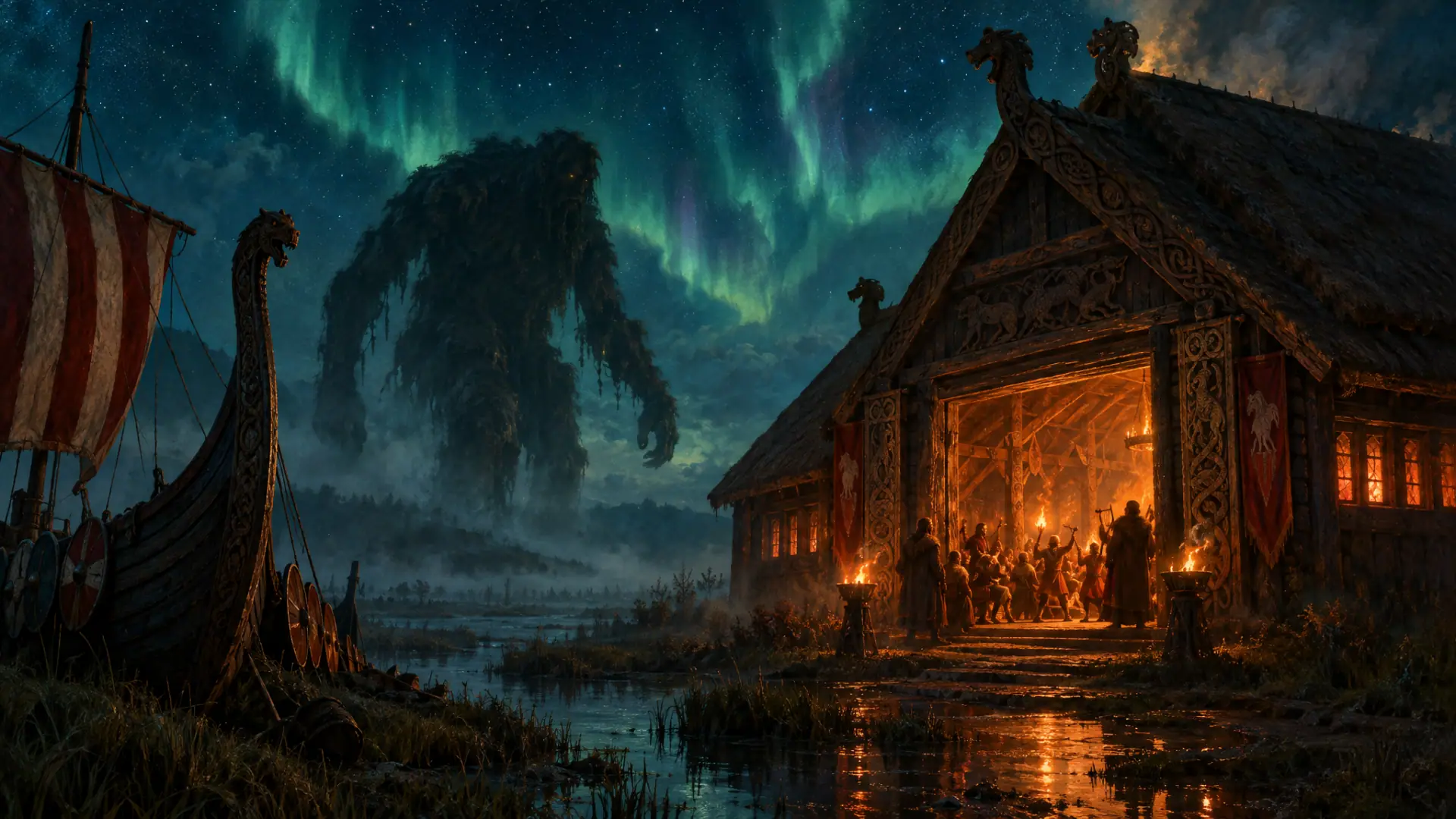
Arthurian legend is fantasy's oldest living shared world: the first great body of invented chivalric adventure, the model for knightly quests in every later genre, and still the subject of novels, films and roleplaying games.
Hallmarks
- King Arthur, Camelot and the Round Table as a shared, endlessly retold cast
- Chivalry tested: loyalty, courtly love and the betrayal that breaks the fellowship
- The Grail quest and other spiritual trials that only the pure can finish
- Merlin, Morgan le Fay, the Lady of the Lake — magic at the edges of a Christian court
- A golden age doomed from the start, ending at Camlann with the promise of return
- Constant reinvention: Welsh, French, English, feminist, comic and gaming versions
What it is
Arthurian fantasy is any fiction built on the legend of King Arthur: his miraculous kingship, his court at Camelot, the fellowship of the Round Table, the quest for the Holy Grail, and the adultery, feud and final battle that destroy it all. Medieval writers called this body of story the "Matter of Britain," one of three great story-cycles alongside the Matter of France (Charlemagne) and the Matter of Rome (classical myth). What makes it a genre rather than a single tale is its openness. No one owns Arthur. Every century has retold him, and each retelling adds knights, rearranges loyalties and asks what the fall of Camelot means now.
Origins
The historical Arthur, if there was one, is lost in post-Roman Britain. Early Welsh poetry and prose name him, and the tale "Culhwch and Olwen," later gathered into The Mabinogion, shows a wild, folkloric Arthur hunting a magical boar. The decisive step came around 1136, when Geoffrey of Monmouth's Latin History of the Kings of Britain presented Arthur as a conquering king who defeats the Saxons and marches on Rome. Geoffrey's pseudo-history spread fast, into French verse by Wace and beyond.
In France, the romance took over. Chrétien de Troyes, active roughly 1160–1191, is the first writer known to mention Camelot and the Lancelot–Guinevere affair (in Lancelot, the Knight of the Cart) and the Grail (in the unfinished Perceval). In the 13th century the enormous prose Vulgate Cycle wove these strands into a single history ending in doom. In England, Sir Thomas Malory condensed the French cycles into Le Morte d'Arthur, completed around 1470 and printed by William Caxton in 1485 — the English canon ever since.
Evolution
Interest faded after the Middle Ages, though Arthur still rides through Spenser's The Faerie Queene (1590) as a questing prince. The Victorians revived him wholesale: Tennyson's Idylls of the King (1859–1885) made the Round Table a mirror for moral duty, and Pre-Raphaelite painters and William Morris turned it into a visual language. In the 20th century T. H. White rewrote Malory with wit and grief in The Sword in the Stone (1938), collected with its sequels as The Once and Future King (1958), which in turn inspired Disney's 1963 animated film and the 1960 musical Camelot.
After Tolkien, novelists pulled the legend in every direction. Mary Stewart's The Crystal Cave (1970) told it through a realistically Dark Age Merlin; Marion Zimmer Bradley's The Mists of Avalon (1983) retold it from the viewpoint of Morgaine and the women of the court. On screen, John Boorman's Excalibur (1981) staged Malory as operatic myth, while Monty Python and the Holy Grail (1975) proved the story robust enough to survive total parody.
Games treated Camelot as the ultimate Campaign setting. Greg Stafford's King Arthur Pendragon (1985) follows Malory's chronology and gives knights personality traits and passions that can overrule the player's intentions, with families carrying on across generations. Dark Age of Camelot (2001) made the Arthurian realm of Albion one of three warring factions in an MMORPGs. Early D&D's Deities & Demigods (1980) even statted Arthur's knights.
How to tell it apart
- Arthurian vs. High / Epic Fantasy: high fantasy invents its world and its king; Arthurian fantasy inherits a fixed cast and a known ending. Readers know Camelot falls — the art is in how.
- vs. Historical Fantasy: "historical" Arthurian novels (Stewart, Bernard Cornwell's Warlord books) overlap with historical fantasy by planting the legend in 5th- or 6th-century Britain. Romance-style versions (Malory, White) float in an idealized, anachronistic Middle Ages instead.
- vs. Myth & Epic: the medieval romances are the source texts; modern Arthurian fantasy is authored reinterpretation. The line is Malory: before him is source, after him mostly retelling.
- vs. Mythic Fantasy: Arthurian fantasy is a specialized branch of mythic retelling, distinguished by its single, continuous story-world and its chivalric code.
Where to start
- Le Morte d'Arthur — the version everyone else is answering; dip into the Grail and final books.
- The Once and Future King — T. H. White's funny, heartbreaking modern retelling.
- The Crystal Cave (Mary Stewart, 1970) — Merlin's boyhood in a convincingly ancient Britain.
- The Mists of Avalon (Marion Zimmer Bradley, 1983) — the legend from the women's side.
- Excalibur — the legend as fever dream, in chrome armor.
- King Arthur Pendragon — the best argument for why Camelot makes a great campaign.
Marginalia
- Geoffrey of Monmouth's Latin History of the Kings of Britain (c. 1136) turned a shadowy war-leader into a conqueror who marches on Rome.
- Chrétien de Troyes is the first writer known to mention the Holy Grail, Camelot, and the love affair of Lancelot and Guinevere.
- Sir Thomas Malory finished Le Morte d'Arthur around 1470, reportedly while imprisoned; William Caxton printed it in 1485.
- Tennyson's Idylls of the King appeared in instalments between 1859 and 1885 and made Arthur a Victorian obsession.
- T. H. White's The Sword in the Stone (1938) became the first book of The Once and Future King (1958), the source of the musical Camelot.
- Greg Stafford's King Arthur Pendragon (1985) has players run knightly dynasties across generations of Malory's timeline.
Quick answers
- What is Arthurian Fantasy?
- Nine centuries of retelling one story — the sword, the Round Table, the Grail and the fall — from Geoffrey of Monmouth and Malory to T. H. White, Excalibur and Pendragon.
- What are the hallmarks of Arthurian Fantasy?
- King Arthur, Camelot and the Round Table as a shared, endlessly retold cast; Chivalry tested: loyalty, courtly love and the betrayal that breaks the fellowship; The Grail quest and other spiritual trials that only the pure can finish; Merlin, Morgan le Fay, the Lady of the Lake — magic at the edges of a Christian court; A golden age doomed from the start, ending at Camlann with the promise of return; Constant reinvention: Welsh, French, English, feminist, comic and gaming versions.
- When did Arthurian Fantasy emerge?
- c. 1136 (Geoffrey of Monmouth) — medieval romance to the present.
- Where does the name “Arthurian Fantasy” come from?
- Medieval writers called it the "Matter of Britain," a phrase from the 12th-century poet Jean Bodel.
- What are the key works of Arthurian Fantasy?
- Le Morte d'Arthur, The Once and Future King, The Mabinogion, The Faerie Queene, Excalibur, King Arthur Pendragon and Dark Age of Camelot.