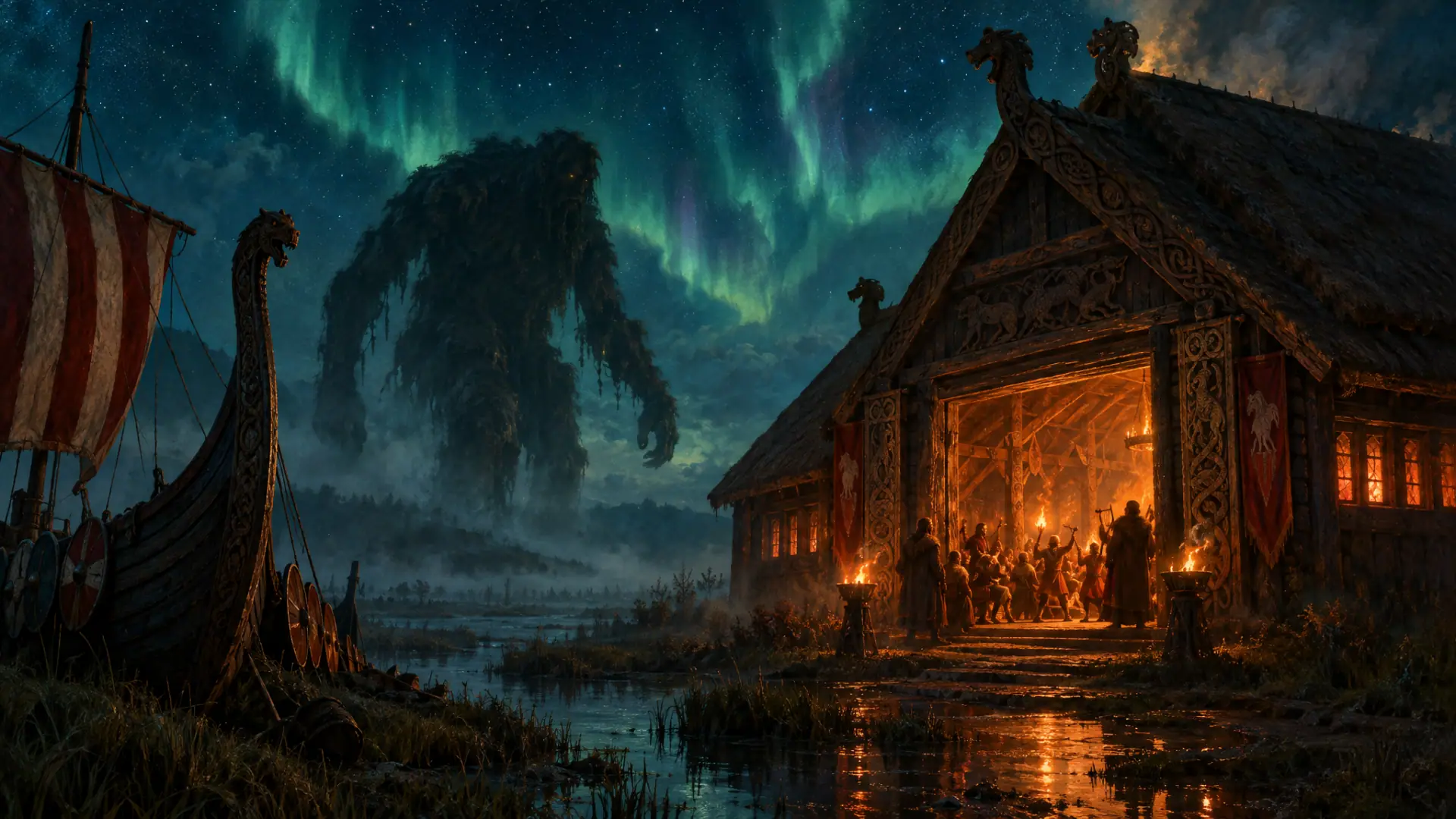
From clay tablets in Uruk to a Welsh manuscript and Caxton's press, the epics and sagas that gave fantasy its heroes, dragons, dwarves and descents into the dark.
Some time around the twenty-first century BCE, in the cities of southern Mesopotamia, scribes pressed wedge-shaped marks into wet clay to record the deeds of a king of Uruk who had wanted to live forever. Nearly four thousand years later a museum assistant in London, piecing together broken tablets from the ruins of Nineveh, found in them a story of a great flood, and fantasy's deepest foundations came back into the light. This chapter spans more than three and a half millennia, from Gilgamesh to the first printed Arthur, and no single thread runs through it. What these stories share is a set of shapes: the hero and his companion, the monster at the edge of the world, the journey down among the dead, the hoard and the curse on it. Modern fantasy did not borrow these shapes loosely. Its founders were philologists, translators and medievalists who had read these texts in their original tongues, and when the first dungeon crawlers went looking for monsters, they found them here.
Clay, cedar and the first quest
The Epic of Gilgamesh is the oldest surviving long narrative in world literature, and it already contains the whole grammar of the adventure story. It began as separate Sumerian poems about Gilgamesh, king of Uruk, some of which may date to around 2100 BCE. These were combined into an Akkadian epic, the "Old Babylonian" version, by the eighteenth century BCE, and later reworked into the twelve-tablet Standard Babylonian version credited to a scribe named Sîn-lēqi-unninni, sometime between the thirteenth and tenth centuries BCE. Many of the best tablets come from the library of the Assyrian king Ashurbanipal at Nineveh, excavated by Austen Henry Layard, Hormuzd Rassam and others in the early 1850s. When George Smith of the British Museum read his translation of the flood tablet to the Society of Biblical Archaeology on December 3, 1872, with the prime minister in the audience, it was a sensation.
The story it told was of a tyrant tamed by friendship. The gods create the wild man Enkidu to check Gilgamesh; the two fight, then become inseparable, and together they march to the Cedar Forest to kill its monstrous guardian, Humbaba, and later slay the Bull of Heaven. The gods demand a death, Enkidu sickens and dies, and the grieving Gilgamesh sets out across the waters of death to find Utnapishtim, the survivor of the flood, and learn the secret of immortality. He finds it, a plant that restores youth, and loses it to a serpent while he bathes. The first great quest of literature ends in failure and acceptance. Here, already, is the two-hero The party, the guarded forest, the monster slain for glory and the price paid for it, and the journey past the edge of the map. Another Mesopotamian monster, the primordial sea-goddess Tiamat of the separate creation poem Enūma Eliš, slain by the god Marduk and often imagined as a Dragon, would one day give her name to the five-headed queen of evil dragons in D&D.
Wine-dark seas and the road to the dead
Homer's The Odyssey, composed in the Greek oral tradition and usually dated to the eighth or seventh century BCE (there is no scholarly consensus on exactly when or how it was written down), gave the West its model of the wandering hero who wins by wit rather than strength. Odysseus spends ten years trying to get home from Troy, and his adventures are a catalogue of encounters that game designers still stock: the one-eyed Giant Polyphemus in his cave, blinded and tricked; the enchantress Circe, who turns men into swine; the Sirens, whose song lures sailors to their deaths; the paired horrors of Scylla and Charybdis; the island of the Lotus-Eaters where men forget to want home.
In Book 11, the Nekyia, Odysseus goes to the edge of the underworld, digs a trench, pours out blood and speaks with the shades of the dead. The descent into the underworld (the Greek katabasis) is the ancestor of every Dungeon crawl: a hero goes down into the dark, faces what dwells there and comes back up changed and laden with knowledge or treasure. The Greek world also supplied a bestiary. The Minotaur in its labyrinth, the Griffin guarding gold, the Phoenix reborn from its own ashes (already described by Herodotus in the fifth century BCE), and later, in Pliny the Elder's Natural History (77 CE), the Basilisk whose glance kills and the Unicorn of travelers' tales all walked out of classical literature and, via the medieval bestiaries, into the Monster Manual. Greek epic also established the idea of a fixed cast of deities meddling in mortal affairs, a pantheon that D&D's Deities & Demigods (1980) would one day stat up alongside the Norse and Babylonian gods.
Monsters in the mere
Sometime between about 700 and 1000 CE, the date is still argued, an Anglo-Saxon poet composed Beowulf, a 3,182-line poem about a Geatish warrior who crosses the sea to rid the Danish king Hrothgar's hall of a man-eating monster. It survives by a thread: one manuscript, the Nowell Codex, copied around the turn of the first millennium and later owned by the antiquary Sir Robert Cotton. In 1731 a fire swept through Ashburnham House in London, where the Cotton library was kept, and the manuscript was pulled out with its edges charred. The Icelandic scholar Grímur Jónsson Thorkelin had transcriptions made in 1786, and published the first complete edition in 1815.
The poem's monsters are the template for fantasy's darkest encounters. Grendel, a descendant of Cain, stalks out of the fens at night; his mother, more terrible still, waits in a lair beneath a haunted mere where Beowulf must dive to fight her. And in the poem's last act the old king Beowulf faces a Dragon roused when a thief steals a jeweled cup from its hoard, a detail any reader of The Hobbit will recognize. The poem even lends fantasy its vocabulary. Among the monstrous descendants of Cain it lists orcneas, and when J. R. R. Tolkien needed a word for his goblin-soldiers he said he took "orc" from Old English; the poem's phrase enta geweorc, "the work of giants," is where his tree-herding Ents found their name (see Orc and Treant).
It was Tolkien, too, who changed how Beowulf was read. In his British Academy lecture of November 25, 1936, "Beowulf: The Monsters and the Critics," he rebuked scholars who treated the monsters as an embarrassing distraction from the poem's history. The monsters, he argued, were the point. That argument is as good a founding statement for modern fantasy as any, and a year later The Hobbit was in the shops (see Tolkien, Lewis & the Inklings). William Morris, whose novels begin the story of The Invention of Modern Fantasy, had published an archaizing verse translation in 1895, leaning heavily on A. J. Wyatt's scholarship.
The North, remembered in Iceland
The richest single source for fantasy's creatures is a pair of thirteenth-century Icelandic books known as The Eddas. The Prose Edda was written around 1220 by the chieftain, lawspeaker and poet Snorri Sturluson as a handbook for young poets who needed to understand the old mythological allusions; it retells the creation of the world from the body of the giant Ymir, the tree Yggdrasil, the gods' feuds with the giants and the final battle of Ragnarök. The Poetic Edda is a collection of older anonymous poems preserved chiefly in the Codex Regius, a manuscript of the 1270s that surfaced in 1643 in the hands of Bishop Brynjólfur Sveinsson, was sent as a gift to the king of Denmark in 1662, and came home to Reykjavík on April 21, 1971, carried by ship under military escort because flying such cargo was judged too risky.
From these pages come the elves (álfar), the dwarves (dvergar) who forge treasures in the earth, the trolls and giants of the wild places, and the Dragon Fáfnir brooding on a cursed hoard until the hero Sigurd kills him and tastes his blood. The poem Völuspá, "the prophecy of the seeress," includes a roll-call of dwarves, the Dvergatal, in which a young Oxford professor found Durin, Thorin, Fíli, Kíli, Bombur, Dori, Nori, Óin and Glóin, a dwarf called Oakenshield (Eikinskjaldi), and even a Gandálfr, "wand-elf." Tolkien simply lifted the list into The Hobbit. The Sigurd story, with its dragon-slaying and its ring that curses every owner, passed through the thirteenth-century Völsunga saga, which Morris translated in 1870, and Richard Wagner's operas on its way to modern fantasy. The Norse imagination of a cold, doomed world fighting a losing war against chaos became the emotional key of High / Epic Fantasy and the scenery of countless games, down to the Nordic province of The Elder Scrolls V: Skyrim.
Snorri himself came to a violent end, assassinated at his farm at Reykholt in 1241 by men claiming to act for the king of Norway. The literary culture he represented, prose sagas of feuds and far voyages told with a spare, fatalistic power, would be admired by Morris, Tolkien and Poul Anderson, whose saga-haunted The Broken Sword (1954) is one of its great modern heirs.
Wales, Arthur and the matter of Britain
On the other side of the North Sea, Welsh storytellers were keeping their own mythology alive in prose. The eleven tales now called The Mabinogion survive in two fourteenth-century manuscripts, the White Book of Rhydderch and the Red Book of Hergest, though the stories themselves are older. At their heart are the Four Branches of the Mabinogi, tales of Pwyll, Branwen, Manawydan and Math, full of shape-shifting, Otherworld hunts, a cauldron that revives the dead and a woman made of flowers. Beside them stands "Culhwch and Olwen," one of the earliest Arthurian stories in any language, in which Arthur's warband helps a young man complete a list of impossible tasks (a structure every quest-giver in a game still uses). Lady Charlotte Guest's translation of 1838–45 gave the collection its name in English; in the twentieth century Lloyd Alexander mined it for The Chronicles of Prydain, and Susan Cooper set parts of The Dark Is Rising in its landscapes.
Arthur himself grew from a shadowy war-leader into a European obsession. Geoffrey of Monmouth's Latin History of the Kings of Britain (around 1136) gave him a court and a conquest; the French poet Chrétien de Troyes added Lancelot, the love affair with Guinevere and, in his unfinished Perceval, the Grail; the vast thirteenth-century French prose cycles wove it all into a history of chivalry. Then an English knight with a criminal record, Sir Thomas Malory, compiled and retold the whole saga in English prose, apparently while in prison, finishing around 1470. William Caxton printed it at Westminster in 1485 as Le Morte d'Arthur. For more than four centuries Caxton's edition was the only known text, until Walter Oakeshott identified a manuscript version in the library of Winchester College in 1934.
Malory's book is the fountainhead of Arthurian Fantasy. It fed Tennyson and the Pre-Raphaelites, T. H. White's The Once and Future King, John Boorman's Excalibur (1981) and Greg Stafford's King Arthur Pendragon roleplaying game (1985). Its code of knighthood — and the related Carolingian legends of Charlemagne's twelve paladins — became, via Poul Anderson, the model for the D&D paladin (see Romance, Fairy Tale & the Gothic). The Round Table itself is a picture of the adventuring party: a fellowship of distinct champions, each with a specialty and a flaw, who ride out on separate quests and return to tell of them.
A thousand and one nights of wonder
While Europe told of knights, the Islamic world was assembling the most influential story collection ever made. One Thousand and One Nights grew from a lost Persian book, the Hezār Afsān ("Thousand Stories"), translated into Arabic probably in the eighth century; the earliest surviving fragment, a few lines on paper, dates to the ninth century, and the full title is first recorded in twelfth-century Cairo. Its frame is itself a survival story: Shahrazad, married to a king who executes each bride after one night, keeps herself alive by telling tales that never quite end. Inside the frame, stories open into stories, and many of them are set in the Baghdad of the caliph Harun al-Rashid.
The Nights gave fantasy the jinn bound into lamps and bottles, flying carpets and enchanted brass horsemen, the enormous roc of Sinbad's voyages, and the Ghoul, from the Arabic ghūl, a shape-shifting desert fiend that haunts graveyards. When the French orientalist Antoine Galland translated the collection as Les mille et une nuits (1704–17) it became a European craze, and Galland added tales that no Arabic manuscript contains: "Aladdin" and "Ali Baba," which he heard from Hanna Diyab, a young Maronite storyteller from Aleppo, in Paris in 1709. Galland's Nights runs straight into the next chapter's Gothic orientalism, and on into the desert settings, genies, wish-granting lamps and treasure caves of computer games and tabletop worlds.
A shared inheritance
It is tempting to say that modern fantasy "borrowed" from these texts. The truth is more intimate. The people who built the genre were, disproportionately, the people who edited, translated and taught them. Tolkien was a professor of Anglo-Saxon who wrote on Beowulf and translated it; C. S. Lewis was a medievalist; Morris translated the sagas; E. R. Eddison translated Egil's Saga. When Gary Gygax and his collaborators went looking for monsters in the 1970s they found them already catalogued, and when they needed gods they reached for Norse, Greek, Babylonian and Arthurian myth, all of which appear in Deities & Demigods. The Myth & Epic tradition is the bedrock under Mythic Fantasy, the museum's name for later fiction that retells these stories directly.
Three things in particular came down intact. First, the monster as an idea: not an animal but a meaning, a thing of chaos at the edge of the ordered world, which is why a dragon in a game still feels like more than a large lizard. Second, the quest: an outward journey with a goal, a series of trials and a return. And third, the fellowship: Gilgamesh and Enkidu, Odysseus and his crew, Arthur's knights, the companions of Sinbad. When a group of players sits down to roll up a party, they are reenacting the oldest social arrangement in literature.
What came next
By 1500, printing presses were turning old stories into books, and the stories were changing as they went. In the next chapter, Romance, Fairy Tale & the Gothic, Renaissance poets turned Charlemagne's paladins into fantastic adventurers riding hippogriffs to the moon, Elizabethan England dressed its queen as a fairy monarch, French salons invented the literary fairy tale, the Gothic novel discovered horror, and two German brothers went out to collect the tales of the countryside, in the same year that a Prussian officer invented the war game.