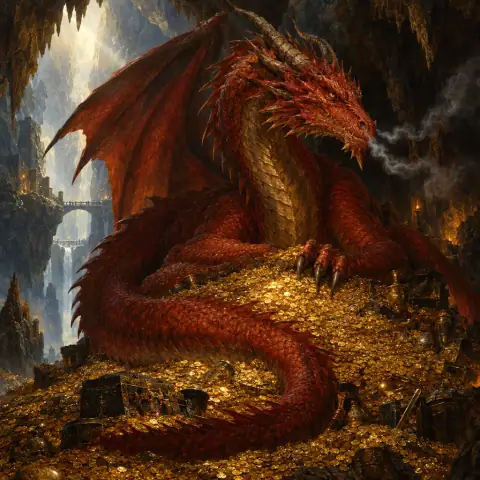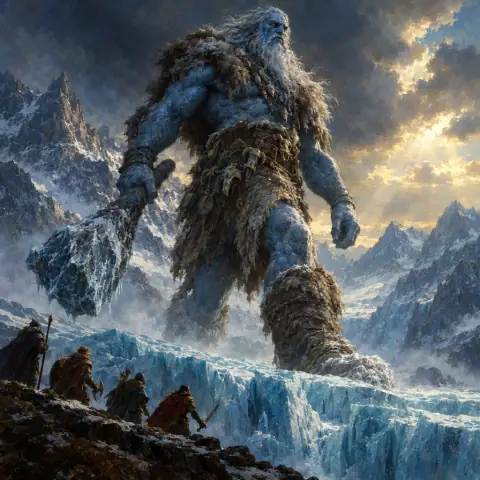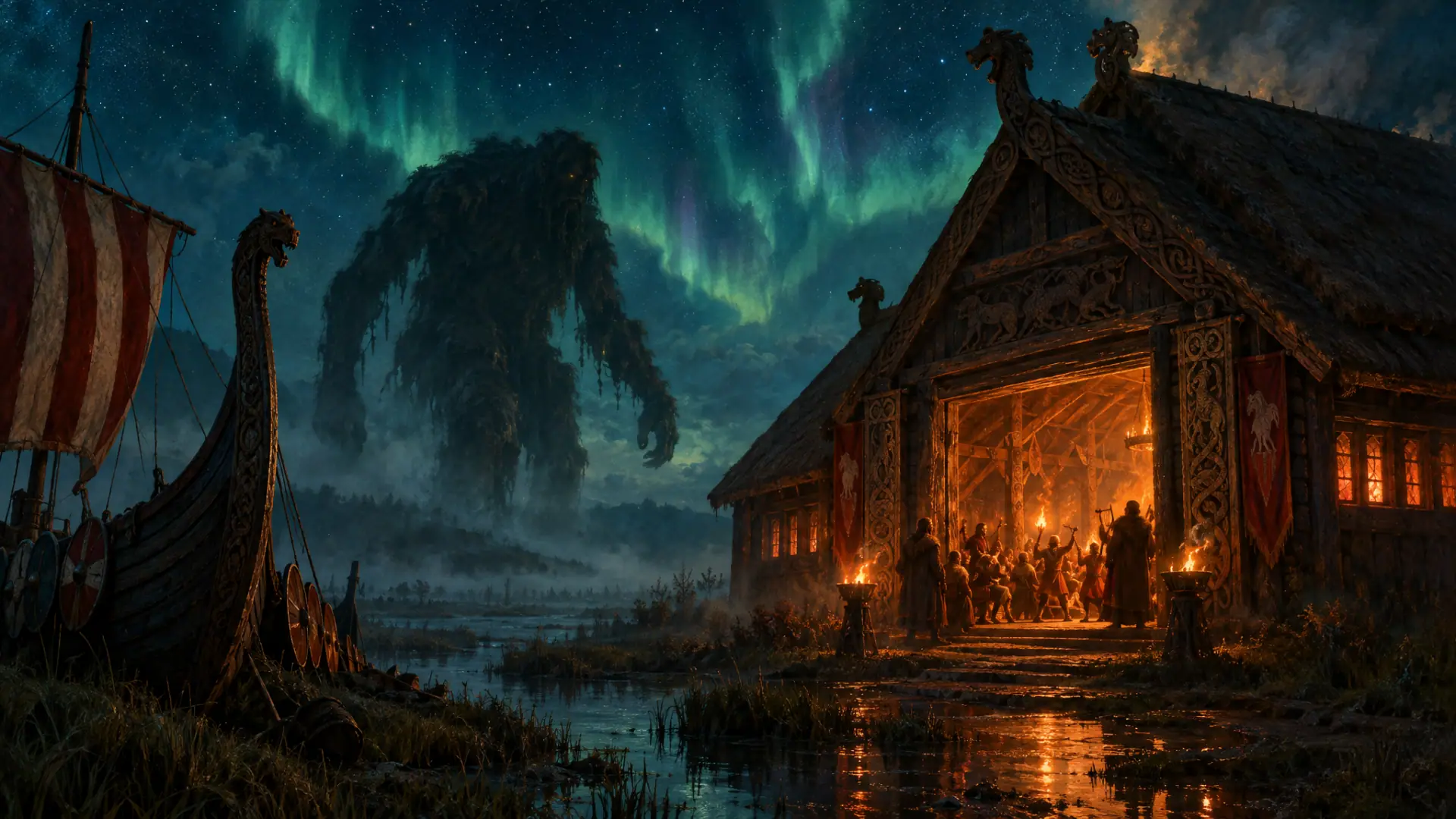
Fantasy did not invent its monsters, underworlds and chosen heroes; it inherited them. Myth and epic are the source layer that Tolkien studied professionally, that Gygax's gods books statted, and that every later genre in this atlas either imitates or argues with.
Hallmarks
- Traditional, often anonymous stories shaped by generations of tellers
- Gods, monsters and heroes of superhuman stature acting on a cosmic stage
- Long verse narratives built for oral performance, with epithets and formulas
- Stakes that are communal or cosmic: the founding of a people, the end of the world
- Journeys to the underworld, quests for immortality, doomed last stands
- A sense of the sacred or the historical, not of invention
What it is
Myth and epic are the oldest rooms in the archive, and in a sense they are not "fantasy" at all. A myth is a traditional story about gods, origins and the shape of the world, told by a culture that took it as sacred or at least foundational. An epic is a long narrative poem, usually composed for performance, about heroes whose deeds define a people: Gilgamesh seeking immortality after his friend Enkidu dies, Odysseus fighting his way home in The Odyssey, Beowulf facing Grendel, Grendel's mother and at last a Dragon. Their audiences did not experience them as invented escapes. They were history, scripture, genealogy and entertainment at once.
That is exactly why fantasy keeps returning to them. Nearly every furniture piece of the modern genre — the underworld journey, the magic sword, the shape-shifter, the giants at the world's edge, the prophecy that cannot be dodged — was already here, polished by centuries of retelling.
Origins
The written record begins in Mesopotamia. The literary history of Gilgamesh starts with five Sumerian poems about the king of Uruk, some of which may date to around 2100 BCE; an Old Babylonian epic in Akkadian followed in the 18th century BCE, and the fuller Standard Babylonian version, attributed to Sîn-lēqi-unninni, was compiled somewhere between the 13th and 10th centuries BCE. Some of its best tablets were found in the ruins of the Assyrian king Ashurbanipal's library.
Greek epic crystallized in the Homeric poems, conventionally dated to around the 8th century BCE, which still carry the marks of oral composition — repeated epithets, stock scenes, formulas that let a singer build lines on the fly. Northern Europe's great heroic poem, Beowulf, was composed in Old English sometime between roughly 700 and 1000 CE and survives in just one manuscript. The Norse myths reached us through two Icelandic books: the anonymous poems of the Poetic Edda and the Prose Edda of Snorri Sturluson, written around 1220 as a guide for poets (see The Eddas). Wales supplied the tales later gathered as The Mabinogion, which Lady Charlotte Guest published in English between 1838 and 1845.
Evolution
Epic did not stop with antiquity. Renaissance poets fused it with chivalric romance: Ariosto's Orlando Furioso (1516) sends knights to the Moon on a hippogriff, and Spenser's The Faerie Queene (1590) turns the form into moral allegory. The collected story-cycle of One Thousand and One Nights, arriving in Europe through Antoine Galland's French translation from 1704, added djinn, flying carpets and sorcerers to the Western imagination.
The 19th century turned myth into a scholarly and national project. The Grimms collected folklore to recover a German past; Elias Lönnrot assembled the Finnish Kalevala (1835, expanded 1849) from oral songs; William Morris translated Icelandic sagas and then wrote invented medieval romances in their manner. That line runs straight to J. R. R. Tolkien, an Oxford professor of Anglo-Saxon whose 1936 lecture "Beowulf: The Monsters and the Critics" defended the poem's monsters as central to its meaning, and whose Middle-earth borrowed names from the Eddas, a tragic hero from the Kalevala's Kullervo, and a dragon-hoard theft straight out of Beowulf.
Games inherited the same library. The early D&D supplement Gods, Demi-Gods & Heroes (1976) and the hardcover Deities & Demigods (1980) gave statistics to Zeus, Odin and Ra; the monster lists of every RPG since is thick with minotaurs, basilisks, Kraken and trolls that walked out of myth.
How to tell it apart
Folklorists have long separated myth (sacred narrative set in a remote, formative past), legend (a story told as history, set in the recognizable past) and folktale (openly fictional, "once upon a time"). Myth and epic belong to the first two categories, and that is the crucial line between this exhibit and its descendants:
- Myth & epic vs. Mythic Fantasy: the ancient texts are traditional and collectively shaped; mythic fantasy is a modern author deliberately retelling or reworking them, like Madeline Miller's Circe reworking the Odyssey.
- vs. High / Epic Fantasy: high fantasy imitates the epic's scale and moral weight inside an invented Secondary world written by one person. The Lord of the Rings reads like an epic; Beowulf was one.
- vs. Fairy-Tale Fantasy: fairy tales descend from folktale — small, domestic, often nameless characters. Epic heroes have genealogies, kingdoms and gods watching.
- vs. Sword & Sorcery: Conan borrows the epic hero's body but not his burden. Gilgamesh and Beowulf act for their people; the barbarian acts for himself.
Where to start
- Epic of Gilgamesh in a modern translation — the oldest story here, and still devastating on grief and mortality.
- The Odyssey — the template for every wandering-hero campaign.
- Beowulf, ideally in Seamus Heaney's 1999 translation, then Tolkien's lecture on it.
- The Eddas — the Prose Edda first, for the clearest account of the Norse gods and Ragnarök.
- The Mabinogion — Welsh strangeness that seeded Arthurian Fantasy and Lloyd Alexander's Prydain.
Marginalia
- The oldest Gilgamesh material is a set of Sumerian poems that may date to around 2100 BCE; the later 12-tablet Standard Babylonian version is attributed to the scholar Sîn-lēqi-unninni.
- Beowulf survives in a single manuscript, which was scorched in the Cotton library fire of 1731.
- J. R. R. Tolkien's 1936 lecture "Beowulf: The Monsters and the Critics" argued that the poem's dragon and Grendel were its heart, not an embarrassment.
- Snorri Sturluson wrote the Prose Edda around 1220 partly as a handbook for poets who needed to understand the old myths behind skaldic verse.
- Elias Lönnrot's Finnish Kalevala (1835; expanded 1849) fed Tolkien's tale of Túrin, who owes much to the tragic Kullervo.
- D&D statted the gods of real mythologies in Gods, Demi-Gods & Heroes (1976) and again in Deities & Demigods (1980).
Quick answers
- What is Myth & Epic?
- The bedrock of the whole museum: the myths, sagas and heroic poems — Gilgamesh, Homer, Beowulf, the Eddas — from which every dragon, quest and doomed hero in fantasy was quarried.
- What are the hallmarks of Myth & Epic?
- Traditional, often anonymous stories shaped by generations of tellers; Gods, monsters and heroes of superhuman stature acting on a cosmic stage; Long verse narratives built for oral performance, with epithets and formulas; Stakes that are communal or cosmic: the founding of a people, the end of the world; Journeys to the underworld, quests for immortality, doomed last stands; A sense of the sacred or the historical, not of invention.
- When did Myth & Epic emerge?
- c. 2100 BCE (earliest Gilgamesh poems) onward.
- Where does the name “Myth & Epic” come from?
- "Epic" comes from the Greek epos, "word" or "song"; "myth" from mythos, "story"
- What are the key works of Myth & Epic?
- Epic of Gilgamesh, The Odyssey, Beowulf, The Eddas, The Mabinogion, One Thousand and One Nights, Orlando Furioso and The Faerie Queene.