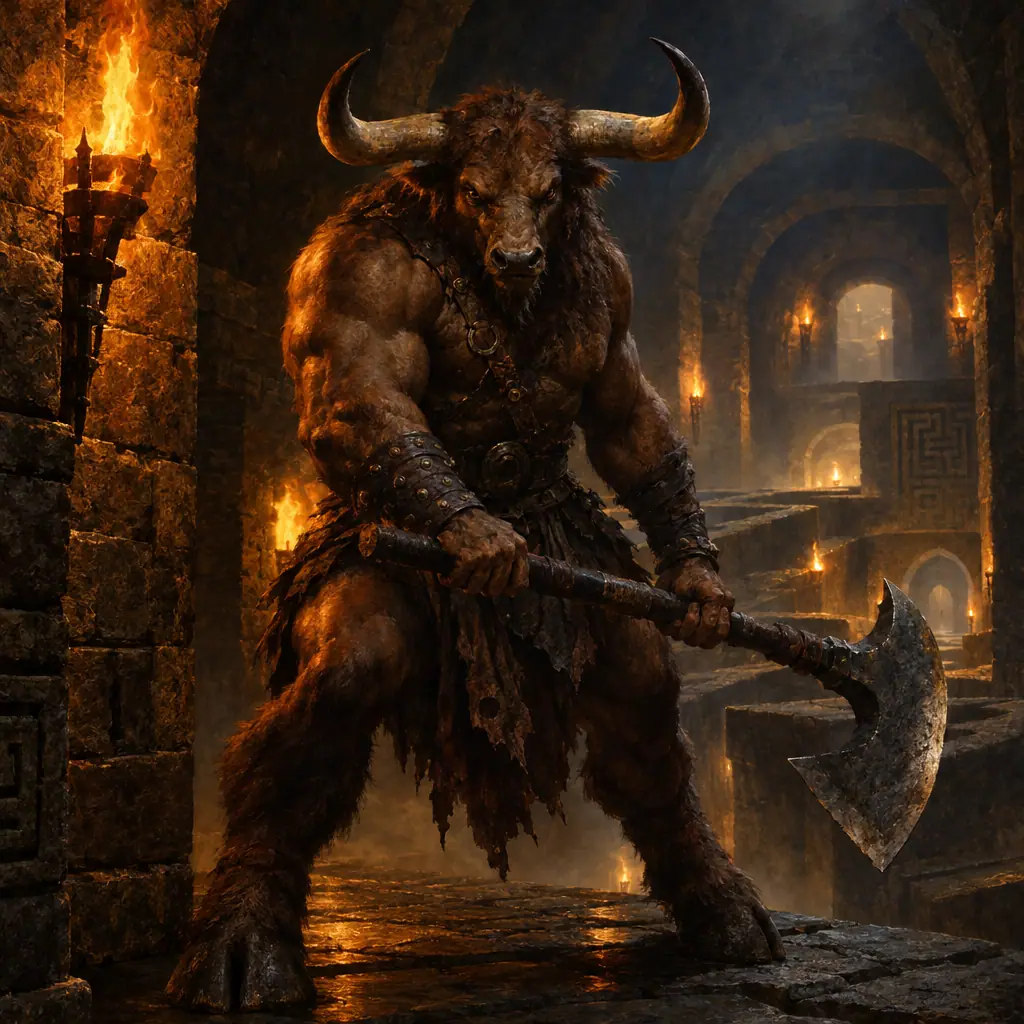
The Minotaur gave fantasy its founding image of the dungeon: a monster waiting at the center of a maze built to contain it. Games made it a species, a playable people, and the boss at the end of countless labyrinths.
Origins
The story begins with a broken promise. Minos, seeking the throne of Crete, prayed to Poseidon for a sign, and the god sent a snow-white bull from the sea to be sacrificed. Minos kept the bull and offered another. In punishment Poseidon made the king's wife, Pasiphaë, fall in love with the animal, and the craftsman Daedalus built her a hollow wooden cow so that she could lie with it. The child was the Minotaur, the "Bull of Minos", known on Crete as Asterion: a man's body with a bull's head and tail, and a hunger for human flesh.
Minos had Daedalus build the Labyrinth to hold it. After Minos's son Androgeus died in Attica, Minos made war on Athens and forced it to send tribute, seven young men and seven young women, to be sent into the maze. Plutarch and Ovid say the tribute came every nine years; other sources make it annual. The Athenian prince Theseus volunteered to go, and Minos's daughter Ariadne gave him a ball of thread so that he could find his way out after killing the monster.
Greek painters loved the scene; Theseus stabbing the bull-man is everywhere on 6th-century BCE Athenian pottery, and coins minted at Knossos paired a labyrinth pattern with the Minotaur or a star. Roman poets from Catullus to Ovid retold the myth, and it passed into the Middle Ages: in Canto XII of Dante's Inferno the Minotaur, "the infamy of Crete", guards the circle of the violent. When Arthur Evans excavated the palace at Knossos from 1900, its warren of rooms seemed to some a real labyrinth, though the theory is now generally discredited.
Into the dungeon
For games the Minotaur is the prototype of the Dungeon crawl: a hero goes into a built underground maze, finds the monster at the center and comes back out by memory and wit. Gary Gygax and Dave Arneson's Dungeons & Dragons included minotaurs in its first monster list in 1974, and in doing so made a significant change: the unique son of Pasiphaë became a species of "man-eaters" who dwell in labyrinthine places. The Keep on the Borderlands (1979), the introductory module sold with the Dungeons & Dragons Basic Set, placed a minotaur's confusing maze in its Caves of Chaos, a trap for players who did not map carefully.
Later designers gave the species a society. The Dragonlance setting of Krynn made minotaurs a proud, seafaring, honor-bound people; Dragonlance Adventures (1987) detailed the Bloodsea minotaurs, and Kaz the minotaur fought beside the hero of Richard A. Knaak's novel The Legend of Huma (1988). Dungeons & Dragons 5th Edition made them a playable race in Guildmasters' Guide to Ravnica (2018). Computer games followed: Heroes of Might and Magic recruits minotaurs into its armies, and Dark Age of Camelot's expansion Labyrinth of the Minotaur (November 2006) built a vast underground maze and made minotaurs playable in all three realms.
Variations
Modern writers have often taken the monster's side. Jorge Luis Borges's short story "The House of Asterion" (1947) is narrated by a lonely Minotaur who waits for his "redeemer", and its twist has echoed through literature since. Mary Renault's The King Must Die (1958) rationalized the myth in the light of the Knossos excavations, and Picasso used the Minotaur in the 1930s as an image of desire and violence.
In games, bull-headed brutes recur far beyond the Greek setting, down to the tauren of Warcraft, a noble people with bovine features. The Minotaur's deepest legacy is structural, though: every maze with something waiting at its heart, from Greek epic's underworlds to the procedurally generated labyrinths of the Roguelikes, carries its shape.
Migration
How the creature traveled from story to story.
- 550 BCEAthenian black-figure potteryTheseus killing the bull-headed man is a favorite scene of Archaic Greek vase painters; the myth itself is older than any surviving text.
- 400 BCECoins of KnossosCretan coins show the Labyrinth on one side and the Minotaur, ringed with stars, on the other — a nod to its other name, Asterion.
- 8Ovid, MetamorphosesOvid's 'part man and part bull' and his account of Daedalus's maze fix the story for later Europe.
- 1320Dante, Inferno, Canto XIIThe 'infamy of Crete' guards the circle of the violent, raging at the sight of the living poet.
- 1974Dungeons & Dragons, Monsters & TreasureMinotaurs, 'man-eaters', enter the first monster list — no longer one unique monster but a whole species.
- 1979B2 The Keep on the BorderlandsA minotaur's maze in the Caves of Chaos teaches a generation of players to map carefully.
- 1987Dragonlance AdventuresThe seafaring, honor-bound minotaurs of Krynn turn the monster into a culture — and, later, a playable race.
- 2006Dark Age of Camelot: Labyrinth of the MinotaurAn MMO expansion builds an entire underground labyrinth and adds minotaurs as a race for all three realms.
Marginalia
- 'Minotaur' means 'Bull of Minos'; on Crete the creature was also called Asterion, 'starry one'.
- Athens sent seven young men and seven young women as tribute; Plutarch and Ovid give the interval as every nine years, other sources say yearly.
- Arthur Evans's excavations at Knossos found a palace of many rooms but no labyrinth; the idea that the palace itself inspired the myth is now generally discredited.
- Jorge Luis Borges's 'The House of Asterion' (1947) retells the story from the lonely Minotaur's point of view.
- D&D turned the singular monster into a species in 1974; fifth edition made minotaurs a playable race in Guildmasters' Guide to Ravnica (2018).
- Picasso returned to the Minotaur again and again in the etchings of his Vollard Suite in the 1930s.
Quick answers
- Where does the Minotaur come from?
- Greek myth of Minos, Theseus and the Cretan Labyrinth; common in Greek art by the 6th century BCE.
- When did the Minotaur first appear?
- c. 550 BCE, in Athenian black-figure pottery.
- How did the Minotaur get into games?
- Key appearances: Dungeons & Dragons, Monsters & Treasure (1974), B2 The Keep on the Borderlands (1979), Dragonlance Adventures (1987) and Dark Age of Camelot: Labyrinth of the Minotaur (2006).
- Why is the Minotaur significant?
- The Minotaur gave fantasy its founding image of the dungeon: a monster waiting at the center of a maze built to contain it. Games made it a species, a playable people, and the boss at the end of countless labyrinths.