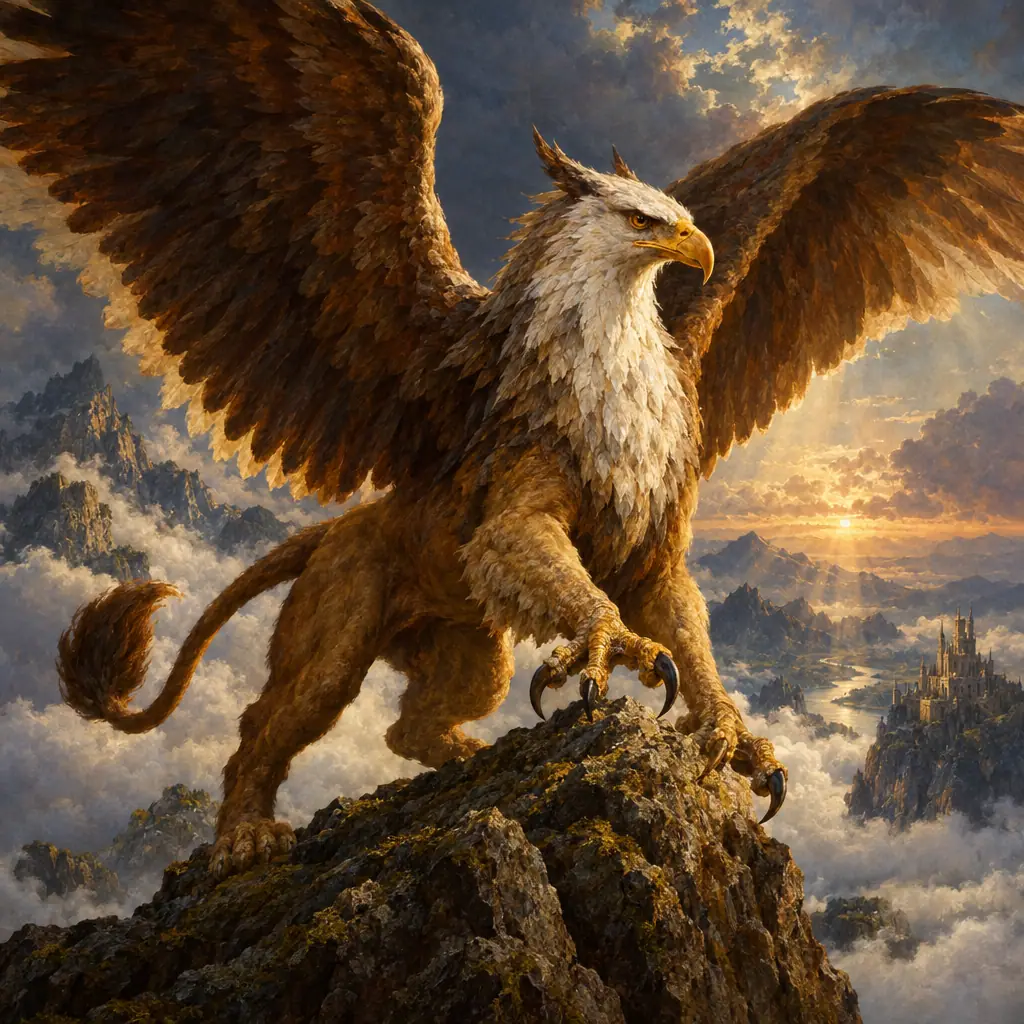
The griffin is among the oldest composite monsters in the museum, and one of the few that games turned from an enemy into a steed — a line that runs from Ariosto's hippogriff to D&D's trained griffons and MMO flight paths.
Origins
Long before anyone wrote its name, artists were carving the griffin. A beaked, four-legged hybrid appears on Egypt's Two Dog Palette from Hierakonpolis, around 3300–3100 BCE, and griffin-like beasts turn up on Mesopotamian cylinder seals of the same age. By the Bronze Age they guarded the Minoan palace at Knossos, where crested griffins flank the throne room, and Greek workshops of the 7th century BCE fixed bronze griffin heads, beaks open as if screaming, around the rims of great cauldrons.
The literary griffin comes from Central Asia. Aristeas of Proconnesus, a Greek who traveled toward the Altai in the 7th century BCE, wrote a poem, now lost, about the gold-guarding griffins of the far north and the one-eyed Arimaspians who raided their hoards on horseback. Aeschylus and Herodotus preserved the story in the 5th century BCE. Scythian gold ornaments show griffins tearing at horses and stags, and the Roman writers added the rest: Pliny the Elder gave them wings and long ears, Aelian gave them black backs and red breasts, and Isidore of Seville declared them the horse's great enemy. Medieval Christians read the union of eagle and lion as a symbol of Christ's two natures, and Dante has a griffin draw the chariot of the Church in the Purgatorio.
From there the griffin flew into heraldry, where it became a sign of strength and courage on the arms of Genoa and Pomerania, and into literature. Ludovico Ariosto's Orlando Furioso (1516) made the hippogriff, the offspring of a griffin and a mare, a knight's winged mount. Lewis Carroll's Gryphon in Alice's Adventures in Wonderland (1865) is a lazy, Cockney-voiced guide who takes Alice to hear the Mock Turtle's story.
Into the dungeon
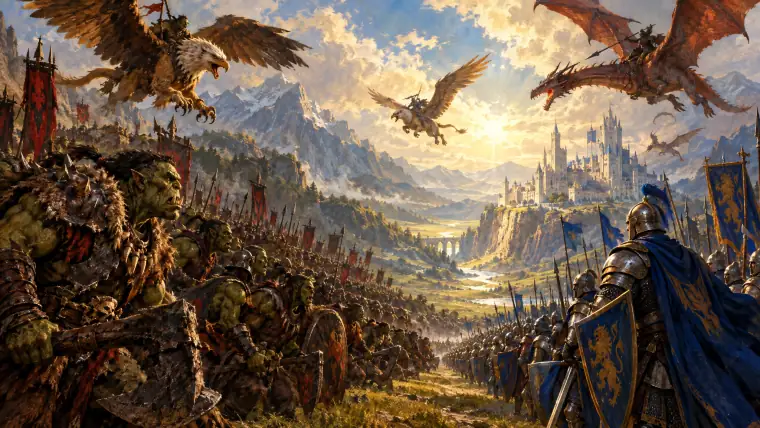
Griffons (D&D uses the French spelling) and hippogriffs were both in the first monster list of Dungeons & Dragons in 1974. The game kept Isidore's detail that griffons love horseflesh, which makes them dangerous neighbors for mounted adventurers, and Ariosto's idea that such beasts could be ridden: later rulebooks let a griffon captured young be trained as a flying steed. That turned a gold-guardian into a prize, and the flying mount became a standard reward in tabletop campaigns.
Video games took the steed idea furthest. Blizzard's Warcraft II (1995) gave the Alliance gryphon riders from the Wildhammer dwarves, and World of Warcraft (2004) made the gryphon master a fixture of every Alliance town, carrying players along fixed flight paths across Azeroth while Horde players rode wyverns. Heroes of Might and Magic and its sequels fielded griffins as recruitable troops, and they appear as mounts, foes or summons throughout fantasy games.
Variations
The hippogriff is the most successful offshoot: J. K. Rowling's proud Buckbeak in Prisoner of Azkaban (1999) made the creature beloved to a generation, and her Harry Potter books also name a whole school house for the griffin. Rebecca Yarros's Empyrean series gives griffins to the fliers of Poromiel as a rival to the dragons of Navarre. Heraldry supplies stranger kin: the sea-griffin with a fish's tail, the opinicus with a camel's tail, and the wingless "male griffin" or keythong of British arms.
The griffin sits beside the Phoenix and the Unicorn as one of the classical composites that fantasy never stopped using. Where the Dragon became the ultimate enemy, the griffin became, more often than not, the ally you ride.
Migration
How the creature traveled from story to story.
- 3300 BCEEgypt and MesopotamiaBeaked, four-legged hybrids appear on the Two Dog Palette from Hierakonpolis and on cylinder seals — the griffin's shape is older than writing about it.
- 1450 BCEPalace of Knossos, CreteCrested griffins flank the Throne Room in Bronze Age frescoes, later restored by Arthur Evans.
- 450 BCEHerodotus and AeschylusDrawing on Aristeas, the Greeks place gold-guarding griffins beyond the one-eyed Arimaspians of Central Asia, who ride in to steal their gold.
- 1516Ariosto's Orlando FuriosoThe griffin's offspring with a mare, the hippogriff, becomes a knight's flying steed.
- 1865Alice's Adventures in WonderlandCarroll's Gryphon, drawn by John Tenniel, escorts Alice to the Mock Turtle.
- 1974Dungeons & Dragons, Monsters & TreasureGriffons and hippogriffs enter the first monster list; griffons have a taste for horseflesh, a trait inherited from medieval lore.
- 2004World of WarcraftAlliance players cross Azeroth on gryphon flight paths, a legacy of the gryphon riders of Warcraft II (1995).
Marginalia
- Griffin-like creatures were carved in Egypt on the Two Dog Palette, c. 3300–3100 BCE, millennia before the Greeks named them.
- Aeschylus called griffins the 'hounds of Zeus'; scholars have wondered whether he imagined them wingless. Pliny first states plainly that they have wings.
- Isidore of Seville (7th century) made griffins 'fierce enemies of horses' — a trait D&D's griffons still have.
- In British heraldry a griffin rearing up is 'segreant', not 'rampant' as a lion would be.
- Hogwarts' Gryffindor house takes its name from the French griffon d'or, 'golden griffin'.
- Folklorist Adrienne Mayor has proposed that Protoceratops fossils in Central Asia inspired griffin lore; other scholars reject the idea.
Quick answers
- Where does the Griffin come from?
- Ancient Near Eastern and Egyptian art (before 3000 BCE); named in Greek from Aristeas's lost poem (7th century BCE)
- When did the Griffin first appear?
- c. 3300 BCE, in Egypt and Mesopotamia.
- How did the Griffin get into games?
- Key appearances: Dungeons & Dragons, Monsters & Treasure (1974) and World of Warcraft (2004).
- Why is the Griffin significant?
- The griffin is among the oldest composite monsters in the museum, and one of the few that games turned from an enemy into a steed — a line that runs from Ariosto's hippogriff to D&D's trained griffons and MMO flight paths.