New World Computing built one of the longest-running Western RPG series of the 1980s and 1990s and, with King's Bounty and Heroes, invented a hybrid of RPG and strategy game that is still imitated.
History
New World Computing began as one young designer's refusal to take no for an answer. Jon Van Caneghem spent roughly three years writing an enormous first-person RPG for the Apple II almost single-handedly, and when no publisher would take it he formed his own company, founded with his wife Michaela Van Caneghem and Mark Caldwell. Sources differ on whether that happened in 1983 or 1984. Might and Magic Book One: The Secret of the Inner Sanctum appeared in 1986, shipped at first from Van Caneghem's apartment until Activision agreed to distribute it, and sold more than 100,000 copies by 1989.
From its offices in Agoura Hills, California, the company grew into a full publisher. It released Might and Magic II: Gates to Another World in 1988, the strategy games Nuclear War (1989) and Planet's Edge (1991), and in 1990 King's Bounty, a turn-based blend of adventuring hero and marching army. In 1994 NTN Communications bought the company for $10 million in stock, and on July 10, 1996, it became a division of The 3DO Company. Under 3DO the studio increasingly concentrated on the Might and Magic universe, but its parent's finances collapsed: 3DO laid off a large part of New World's staff in April 2002 and filed for Chapter 11 bankruptcy in May 2003, taking New World Computing with it. Ubisoft acquired the Might and Magic rights for a reported $1.3 million and has kept the brand alive ever since.
Notable work
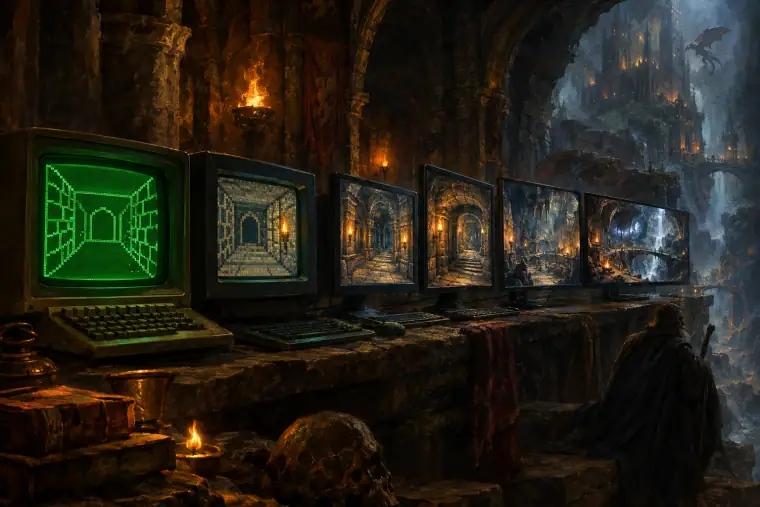
The Might and Magic series was New World Computing's backbone. Its early games were first-person dungeon crawlers in the lineage of Wizardry: Proving Grounds of the Mad Overlord and The Bard's Tale, but far larger and more open than their rivals: whole continents of towns, castles and wilderness to map square by square, a The party of six adventurers, and a science-fiction secret hidden beneath the knights and dragons. Might and Magic IV: Clouds of Xeen (1992) and V: Darkside of Xeen (1993) could be joined into a single game, World of Xeen. Might and Magic VI: The Mandate of Heaven (1998) brought the series into smooth-scrolling 3D, and the line continued to Might and Magic IX in 2002.
The studio's other great invention was the hybrid of RPG and strategy game. King's Bounty led directly to Heroes of Might and Magic (1995), in which heroes gain Experience points and levels while their armies of fantasy creatures — dragons, griffins, minotaurs — fight turn-based battles on a hex grid. Heroes of Might and Magic II (1996) and III (1999) became among the most loved strategy games of their decade, their hot-seat mode letting several players share a single computer.
Legacy
New World Computing sits alongside Origin Systems, Sir-Tech, Interplay and SSI as one of the great American Western Computer RPGs (CRPG) houses of the 1980s, and it outlived most of them in creative vitality. Its sprawling, exploration-heavy RPG worlds foreshadowed the Open-World RPGs, while Heroes created an entire subgenre of fantasy strategy that fans still play competitively, with Heroes III enjoying a devoted community decades after release.
Van Caneghem left the industry's front line after 2003, working at NCSoft in 2004–05 and later on mobile games. Ubisoft has continued both lines under its own studios and licensees, which means the world first mapped on an Apple II in the mid-1980s is still, in one form or another, being explored.
Marginalia
- Jon Van Caneghem self-published Might and Magic Book One in 1986, shipping copies from his own apartment until Activision agreed to distribute it.
- Accounts date the company's founding to 1983 or 1984; its Wikipedia article gives 1984 and names Michaela Van Caneghem and Mark Caldwell as co-founders.
- King's Bounty (1990), a turn-based tactical RPG, was the direct forerunner of Heroes of Might and Magic (1995).
- NTN Communications bought the company for $10 million in stock in 1994; The 3DO Company acquired it on July 10, 1996.
- 3DO filed for Chapter 11 bankruptcy in May 2003, ending New World Computing; Ubisoft acquired the Might and Magic rights for a reported $1.3 million.
- Under Van Caneghem the company published more than 250 titles in about 20 years.
Quick answers
- What was New World Computing?
- Jon Van Caneghem's Southern California studio, which grew from a one-man Apple II epic into the Might and Magic role-playing saga and the turn-based strategy phenomenon Heroes of Might and Magic.
- When was New World Computing founded?
- New World Computing was founded in 1984 and was based in Agoura Hills, California; it closed in 2003.
- Who founded New World Computing?
- Jon Van Caneghem.
- What is New World Computing known for?
- Might and Magic Book One and Heroes of Might and Magic.
- What happened to New World Computing?
- Sold to NTN Communications in 1994 and to The 3DO Company in 1996; closed when 3DO went bankrupt in 2003. Ubisoft bought the Might and Magic rights.