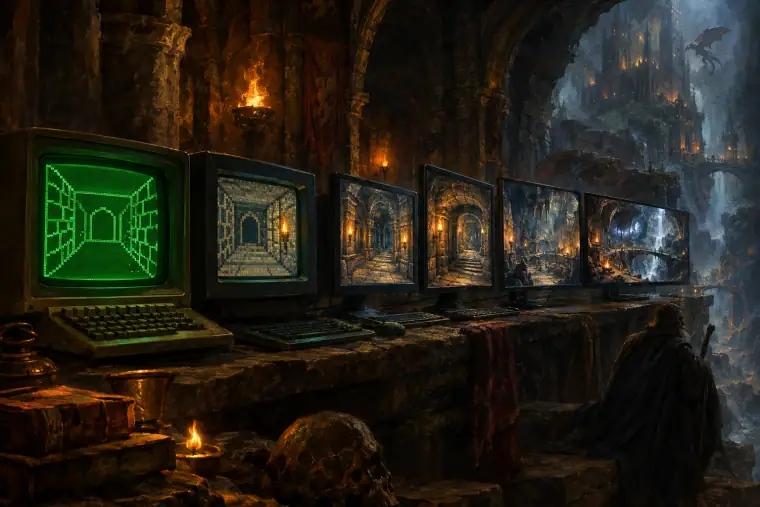
SSI brought official AD&D rules to home computers, publishing some 30 licensed titles from Pool of Radiance to Eye of the Beholder and the first graphical online RPG, AOL's Neverwinter Nights.
History
Strategic Simulations, Inc. was a Miniatures & Board Wargames company before it was anything else. Joel Billings, a board-wargame enthusiast, founded it in the summer of 1979 after realizing that home computers like the TRS-80 could handle the bookkeeping that made hex-and-counter games so slow. Trip Hawkins — then at Apple, and soon the founder of Electronic Arts — persuaded him to back the Apple II, and Computer Bismarck arrived in January 1980. By late 1980 SSI was advertising games "from Waterloo to the Super Bowl," and by 1985 it had some 60 employees and was publishing about a dozen titles a year from its base in Mountain View, California.
The company's turn toward fantasy began in 1984–85 with Questron, the Phantasie series and Wizard's Crown, tactical RPGs that owed as much to tabletop miniatures play as to Ultima or Wizardry: Proving Grounds of the Mad Overlord. Then, in 1987, came the deal that defined it. TSR put the computer rights to Advanced Dungeons & Dragons up for bid, and SSI — smaller and less technically advanced than other bidders — unexpectedly won on the strength of its experience turning complex rules into software.
By 1992 SSI was no longer primarily a wargame house. In 1994 it launched Panzer General, the hit that spawned a "5-Star General" line including Fantasy General (1996), and in the same year it was acquired by Mindscape. Through Mindscape it passed to The Learning Company and Mattel, and in March 2001 to Ubisoft, which retired the SSI brand a few years later.
Notable work
The heart of SSI's legacy is the Gold Box, the engine and house style that began with Pool of Radiance in 1988. Set in the Forgotten Realms and built on real AD&D rules — THAC0, saving throws, memorized spells — it paired a first-person exploration view with turn-based tactical battles on a grid. Pool of Radiance sold 264,536 computer copies in North America and was followed by Curse of the Azure Bonds (1989), Secret of the Silver Blades (1990) and Pools of Darkness (1991); a Dragonlance trilogy beginning with Champions of Krynn (1990); and the Savage Frontier games developed by Stormfront Studios. The line closed with Forgotten Realms: Unlimited Adventures (1993), a construction kit that let players build their own Gold Box modules.
SSI also served as publisher for outside studios. Westwood Associates made Hillsfar (1989) and then Eye of the Beholder (1991), a real-time, Blobber-style First-Person Dungeon Crawlers ('Blobbers') in the vein of Dungeon Master that SSI sold more than 129,000 copies of. Stormfront built Neverwinter Nights (1991) on the Gold Box engine for America Online: the first graphical online RPG, and for years one of AOL's most popular features. In the 1990s SSI carried the license into TSR's newer worlds with Dark Sun: Shattered Lands (1993) for Dark Sun and Ravenloft: Strahd's Possession (1994) for Ravenloft.
Legacy
SSI proved that the full weight of a tabletop rulebook could survive translation to a floppy disk, and it did so while Gary Gygax's AD&D was still the dominant tabletop RPG. The Gold Box set the template — licensed setting, party creation, rules fidelity, turn-based tactics — that BioWare's Baldur's Gate and eventually Baldur's Gate 3 would refine, and Neverwinter Nights on AOL was an early step toward the MMORPGs. Its games are still sold and played today through digital re-releases, and "Gold Box" remains shorthand among RPG fans for the most rules-faithful D&D computer games of their generation.
Marginalia
- Joel Billings founded SSI in the summer of 1979; Trip Hawkins, then at Apple, persuaded him to publish for the Apple II.
- Its first game, Computer Bismarck (January 1980), is described as the first serious wargame published for a microcomputer.
- SSI moved into RPGs in 1984–85 with Questron, Phantasie and Wizard's Crown.
- Smaller than rival bidders, SSI unexpectedly won TSR's AD&D computer license in 1987 on the strength of its wargaming experience.
- Pool of Radiance sold 264,536 computer copies in North America, by far the most successful game in SSI's history.
- SSI published about 30 AD&D titles, including Westwood's Eye of the Beholder (1991) and Stormfront's Neverwinter Nights for AOL (1991).
Quick answers
- What is Strategic Simulations, Inc. (SSI)?
- A Silicon Valley wargame publisher that won TSR's Advanced Dungeons & Dragons license in 1987 and turned it into the Gold Box, the most faithful D&D computer games of their era.
- When was Strategic Simulations, Inc. (SSI) founded?
- Strategic Simulations, Inc. (SSI) was founded in 1979 and is based in Mountain View, California.
- Who founded Strategic Simulations, Inc. (SSI)?
- Joel Billings.
- What is Strategic Simulations, Inc. (SSI) known for?
- Pool of Radiance, Eye of the Beholder and Neverwinter Nights.
- What happened to Strategic Simulations, Inc. (SSI)?
- Acquired by Mindscape in 1994; passed to Mattel and then to Ubisoft in March 2001, which retired the SSI brand a few years later.