The Computer RPG Lineage
From PLATO terminals to Baldur's Gate 3
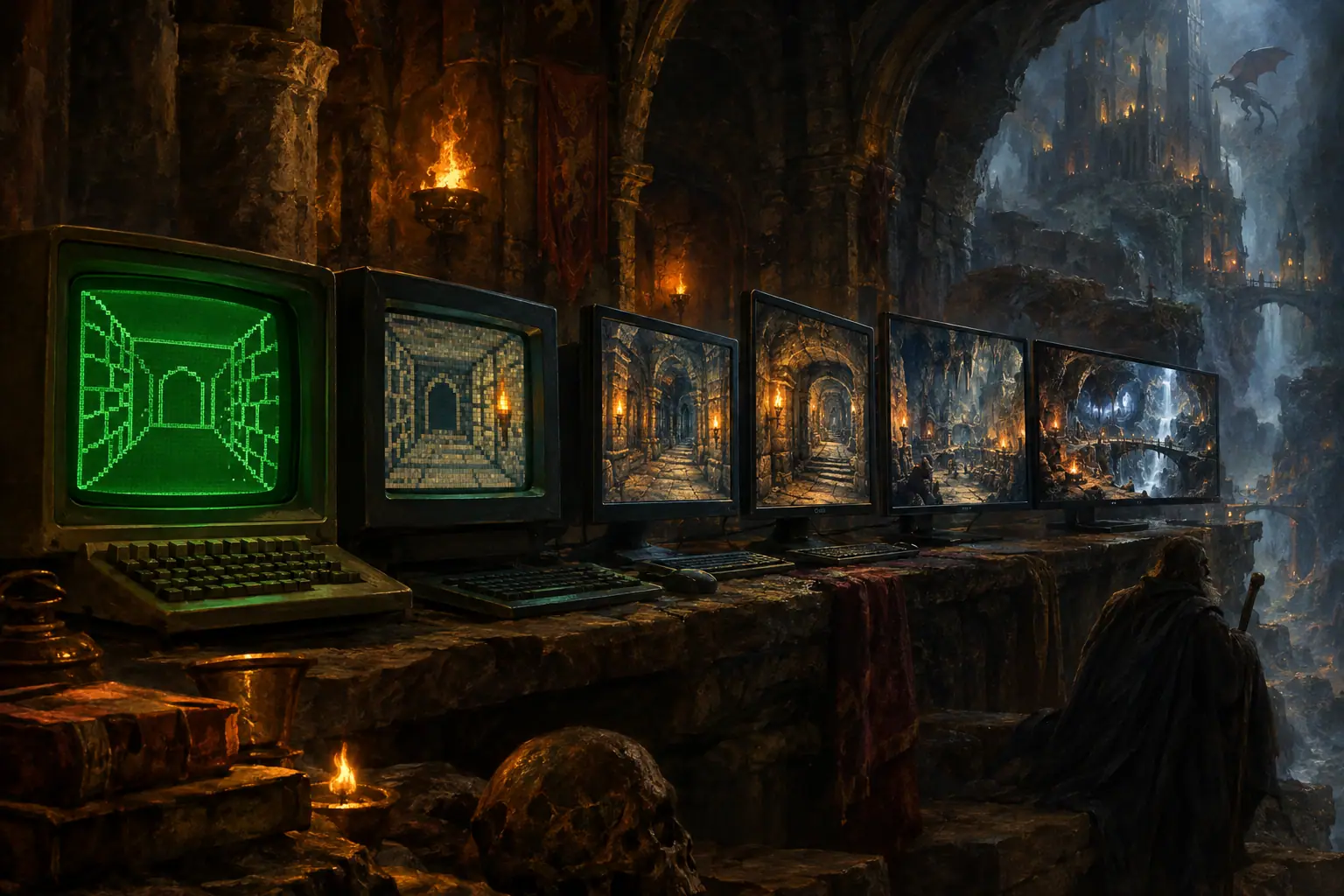
The first computer role-playing games were made by students who wanted to play Dungeons & Dragons when no Dungeon Master was available. Half a century later, the computer RPG is one of the largest genres in games, and its latest landmark is an official D&D game. This tour follows the road between them.
It begins on the PLATO, the University of Illinois network where pedit5 and dnd appeared within about a year of D&D's release. The same idea emerged independently on Unix terminals as Rogue, which gave its name to the Roguelikes.
With the Apple II the computer RPG became a commercial product. Richard Garriott's Akalabeth: World of Doom and Sir-Tech's Wizardry: Proving Grounds of the Mad Overlord established its two great templates, the open world map and the party-based Dungeon crawl. By 1985 Ultima IV: Quest of the Avatar had made morality a game mechanic and The Bard's Tale had made the dungeon crawl a best-seller.
The late 1980s and early 1990s brought official rules and new technology. Pool of Radiance adapted AD&D directly. Dungeon Master and Ultima Underworld: The Stygian Abyss made the dungeon real-time and three-dimensional. Then Diablo turned the Roguelikes into the Action RPGs & Hack-and-Slash, and Baldur's Gate brought the D&D party game back with a new engine and a strong emphasis on story. Morrowind showed a different future, the huge single-player Open-World RPGs.
The tour ends with Baldur's Gate 3, which draws on almost every stop before it: the D&D rules, the party, the tactical combat, the companions and the freedom of an open world. As you walk, watch how each designer tried to recreate some part of what a good human referee does, and how each ended up inventing something the tabletop never had.
- 1pedit5Dungeon crawler · 1975
Begin in 1975 on the University of Illinois' PLATO network, where a student hid a one-level dungeon in a spare program slot. Administrators kept deleting it. It is one of the earliest surviving computer role-playing games, made within about a year of D&D's release.
- 2dndDungeon crawler · c. 1975
Its PLATO rival added a multi-level dungeon and a dragon guarding the Orb at the bottom, arguably the first boss. Gold carried out of the dungeon became hit points and spells for the next trip. The loop of descending, looting and returning stronger is already in place.
- 3RogueRoguelike · c. 1980
A branch line: around 1980 on Unix terminals, Rogue drew its dungeons in ASCII and generated a new one each game, with one life only. Its descendants, the roguelikes, would reshape the genre decades later.
- 4Akalabeth: World of DoomComputer RPG · 1979
The personal computer arrives. A Texas teenager, Richard Garriott, wrote this Apple II game in 1979–80 and sold it in Ziploc bags. Its wireframe first-person dungeon and overhead world map point straight to Ultima.
- 5Wizardry: Proving Grounds of the Mad OverlordDungeon crawler · 1981
Sir-Tech's 1981 maze defined the party-based crawl: six characters, ten levels drawn in green lines, and graph paper in the box. It shaped computer RPGs in America and, through players such as Yuji Horii, in Japan.
- 6Ultima IV: Quest of the AvatarComputer RPG · 1985
Garriott's 1985 game made ethics the goal: no villain, only eight virtues to live by. It showed the CRPG could ask questions a tabletop referee might ask about who the character is.
- 7The Bard's TaleComputer RPG · 1985–2019
Also 1985: Interplay's colorful Commodore 64 crawl through Skara Brae, by one count the best-selling computer RPG of the decade. Compare its town-and-dungeon structure with Wizardry, two stops back.
- 8Pool of RadianceComputer RPG · 1988–1993
In 1988 SSI built the first computer RPG on the full AD&D rules, set in the Forgotten Realms. Its 'Gold Box' engine powered a whole shelf of licensed D&D games and tied the computer RPG closely to the tabletop game.
- 9Dungeon MasterDungeon crawler · 1987
FTL's 1987 Atari ST game made the dungeon run in real time, with the mouse used to grab objects and runes combined to cast spells. Characters improved by using skills. The first-person crawl had come alive.
- 10Ultima Underworld: The Stygian AbyssAction RPG · 1992
In 1992 a small New England studio built a texture-mapped 3D dungeon in which players could look up, jump and swim. It points toward the immersive simulations and first-person open worlds that followed.
- 11DiabloAction RPG · 1996
Blizzard North's 1996 game combined a roguelike's random dungeons and loot with real-time clicking, and launched Battle.net for online play. It created the modern action RPG.
- 12Baldur's GateComputer RPG · 1998
BioWare's 1998 debut revived the party-based D&D game with real-time-with-pause combat, voiced companions and the Forgotten Realms' Sword Coast. The Infinity Engine it introduced carried a golden age of isometric RPGs.
- 13The Elder Scrolls III: MorrowindComputer RPG · 2002
Bethesda's 2002 island of giant mushrooms and silt striders showed the other road: a handcrafted open world for a single hero, explored in first person, and shipped with its own construction kit for modders.
- 14Baldur's Gate 3Computer RPG · 2023
The line comes full circle. Larian's 2023 game, built on D&D's fifth edition, combines the turn-based tactics of the tabletop with cinematic companions and a vast range of player choices. It won Game of the Year at The Game Awards 2023.