Diablo distilled the computer roleplaying game into a fast, mouse-driven loop of killing, looting and descending, and paired it with free online play on Battle.net; the hack-and-slash action RPG as a genre descends from it.
Overview
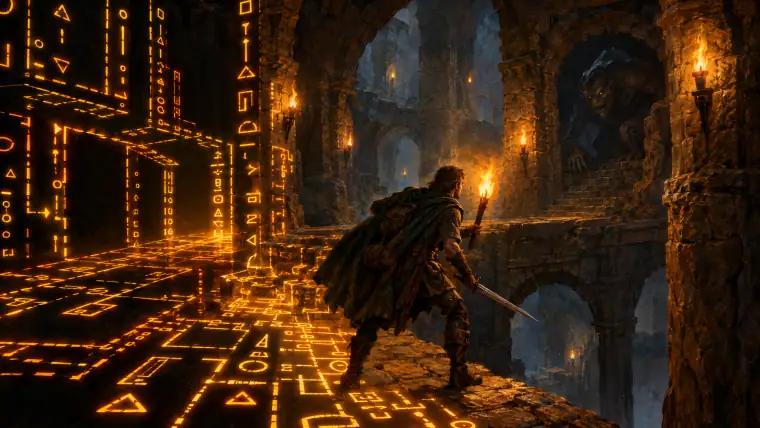
Diablo is a small game about a very deep hole. Beneath the cathedral of Tristram, a village in the kingdom of Khanduras, sixteen randomized levels descend through church crypts, catacombs and caves into Hell itself, where the Lord of Terror waits. The player picks a Warrior, a Rogue or a Sorcerer, walks down the stairs, and clicks. Every click is an attack, every corpse may spill gold or a glowing item, and every trip back to town to sell, repair and identify is a breath before the next plunge. Developed by Blizzard North and released for Windows at the turn of 1996–97, Diablo took the computer roleplaying game, stripped out almost everything but its compulsive core, and created the action RPG as a mass-market genre.
Origins
The game began at Condor, a San Francisco Bay Area studio founded in 1993 by David Brevik and the brothers Erich and Max Schaefer, who had worked together at a clip-art company called FM Waves. Brevik had been nursing the idea since his teens: a game that fused Dungeons & Dragons with the roguelikes he loved, especially Angband, and with Rogue, Moria and NetHack behind it. From the roguelikes came the dungeon rebuilt differently every game, the random treasure, and the sense that the next level down could hold anything. The name came from Mount Diablo, the peak that looms over the East Bay.
Condor pitched the game to Blizzard Entertainment, then fresh from Warcraft, and in 1996 Davidson & Associates, Blizzard's parent, bought the studio outright and renamed it Blizzard North. Blizzard's biggest intervention was a single request. Diablo was turn-based, like its roguelike ancestors, and Blizzard wanted it in real time. Brevik has recounted that he rewrote the system over one weekend and showed a working version on Monday. The game was also meant to be approachable in a way roguelikes never were; Brevik cited console sports games such as NHL '94 as the model of how quickly a player should get from box to action. Online play came late. According to Brevik, multiplayer code had barely been written when staff from Blizzard's Irvine studio, including Mike O'Brien, came north for the final six months to build it on top of Battle.net, a free matchmaking service that launched alongside the game.
How it plays
A character has three attributes that matter to their class, a handful of spells or skills, and a belt of potions. Everything else is Loot & loot tables. Items roll from tables of magical prefixes and suffixes, so that a plain short sword might emerge sharper, faster, or quietly draining the life of whatever it strikes, and unidentified magic gear must be taken to the town elder or read with a scroll. The dungeon is procedurally generated each game, and so are many of the quests, drawn from a pool so that no two descents meet the same butchers, skeleton kings and poisoned wells. Death drops the character's equipment on the floor of the level where it happened, a sharp roguelike sting softened by the chance to go back for it.
Most of the fiction arrives in town. Tristram's survivors, the healer Pepin, the blacksmith Griswold, the witch Adria and the storyteller Cain, talk the player through the cathedral's history and the fate of the missing King Leoric and his son, and Matt Uelmen's acoustic guitar theme for the town became one of the most recognizable pieces of game music of the decade. Up to four players could descend together over a local network, a modem link, or Battle.net, where the game also acquired its first notorious problems: player-killing and cheating in open games that Blizzard's peer-to-peer design could not police.
Reception & impact
Diablo arrived to more than 450,000 preorders and immediate acclaim. Computer Gaming World and GameSpot each called it the Game of the Year for 1996, and GameSpot gave it 9.6 out of 10. It was the best-selling computer game in the United States in the first half of 1997, passed a million copies by late 1997 and about two million worldwide by September 1998, and had sold more than 2.5 million by mid-2001. Sierra published an expansion, Hellfire, developed by Synergistic Software, in November 1997, adding a Monk class and two new dungeon areas. A PlayStation version by Climax Studios, published by Electronic Arts, followed in 1998 with split-screen cooperative play, as did a Mac OS port.
Legacy
Diablo showed that a roleplaying game could be played at the speed of an arcade game without losing its hooks: the descent, the gamble of every item drop, the slow accretion of power. Its loop fed straight into Diablo II in 2000, a far larger game that became the template for a genre, and through it into the item-chasing of World of Warcraft, the free-to-play Path of Exile, and countless hack-and-slash descendants. Battle.net, conceived as a convenience for Diablo, became the backbone of Blizzard's online business. The original returned in 2019 on GOG.com, its first digital-storefront release, with a modernized version alongside the 1996 code, and the town of Tristram, its church, and Deckard Cain have been revisited in every Diablo since.
Did you know?
The Butcher, the cleaver-wielding demon who greets many players on the second level with the line "Ah, fresh meat!", became so iconic that Blizzard brought him back as a boss in later Diablo games and as a playable hero in Heroes of the Storm.
Marginalia
- It was designed as a turn-based game; when Blizzard asked for real time, David Brevik converted it over a single weekend.
- The name comes from Mount Diablo, the peak near the developers' home in the San Francisco Bay Area.
- Brevik's stated models were D&D and the roguelikes, especially Angband, Moria and NetHack.
- Battle.net, Blizzard's free online matchmaking service, launched with Diablo in January 1997.
- Diablo was the best-selling computer game in the United States in the first six months of 1997.
- Computer Gaming World and GameSpot both named it their Game of the Year for 1996.
- Announced at BlizzCon 2016, a free Diablo III event, 'The Darkening of Tristram', rebuilt the original's 16-level dungeon in miniature.
Quick answers
- When was Diablo first released?
- Diablo was first released in 1996–97 (Windows); 1998 (PlayStation, Mac OS).
- Who created Diablo?
- Diablo was made by David Brevik (designer & lead programmer; co-founder of Condor / Blizzard North).
- Who published or developed Diablo?
- Blizzard Entertainment, Sierra On-Line and Electronic Arts.
- What kind of work is Diablo?
- Diablo is an action RPG in the Action RPGs & Hack-and-Slash, Roguelikes and Western Computer RPGs (CRPG) tradition, released for Windows, Mac OS and PlayStation.
- Why is Diablo important?
- Diablo distilled the computer roleplaying game into a fast, mouse-driven loop of killing, looting and descending, and paired it with free online play on Battle.net; the hack-and-slash action RPG as a genre descends from it.