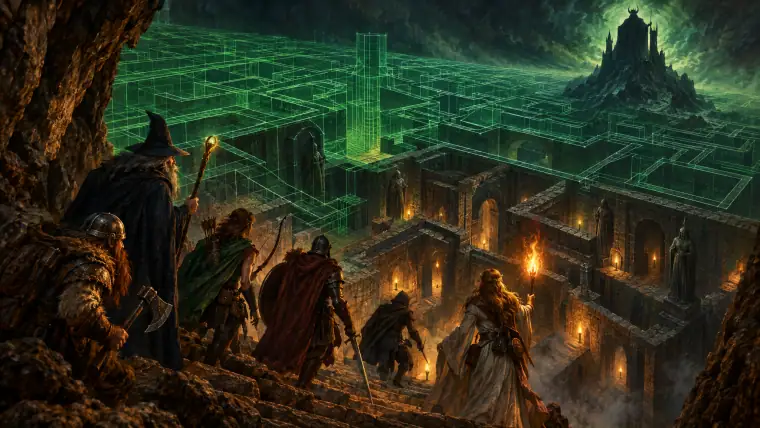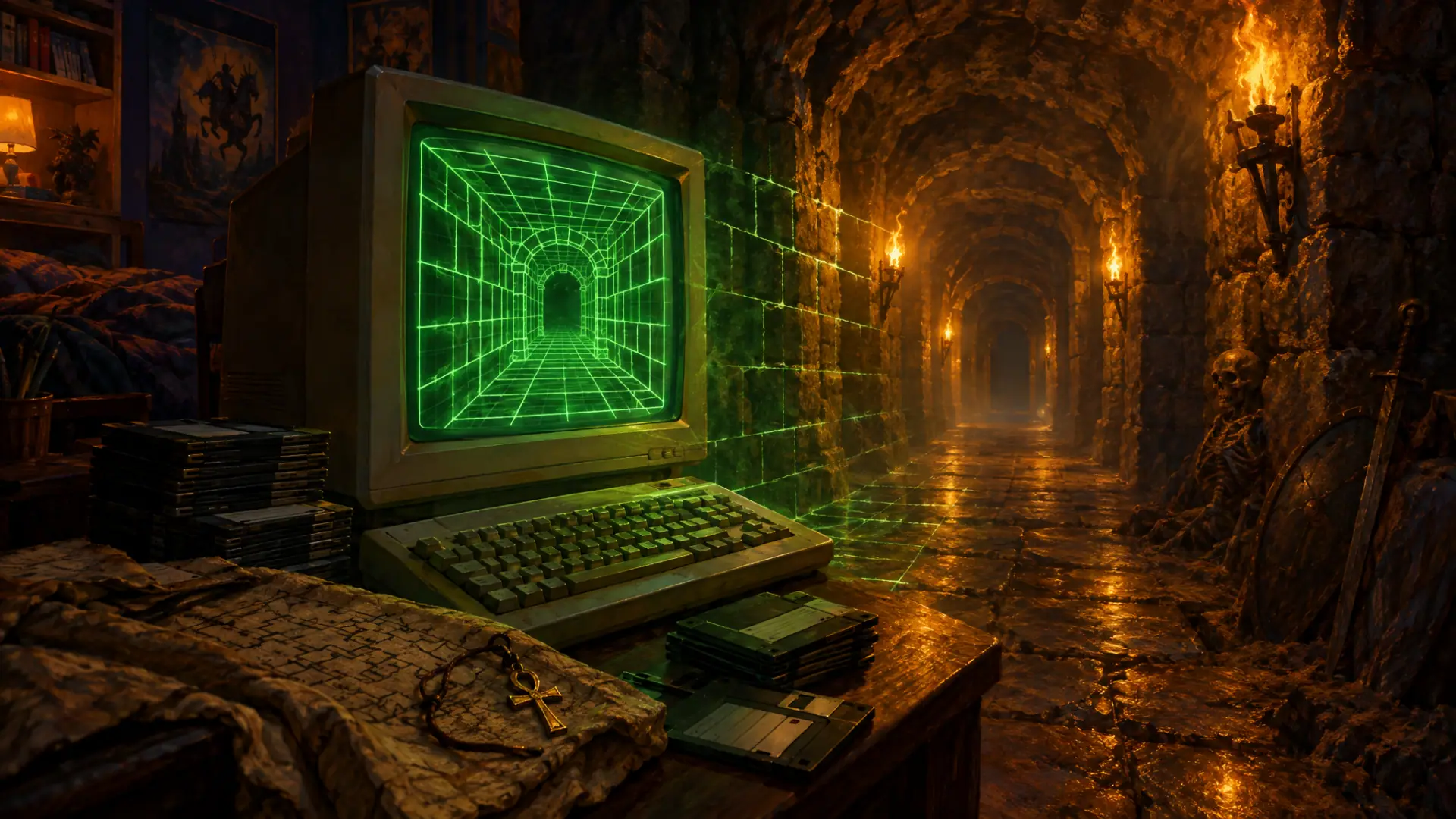
Dungeon Master replaced turn-based dice with real-time action and direct manipulation, became the Atari ST's best-selling game, and set the template for the real-time first-person dungeon crawler from Eye of the Beholder to Ultima Underworld and beyond.
Overview
Dungeon Master is a first-person fantasy role-playing game developed and published by FTL Games for the Atari ST, where it debuted on December 15, 1987. Amiga and MS-DOS versions followed in 1988 and 1992, and it was eventually ported to many more platforms and translated into five other languages. The player is Theron, apprentice to the Grey Lord, Librasulus, who needs the lost Firestaff to take physical form again and defeat Lord Chaos. Many champions have already died in the dungeon trying to recover it; Theron must revive up to four of them, lead them down through its levels, find the Firestaff and use it to destroy Lord Chaos — or, for an alternative ending, simply walk out with it.
Beneath that stock plot lay a revolution in how a computer dungeon crawl felt. Dungeon Master ran in real time, so monsters advanced whether or not the player was ready; it let players reach into the first-person view with the mouse to pick up items, press switches and throw objects; and it used sound to tell them something was approaching around the corner.
Origins
FTL, founded by Wayne Holder in 1982, was the games division of his company Software Heaven. Its first release, the space-trading game SunDog: Frozen Legacy (1984), had become the Atari ST's best seller during the machine's first year after Doug Bell, Andy Jaros and Michael Newton overhauled its graphics for the ST.
Dungeon Master began earlier still, as a project called Crystal Dragon, written in Pascal for the Apple II by Bell and artist Andy Jaros. It was finished at FTL in C and targeted at the 16-bit Atari ST, whose mouse, graphics and sound it exploited fully. By one account the design drew inspiration from the early Ultima games; its real innovations, though, were in interface and pacing. Some of its ideas had appeared before — Dungeons of Daggorath on the TRS-80 Color Computer used real-time combat and sound cues in 1982 — but Dungeon Master was the game that popularized them.
How it plays
The adventure opens in a small dungeon of 24 mirrors, each holding a frozen champion drawn from a different fantasy archetype. The player chooses up to four, resurrecting or reincarnating each one, and cannot go further until at least one has joined. The party then moves as one block through a grid of corridors — the classic "blobber" arrangement.
Everything happens in real time. Characters must find food and water, light matters in the gloom, and monsters close in while the player is still fumbling through a backpack. Items are managed on a "paper doll" inventory screen, where weapons, armor and supplies are dragged onto each champion's body — an interface Dungeon Master helped to standardize.
Magic is a language. Spells are built from sequences of runes representing the form and function of an effect, so a fireball combines the fire symbol with the wing symbol; the player must learn or discover each combination and cast it in the heat of combat. Instead of D&D-style experience points and levels, champions improve in the specific skills they use — fighting, ninja arts, priestly and wizardly magic — so a character who casts often becomes a better caster.
Reception & impact
The game was an immediate hit. By early 1988 it was a strong seller and went on to become the best-selling Atari ST game of all time; Bell estimated that at one point more than half of all ST owners had bought a copy. FTL's sophisticated copy protection meant that many players who usually pirated had to pay for it. The Amiga version, which FTL could not squeeze into 512 KB, shipped needing 1 MB — the first prominent Amiga game to demand more than the standard memory — and it likely prompted many owners to buy extra memory.
Critics were rapturous. Computer Gaming World's reviewer praised dungeons so detailed one could "practically feel the damp chill," and the magazine gave it a Special Award for Artistic Achievement in 1988 and entered it into its hall of fame in November 1989. Zzap!64's reviewer called the Amiga version "the most amazing game of all-time, anywhere, ever." Jerry Pournelle named it his game of the month in July 1988.
Legacy
Dungeon Master redefined the first-person dungeon crawl. Westwood's Eye of the Beholder (1991) brought its real-time, mouse-driven model to licensed AD&D, and at Origin Systems Richard Garriott said he was "ecstatic" at the "neat new things" it showed him; it influenced Ultima VI's interface and the later Ultima Underworld (1992), whose designer Paul Neurath regarded Dungeon Master's detailed first-person presentation as "a glimpse into the future." Journalist Niko Nirvi wrote that no 3D role-playing game before Ultima Underworld could challenge it.
FTL followed with Chaos Strikes Back (1989) and Dungeon Master II: The Legend of Skullkeep, released in Japan in 1993 but in the West only in 1995, when reviewers found it dated and it sold poorly. The studio wound down soon after. Fans kept the original alive through reverse-engineered reconstructions such as Paul R. Stevens's CSBWin (2001), and its design lives on in modern real-time dungeon crawlers such as Legend of Grimrock (2012).
Marginalia
- It debuted on the Atari ST on December 15, 1987, and became the best-selling game ever released for that computer.
- Designer Doug Bell estimated that at one point more than half of all Atari ST owners had bought it.
- The Amiga version required 1 MB of memory; at least one RAM-expansion maker bundled the game with its upgrade kit.
- Spells are cast by combining runes — a fireball, for example, mixes the fire symbol with the wing symbol.
- Characters improve by using their skills, not by earning abstract experience levels.
- The project began on the Apple II under the name Crystal Dragon, coded in Pascal, before being finished in C.
- Richard Garriott said he was "ecstatic" at the new things Dungeon Master showed him, and it influenced Ultima VI and Ultima Underworld.
Quick answers
- When was Dungeon Master first released?
- Dungeon Master was first released in 1987 (Atari ST, December 15).
- What kind of work is Dungeon Master?
- Dungeon Master is a dungeon crawler in the First-Person Dungeon Crawlers ('Blobbers') and Western Computer RPGs (CRPG) tradition, released for Atari ST, Amiga (1988), MS-DOS (1992), Apple IIGS, Super NES / Super Famicom, TurboGrafx-CD and X68000, PC-98, FM Towns.
- Why is Dungeon Master important?
- Dungeon Master replaced turn-based dice with real-time action and direct manipulation, became the Atari ST's best-selling game, and set the template for the real-time first-person dungeon crawler from Eye of the Beholder to Ultima Underworld and beyond.