The first Might and Magic launched one of the longest-running computer RPG franchises, set a new benchmark for the size of a game world, and founded New World Computing, whose later Heroes of Might and Magic spin-off grew even larger.
Overview
Might and Magic Book One: The Secret of the Inner Sanctum is a first-person, party-based role-playing game released in 1986 for the Apple II. It was the debut of New World Computing and of its founder, Jon Van Caneghem, and the first entry in a series that ran through nine numbered sequels over the next fifteen years under its original makers, then continued under Ubisoft.
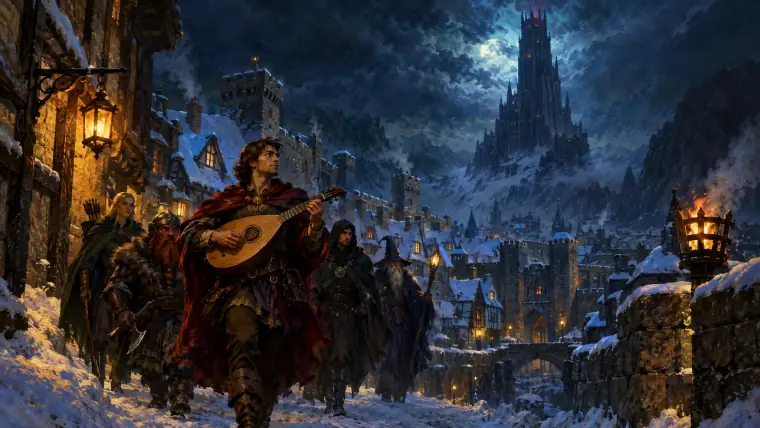
Six adventurers set out across Varn, a land of castles, caves, underground cities, wilderness and an Astral Plane, in search of the fabled Inner Sanctum. Along the way they learn of a being called Corak and his hunt for an escaped villain, Sheltem, who has been masquerading as the King. The medieval surface is a disguise: the party finds a crashed spaceship and aliens who warn that their prisoner is loose, and the game eventually reveals that VARN stands for "Vehicular Astropod Research Nacelle." That blend of fantasy with hidden science fiction would define the whole series.
Origins
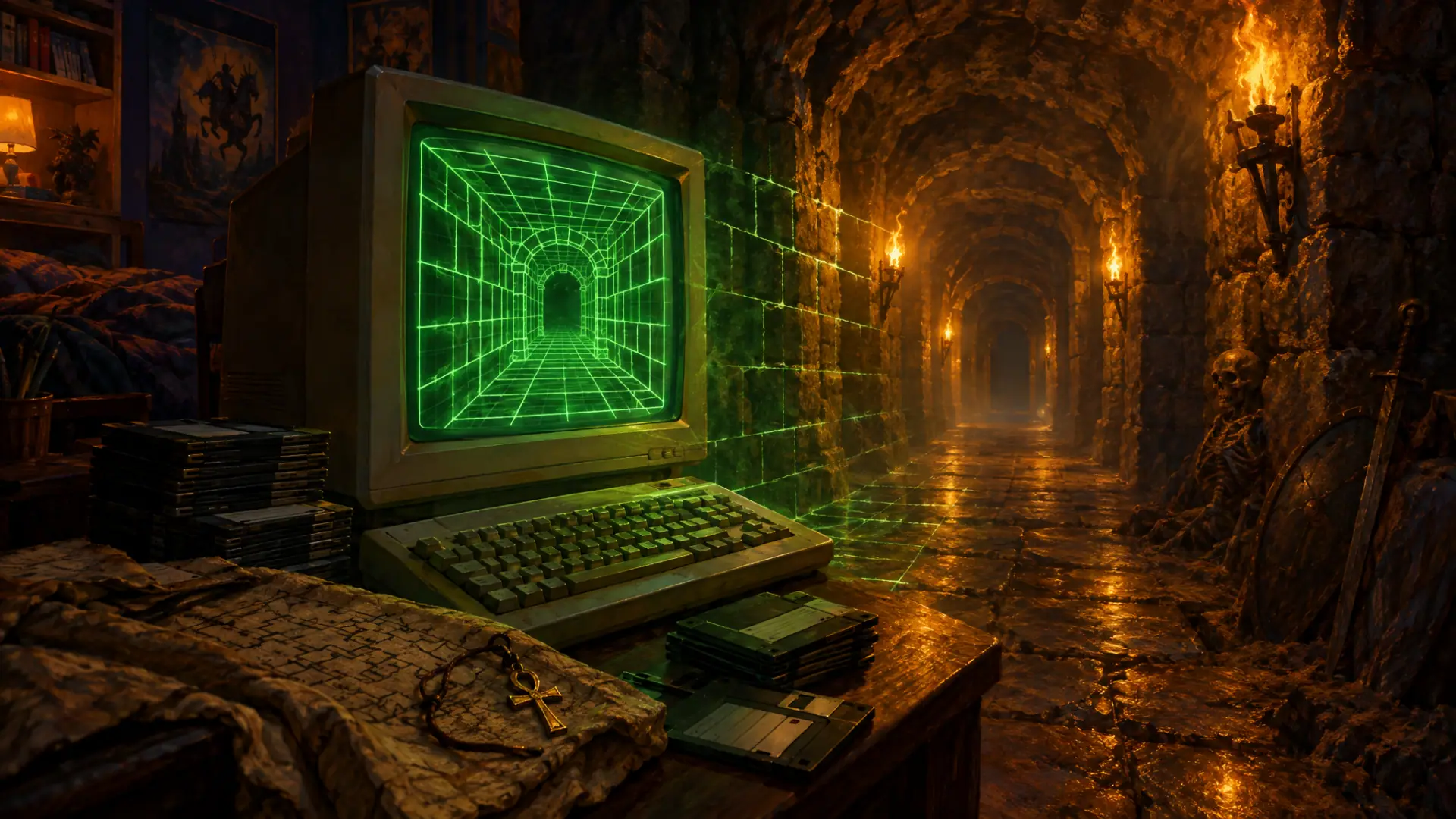
Van Caneghem, a UCLA computer-science graduate, founded New World Computing in 1983 and spent roughly three years writing Might and Magic almost entirely on his own. No publisher would take it, so he published it himself, handling distribution from his apartment until he secured a distribution deal with Activision.
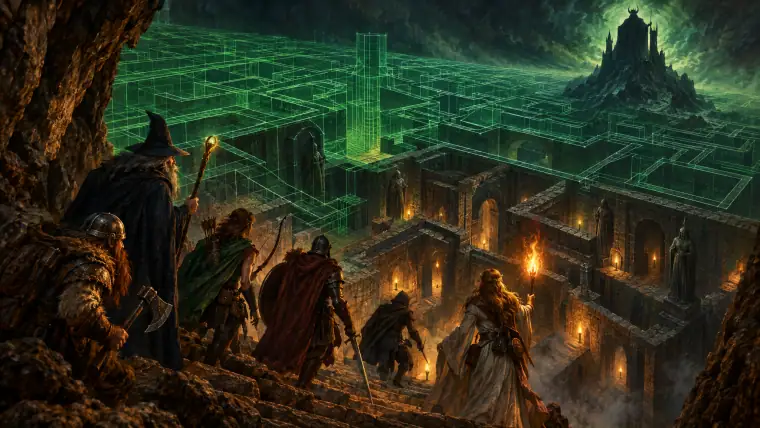
The game arrived in a crowded moment for the computer RPG. Wizardry (1981) had established the first-person party dungeon crawl, and The Bard's Tale (1985) had given it lush color graphics. Might and Magic used a similar step-and-turn, grid-based view, but applied it not only to dungeons but to an entire outdoor world; It is often cited as one of the first RPGs to show detailed drawings of both indoor and outdoor locations. Van Caneghem later said the series' lore drew on his love of both science fiction and fantasy, citing The Twilight Zone and a Star Trek episode among its inspirations.
How it plays
The player creates a party of six. Each character has seven statistics — Might, Endurance, Speed, Accuracy, Personality, Intelligence and Luck — and one of six classes: the Knight, the Cleric, the Robber (a thief), the Sorcerer, the Paladin, who gains clerical magic at higher levels, and the Archer, who can shoot from the front line and later gains sorcerer spells. Characters also choose a race (human, elf, half-orc, gnome or dwarf), an alignment and a sex. Race affects statistics and resistances; alignment and sex matter only occasionally, as in the city of Portsmith, where certain squares injure only male characters.
Magic is divided into sorcerer spells, mostly offensive and fueled by Intelligence, and clerical spells, mostly healing and protective and fueled by Personality. Exploration is strictly turn-based: the party moves forward or back, or turns ninety degrees, on a maze-like grid where walls may be mountain ridges, cave stone or rows of trees. When monsters appear, the player can try to flee, surrender, bribe them or fight; on most platforms combat plays out in text, with each combatant acting in order of speed.
The game's reputation rests on scope and freedom. Varn is large, largely open to exploration in any order, and notoriously hard at the start — Computer Gaming World's reviewer Scorpia noted that early versions equipped new characters with nothing but clubs.
Reception & impact
Reviewers were impressed by the size of the thing. Compute! praised its wealth of content and non-linear play in 1987, while noting that its graphics lacked animation. In Dragon #122, Patricia Lesser called it "one of the top five games ever produced for a computer," and the magazine's "The Role of Computers" column went on to give it five stars. Computer Gaming World inducted it into its Hall of Fame in 1988 and in 1996 named it the 23rd best game ever, citing its 3D dungeon view and "the biggest world map to date." The game had sold more than 100,000 copies by 1989.
Its success paid for a franchise. Might and Magic II: Gates to Another World followed in 1988, picking up as the party steps through a gate to the world of Cron; Isles of Terra (1991), Clouds of Xeen (1992) and Darkside of Xeen (1993) continued the Sheltem saga, and by March 1994 the series had sold one million units in total. The original game itself was ported widely, including a 1992 NES version with music by Masaharu Iwata and a Japanese PC Engine CD-ROM² remake with digitized voices.
Legacy
Might and Magic stands with Wizardry, Ultima and The Bard's Tale as one of the defining early computer RPG series. Van Caneghem's company grew into a notable developer and publisher; in 1990 his strategy game King's Bounty set out the formula for Heroes of Might and Magic (1995), which eventually overshadowed its parent. New World Computing was sold to the 3DO Company in 1996, and when 3DO went bankrupt in 2003 Ubisoft bought the Might and Magic name for $1.3 million, keeping both lines alive into the 2020s.
Modern commentators credit the first game above all for the scale of its world and its freedom of exploration, and for tying characters' race, sex and alignment into play at a time when most games ignored them — a sprawling, idiosyncratic world that rewarded curiosity long before open worlds became a selling point.
Marginalia
- Jon Van Caneghem wrote the original Apple II version almost single-handedly over three years.
- Unable to find a publisher, he released it himself as New World Computing, shipping from his own apartment until he signed a distribution deal with Activision.
- The world's name, VARN, turns out to stand for "Vehicular Astropod Research Nacelle."
- Might and Magic sold more than 100,000 copies by 1989.
- In one city, Portsmith, only male characters are hurt by certain squares, and characters' gender can be switched by events in the game.
- Computer Gaming World entered it in its Hall of Fame in 1988 and in 1996 ranked it the 23rd best game ever.
Quick answers
- When was Might and Magic Book One first released?
- Might and Magic Book One was first released in 1986 (Apple II).
- Who created Might and Magic Book One?
- Might and Magic Book One was made by Jon Van Caneghem (designer & programmer; publisher).
- Who published or developed Might and Magic Book One?
- New World Computing.
- What kind of work is Might and Magic Book One?
- Might and Magic Book One is a dungeon crawler in the First-Person Dungeon Crawlers ('Blobbers') and Western Computer RPGs (CRPG) tradition, released for Apple II, MS-DOS, Commodore 64, Macintosh, MSX, NES (1992) and PC Engine CD-ROM².
- Why is Might and Magic Book One important?
- The first Might and Magic launched one of the longest-running computer RPG franchises, set a new benchmark for the size of a game world, and founded New World Computing, whose later Heroes of Might and Magic spin-off grew even larger.