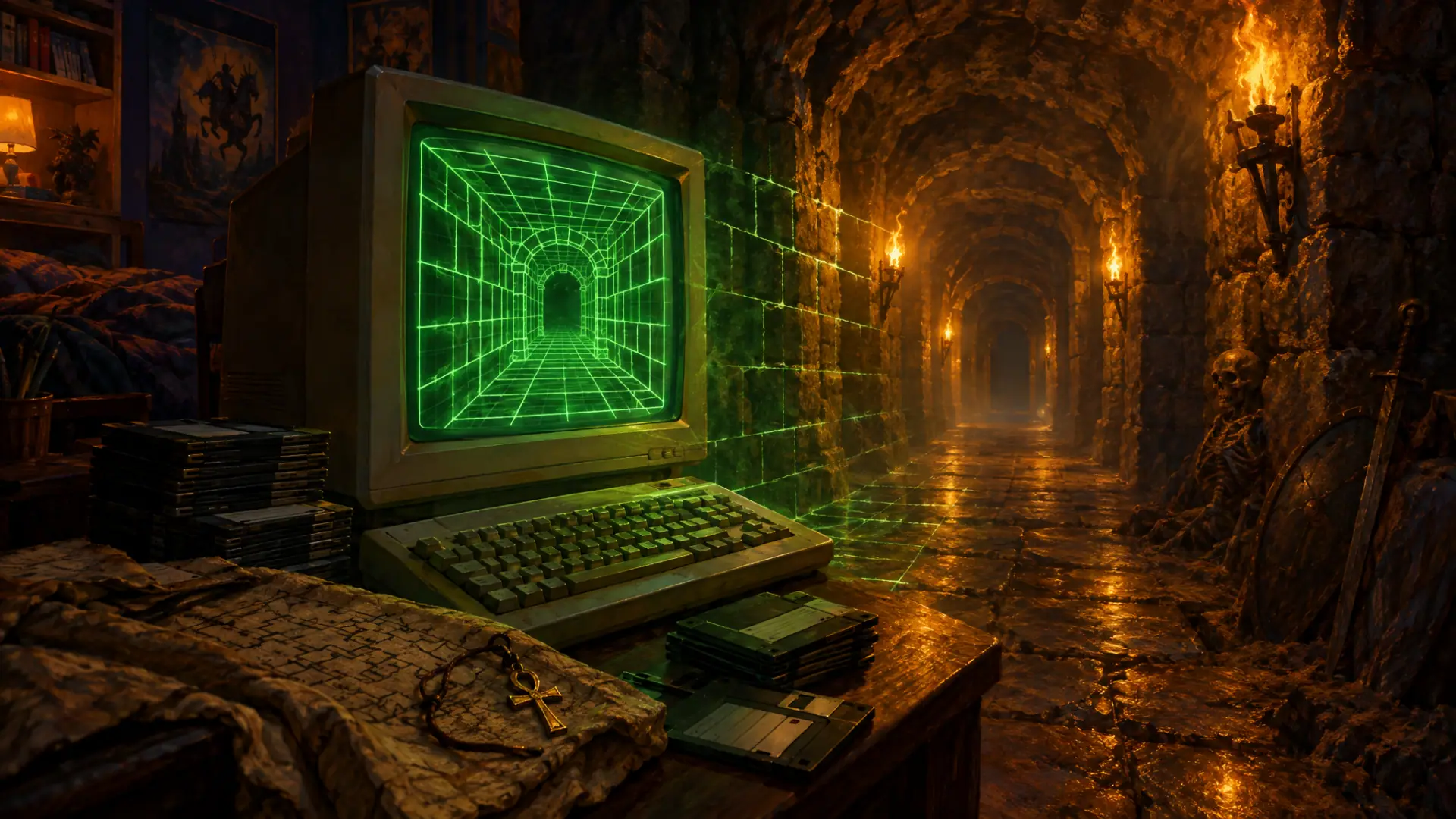
Sir-Tech's Wizardry was, with Ultima, one of the two founding series of the computer RPG, and its menu-driven party combat shaped Dragon Quest, Final Fantasy and the whole Japanese RPG tradition.
History
Sir-Tech was a family business with an unlikely product. In 1978 Andrew Greenberg, a Cornell student, began a dungeon game for the Apple II inspired by the role-playing games of the PLATO network, and he soon teamed with fellow student Robert Woodhead. In the fall of 1979 Woodhead and Norman Sirotek, whose father Frederick, a businessman, supplied the money, set up Sirotech Software. Its early releases were a database program, Info Tree, and a space game, Galactic Attack. Greenberg and Woodhead rewrote the dungeon game in Pascal when BASIC proved too slow, and in 1980 Sirotek showed a beta at the Boston Computer Convention. In spring 1981 the company was incorporated as Sir-Tech Software, Inc.
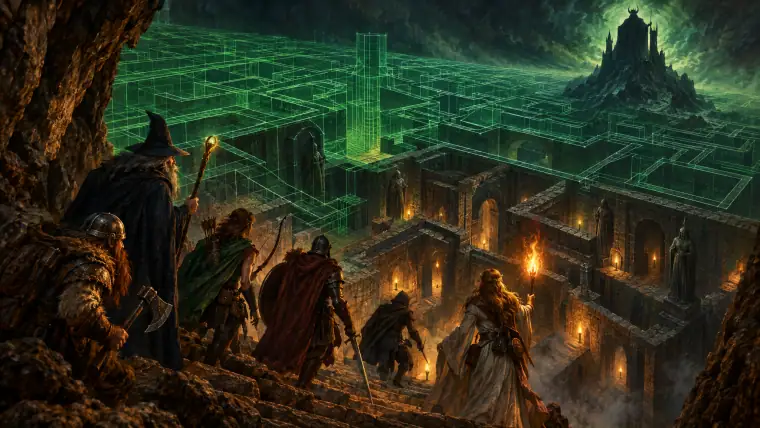
The delay while they waited for a Pascal run-time system proved a blessing. Nearly a year of playtesting made Wizardry: Proving Grounds of the Mad Overlord unusually balanced, and Frederick Sirotek insisted on professional packaging and a proper manual at a time when many games came in plastic bags. Released for the Apple II in September 1981, it put a The party of up to six adventurers into a ten-level maze drawn in green wireframe, with turn-based menu combat, permanent death and a town that was only a menu. It was the most popular Apple II game of the year, sold 24,000 copies by mid-1982, and outsold the original Ultima over its first three years. The designers signed their work in the fiction: the villain Werdna and the overlord Trebor are their first names reversed.
Sequels followed: The Knight of Diamonds (1982), Legacy of Llylgamyn (1983) and the fiendish Return of Werdna (1987), in which players controlled the villain. David W. Bradley then took over design with Heart of the Maelstrom (1988) and led a more story-driven trilogy with Bane of the Cosmic Forge (1990) and Crusaders of the Dark Savant (1992). After Bradley's departure and a false start with an Australian developer, the series closed with Wizardry 8 (2001), made by Sir-Tech Canada in Ottawa under designer Brenda Romero. By around 1990 the company's address was a business center in Ogdensburg, New York, across the St. Lawrence River from Ontario. Sir-Tech also published the Jagged Alliance tactical games (from 1994) and English versions of the German Realms of Arkania RPGs.
The U.S. publishing company closed in 1998. Sirtech Canada kept developing, finishing Jagged Alliance 2 (1999) and Wizardry 8, and shut down in late 2003. The Wizardry rights passed to an Ontario holding company in 1998, to Japan's Aeria IPM in 2006, to Gamepot and GMO Internet, and in 2020 to Drecom. In May 2024 Digital Eclipse's faithful remake of the first game appeared, published by Atari, and in May 2026 Atari announced it had acquired the first five games, an acquisition Drecom disputed the following day.
Notable work
The eight Wizardry games from 1981 to 2001; Jagged Alliance and Jagged Alliance 2; and the Realms of Arkania trilogy it published in English.
Legacy
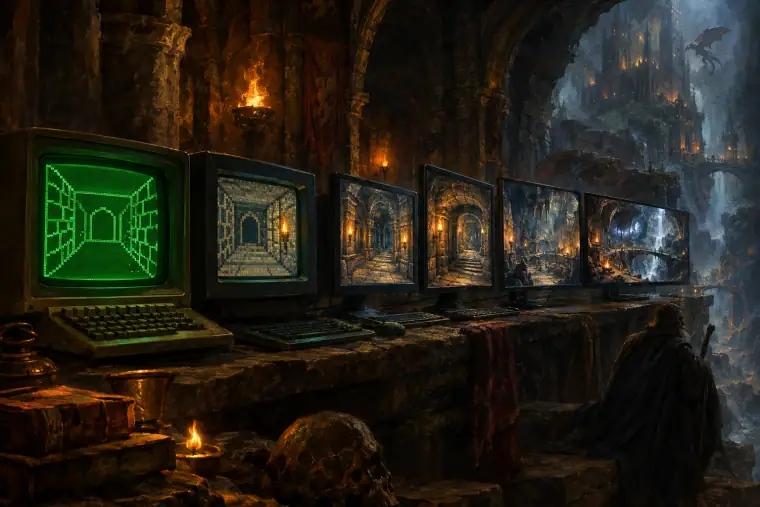
Sir-Tech's most enduring success came in Japan. Translated by ASCII, Wizardry became a sensation in Japan in the 1980s, and its first-person maze and party menus shaped The Black Onyx, Dragon Quest and Final Fantasy. Dozens of Japanese Wizardry spin-offs followed long after the American series ended. In the West it defined the First-Person Dungeon Crawlers ('Blobbers'), the "Blobber" in which a whole party moves as one, a line that runs through The Bard's Tale, Might and Magic Book One and Dungeon Master to the Etrian Odyssey games.
Marginalia
- Its first releases, as Sirotech Software, included a database program, Info Tree, and the game Galactic Attack.
- Sir-Tech showed a beta of Wizardry at the 1980 Boston Computer Convention, then spent almost a year playtesting and balancing it.
- Financier Frederick Sirotek insisted on professional packaging and manuals when rivals sold games in Ziploc bags.
- Wizardry shipped in September 1981 and had sold 24,000 copies by June 30, 1982; by 1989 sales were reported at well over 500,000.
- Around 1990 the company's mailing address was the Ogdensburg Business Center in Ogdensburg, New York.
- Sir-Tech also published the Jagged Alliance tactics games and the English editions of the German Realms of Arkania RPGs.
- Wizardry 8 (2001), led by designer Brenda Romero and producer Linda Currie, was the company's final game.
Quick answers
- What was Sir-Tech Software?
- The small family publisher on the New York–Canada border that shipped Wizardry in 1981, set the template for the party-based dungeon crawl, and saw its creation become a legend in Japan.
- When was Sir-Tech Software founded?
- Sir-Tech Software was founded in 1981 and was based in Ogdensburg, New York; development later centered at Sir-Tech Canada in Ottawa; it closed in 2003.
- Who founded Sir-Tech Software?
- Robert Woodhead.
- What is Sir-Tech Software known for?
- Wizardry: Proving Grounds of the Mad Overlord.
- What happened to Sir-Tech Software?
- Sir-Tech's U.S. company closed in 1998 and Sirtech Canada in late 2003. The Wizardry rights passed through several owners to Drecom (2020); Atari announced in May 2026 that it had acquired the first five games, a claim Drecom disputed.