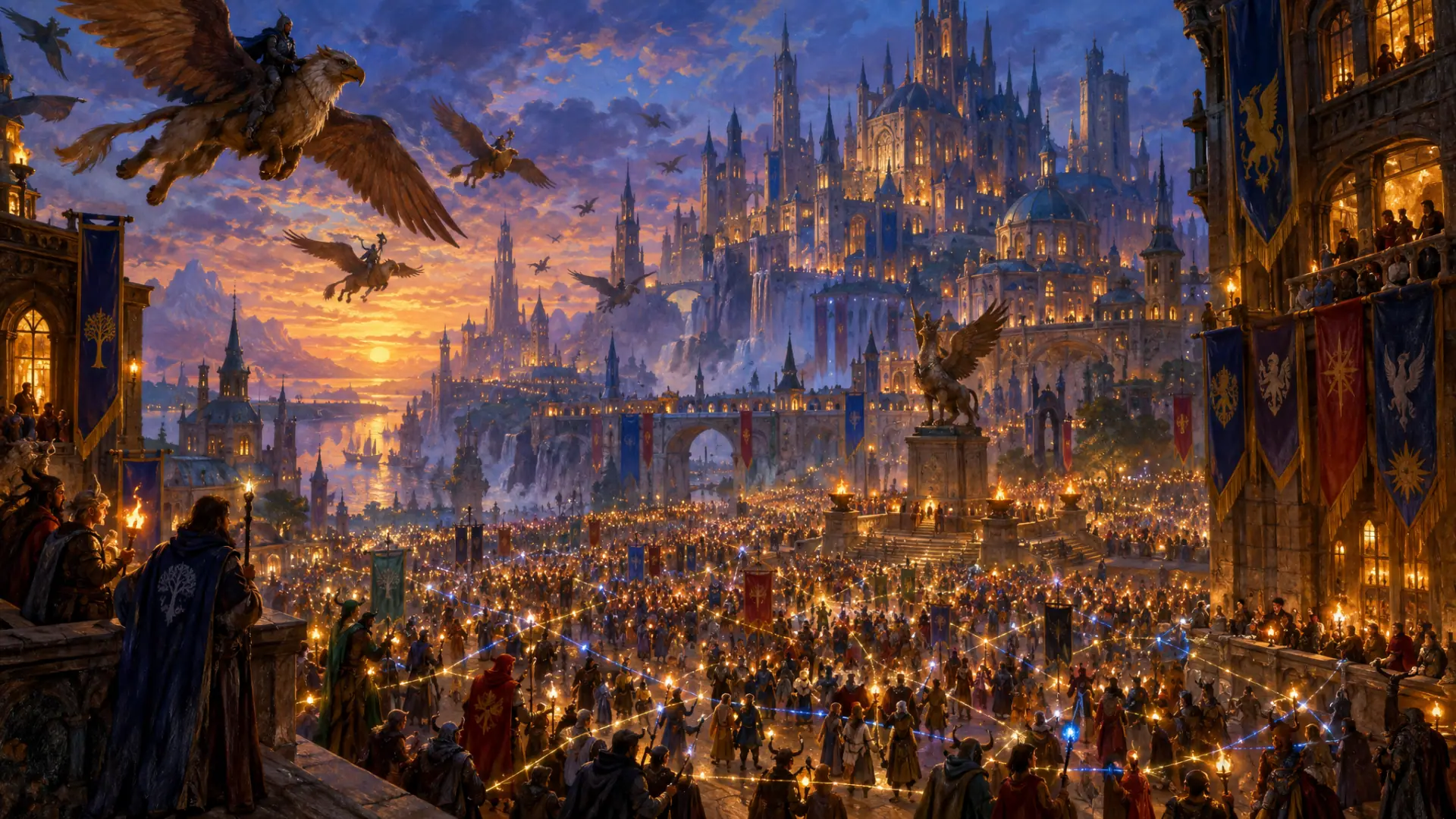
From a text game on an Essex University mainframe to twelve million World of Warcraft subscribers, fantasy became a place millions shared, with economies, feuds, funerals, and a runaway plague.
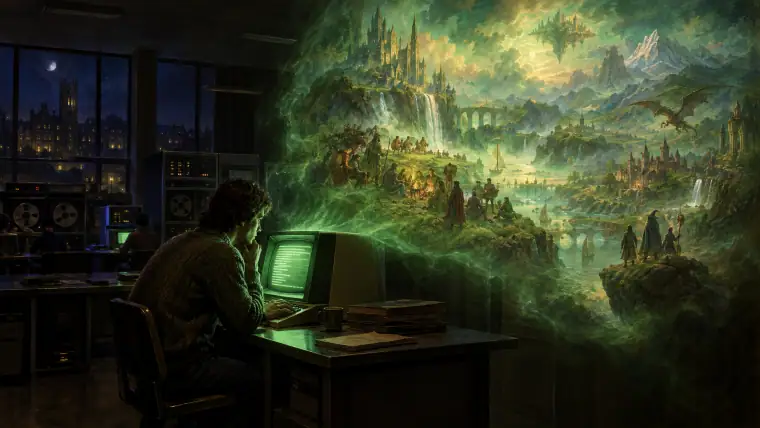
At the University of Essex, near Colchester, the university's DEC PDP-10 did most of its work during the day. Late at night, once the coursework was done, it was available to anyone who could reach it, and from 1983 that included people dialing in from outside. Between two and seven in the morning, players from across Britain and, eventually, overseas connected to a text world called The Land. It had forests, a cottage, and a swamp into which treasure could be dropped for points. Other players were there too, typing in real time, trading insults, fighting, forming alliances, and sometimes killing one another. It was the first multiplayer virtual world in the lineage of fantasy roleplaying, and nearly everything that later happened in EverQuest and World of Warcraft happened there first in some form.
The Land
Roy Trubshaw, an Essex undergraduate, began writing MUD, the "Multi-User Dungeon," in 1978 (some accounts date his first experiments to late 1977). He took the idea of Adventure and Zork, a world described in text, and made it shared. His fellow student Richard Bartle joined him, and when Trubshaw graduated in 1980 Bartle took over, writing most of the world's content and its scoring. The same year Essex connected to the ARPANET, and MUD1 became one of the first multiplayer games on the network that became the internet. Reaching the rank of wizard gave a player special powers over the game, and it became the goal of MUD players everywhere. In 1987 CompuServe licensed the game as British Legends, and it ran there until late 1999.
The MUD became a genre of its own, and its source code spread. Alan Cox's AberMUD (1987), from Aberystwyth, was widely copied on university networks. Jim Aspnes's TinyMUD (1989) dropped combat altogether and let players build a social world. Lars Pensjö's LPMud (1989) let wizards program the world from inside it. DikuMUD, written in Copenhagen around 1990–91, packaged the D&D model of classes, levels, hit points, and monster killing into a codebase that thousands of hobbyist servers adopted. For fifteen years, anyone with a university account could visit hundreds of fantasy worlds, each run by volunteers. The MUDs produced the vocabulary and social structure of online worlds: player killers, guilds, aggro, the grind for levels, and the burnout of administrators. In 1996 Bartle's paper on "players who suit MUDs" defined four player types (achievers, explorers, socializers, and killers) that designers still cite.
Paying by the hour
The commercial side of the story began on university systems and online services. On the PLATO network, Avatar (1979) let several players explore a dungeon together in first person, a precursor of the party raid. Kelton Flinn and John Taylor's Island of Kesmai (1985) ran on CompuServe at hourly rates, with ASCII graphics. In 1986 Lucasfilm Games launched Habitat on the Quantum Link service for the Commodore 64. It was a cartoon world of avatars, a word that Habitat helped popularize for players' on-screen figures, and its designers learned early that players could not be controlled simply by design. On GEnie, Simutronics' GemStone text worlds charged by the hour and made money from dedicated players.
In 1991 the tabletop and the modem came together. Neverwinter Nights, developed by Beyond Software with SSI, TSR, and America Online, used the Gold Box engine described in Mainframes to Microcomputers: the First Computer RPGs to put a graphical Forgotten Realms city online. At first each server held 50 players; by 1995 each held 500. By 1997 it had 115,000 players, and player guilds organized their own role-playing events. AOL shut it down on July 19, 1997. The bulletin-board systems provided a more local version, in which door games such as Legend of the Red Dragon (1989) turned a single phone line into a slow-motion shared world, one caller at a time.
Graphical worlds, east and west
Cheaper internet access and flat-rate pricing made the next step possible. Meridian 59, from the small studio Archetype Interactive and published by 3DO in the fall of 1996, offered a first-person 3D world for a monthly subscription. It is often cited as the first 3D graphical MMORPG. It never drew a large audience, but it established the business model.
In South Korea, fast broadband and the PC bang, the country's internet café, created a much bigger market. Jake Song designed Nexon's Kingdom of the Winds (1996) and then, at NCSoft, Lineage (September 1998), based on a manhwa (Korean comic) by Shin Il-sook. It was a top-down fantasy world of castle sieges between player clans, played nightly in PC bangs across the country. It was one of the first MMORPGs to become a mass phenomenon, and in Korea it reached an audience far larger than Western games of the time. It made NCSoft one of the most powerful game companies in Asia, and online games became a pillar of Korean popular culture.
Korean games also led in business models. Wemade's The Legend of Mir 2 (2001), licensed to Shanda in China, became one of the most popular online games in that country and helped start its enormous online game market. NCSoft's Lineage II (2003) moved the castle sieges into 3D. Nexon's side-scrolling MapleStory (2003) charged nothing to play and made its money by selling cosmetic items and conveniences, the model that Western companies would adopt at the end of the decade. The Korean experience also produced the earliest widespread public worries about compulsive play, and the government began funding counseling programs for gaming addiction in the 2000s.
Britannia online
Richard Garriott had wanted a multiplayer Ultima for years. At Origin, now owned by Electronic Arts, the lead designer Raph Koster and producer Starr Long, both experienced MUD developers, built Ultima Online, launched on September 24, 1997. Garriott is often credited with popularizing the term "massively multiplayer online role-playing game" in the course of promoting it. Britannia was a sandbox: players could make and sell goods, own houses, and kill each other almost anywhere. Its planned ecology, in which predators and prey competed for resources, was abandoned when players hunted faster than the simulation could keep up.
Its most famous moment came before launch. On August 9, 1997, during a public stress test, Garriott's character Lord British appeared before a crowd of players. His invulnerability had failed to persist after a server crash, and a player called Rainz cast a fire field and killed him. The assassination of Lord British became a founding legend of the online worlds. It showed that in a shared world, players, not designers, controlled much of what happened.
Ultima Online reached 100,000 subscribers by December 1998 and about 250,000 at its peak in 2003. It also showed the costs of freedom. Player killers preyed on newcomers, and in 2000 the Renaissance expansion split the world into two parallel copies, Trammel, where players could not attack one another, and Felucca, where they could. The dispute over that decision has continued among designers ever since. That year Koster also wrote a "Declaration of the Rights of Avatars," asking what obligations the owners of virtual worlds had toward the people living in them.
Norrath and the economists
The game that made the MMORPG a substantial business was EverQuest, developed by Verant Interactive for Sony and launched on March 16, 1999. Designed by Brad McQuaid, Steve Clover, and Bill Trost, all players of DikuMUD-derived text worlds, it was essentially a MUD rendered in 3D. Norrath had elves, dwarves, trolls, and ogres, zones separated by loading screens, and a strict hierarchy of classes. It was also punishing. A dead character left a corpse, with all of its gear, deep in a dungeon, and "corpse runs" to recover it could take hours. Groups waited, or "camped," at monster spawn points for rare drops. Raids of dozens of players fought gods and dragons on schedules planned like military operations. The holy trinity of tank, healer, and damage-dealer became standard design. Players called it "EverCrack," and at its peak it had some 550,000 subscribers.
Its economy was serious enough to attract serious study. Players sold gold, items, and characters for real money on eBay, against Sony's wishes. In 2001 the economist Edward Castronova surveyed Norrath's players and prices and estimated its GNP per capita at $2,266, which would have ranked it 77th in the world, between Russia and Bulgaria. His paper made virtual economies a topic for academics and journalists. By the mid-2000s "gold farming," in which workers, many in China, played in shifts to harvest currency for sale to Western players, had become an industry in its own right.
The competition grew quickly. Turbine's Asheron's Call (November 2, 1999), published by Microsoft, had a seamless world and monthly story updates. Mythic Entertainment's Dark Age of Camelot (October 2001) organized large-scale player combat around three realms drawn from Arthurian, Norse, and Celtic legend, a development of the old Arthurian matter. In Britain, Andrew Gower and his brother Paul released RuneScape (January 4, 2001) from Jagex. It was written in Java and ran in a web browser, so a whole generation of schoolchildren could play it on school and library computers, free or cheaply. Square's Final Fantasy XI (May 2002 in Japan) put PC and PlayStation 2 players on the same servers. Sega's Phantasy Star Online (2000) had already brought the idea to consoles.
Azeroth
Blizzard had been watching. Several of its designers had led EverQuest guilds, and its Warcraft strategy games (1994–2002) had built a world of humans and orcs with its own history and a sense of humor. World of Warcraft, with Rob Pardo as lead designer, launched in North America on November 23, 2004. Its approach was to remove as much frustration as possible from the EverQuest model. Death was a brief walk back as a ghost. Quests led players from level 1 to 60 without much grinding. "Rested experience" rewarded time spent away from the game. Dungeons were instanced for each group, so no one had to wait for a monster to respawn. The art was bright and stylized and ran on modest computers. Servers had queues at launch, and millions of new players took up the MMORPG.
World of Warcraft became a social institution with its own folklore. A video of a player called Leeroy Jenkins charging into a room of dragon whelps and wiping out his group spread across the early internet in May 2005. That September, in the Corrupted Blood incident, a contagious curse from the boss Hakkar escaped its dungeon on players' pets and spread through the capital cities. Epidemiologists later studied the event as a model of human behavior in real outbreaks. Blizzard held the first BlizzCon in Anaheim in October 2005. South Park devoted a 2006 episode, "Make Love, Not Warcraft," to the game and won an Emmy for it, and Felicia Day's web series The Guild (2007) turned guild life into a sitcom.
Players also brought their own lives into the game. Guilds lasted longer than many real-world friendships, and couples met in raids and married. In March 2006, when a player died in real life, her guild held a memorial gathering beside a lake in the game, and a rival guild attacked the mourners and filmed the ambush. The episode was widely debated as a test of what counted as fair play in a shared world. Other communities formed around add-ons, theorycrafting spreadsheets, and forums where players worked out the most efficient combinations of gear and abilities. In these ways World of Warcraft's players did what tabletop groups had always done: they argued over rules, shared stories, and built their social lives around the game.
The expansions set records. The Burning Crusade (January 2007) was followed by Wrath of the Lich King (November 13, 2008), which sold 2.8 million copies in its first 24 hours. In July 2008 Blizzard merged into Activision Blizzard. In October 2010 the company announced 12 million subscribers, the high point of the subscription MMORPG.
Other realms, and the end of an era
WoW's size shaped the rest of the market. ArenaNet, founded by former Blizzard developers, launched Guild Wars (April 2005) with NCSoft and no monthly fee. Turbine's The Lord of the Rings Online (April 24, 2007) finally let players walk through Tolkien's Middle-earth, the setting whose paperbacks had filled the MUD programmers' shelves. Mythic's Warhammer Online (2008), set in Games Workshop's Old World, and Funcom's Age of Conan (2008), based on Robert E. Howard's world, had strong launches and then lost players quickly. Many games that tried to compete with WoW directly struggled.
The response was a new business model. In 2009 Turbine made Dungeons & Dragons Online free to play with optional purchases, and revenue went up. The Lord of the Rings Online followed in 2010. Asian games had used the model for years, and it spread quickly. At the same time, Japanese light novels were telling stories about the MMORPG itself. Reki Kawahara's Sword Art Online, first posted online in 2002, imagined players trapped in a virtual world where death in the game meant death in reality. Its premise would influence the LitRPG genre in the following decade.
What came next
By 2010 fantasy online worlds had become ordinary. Parents met their children's guildmates, economists compared exchange rates across game currencies, and a whole generation had learned what a Raid and an aggro table were. The subscription model was about to give way to free-to-play and to games designed for smaller groups and shorter sessions. The same decade also brought Tolkien to cinemas, reshaped D&D through an open license, and produced single-player open worlds. That story is told in Screens, Sandboxes & the Open Game.