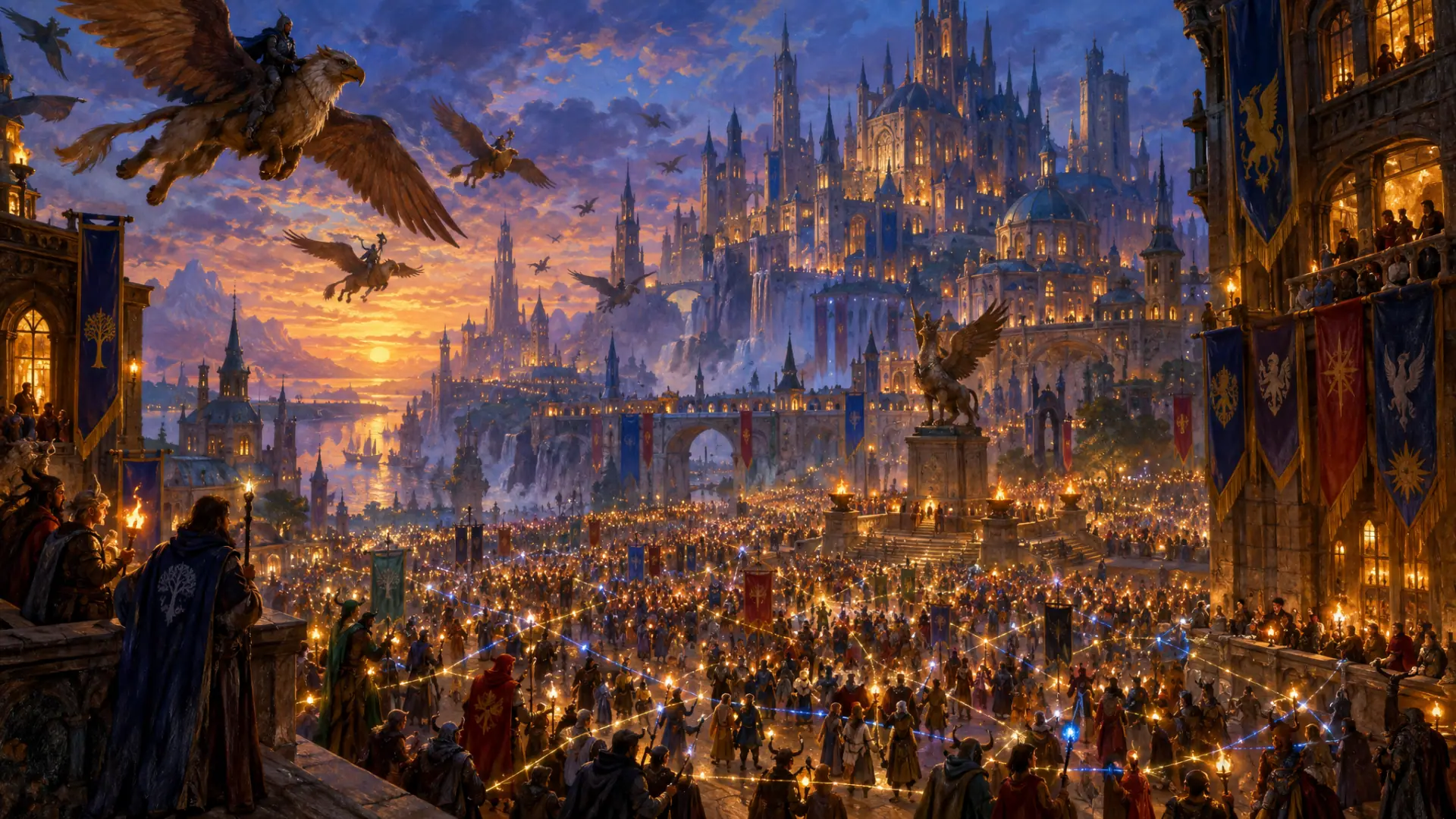
Meridian 59 is generally described as the first 3D graphical MMORPG and one of the first commercial ones. It proved players would pay a flat monthly subscription for a persistent online world, the business model the whole genre adopted.
Overview
Before Ultima Online made the MMORPG famous, there was Meridian 59: a first-person, texture-mapped 3D world, rendered in the style of the shooters of the day, where hundreds of strangers on the internet could explore, fight monsters, form guilds, and kill each other. Developed by a tiny startup called Archetype Interactive and published by The 3DO Company, it was playable online in an early form from December 15, 1995 and launched commercially on October 7, 1996, about a year before Ultima Online. It never became a hit, but it settled two questions that shaped the genre: online worlds could be three-dimensional, and players would pay a flat monthly fee to live in one.
Origins
The online role-playing games of the early 1990s were either free text MUDs in the tradition of MUD1 or commercial games on services such as America Online, where Neverwinter Nights charged by the hour. Meridian 59 was conceived for the open internet. The project began at a studio originally called Terra Nova Interactive, which renamed itself Archetype Interactive after a cease-and-desist letter from Looking Glass Technologies, whose own game was called Terra Nova; the world's working title changed for similar trademark reasons.
Archetype was run by the brothers Steve and Mike Sellers and by John Hanke, then studying for an MBA at Berkeley, with the brothers Andrew and Chris Kirmse as its key programmers. The whole team numbered 22 employees and contractors. The game was in an early beta in April 1996 when it was noticed by Kevin Hester, and 3DO bought Archetype that June; by one account the sale closed on the very day Hanke graduated. About 17,000 players joined the public beta. According to accounts of the period, it was in 3DO's meetings before release that the phrase "massively multiplayer," and an early acronym for the genre, took shape, along with the decision to charge a flat monthly subscription rather than AOL-style per-minute fees.
How it plays
Meridian 59 has no levels and no classes. Each skill and attribute grows on its own. Hit points rise by killing monsters that genuinely challenge the character; Mana is earned by exploring the world and finding mana nodes. Characters can study seven schools: weaponcraft and six schools of magic tied to the world's patron gods, Shal'ille, Qor, Kraanan, Faren, Riija and Jala, each with its own focus. There is no single-school restriction, but a character's intelligence caps the total proficiency they can learn, so every build is a trade-off.
What set the game apart was its social machinery. Guilds elect and depose leaders through a voting system, carry custom sigils on their shields, and can win or lose guild halls. Players post on in-world bulletin boards called newsglobes and exchange mail with each other and with non-player characters. A political metagame grew up around all this. Player-versus-player combat was central, governed by a player-run justice system meant to mediate killings, and in later years the game increasingly became a home for PvP enthusiasts. Many of these features, from guild politics to in-game mail, became standard in later online worlds.
Reception & impact
Reviews were respectable rather than rapturous: GamePro gave it an A−, Computer Gaming World and Computer Games Strategy Plus 3.5 out of 5, and Next Generation 3 out of 5. CNET's Gamecenter named it role-playing game of the year, and Computer Gaming World made it a finalist for its 1996 role-playing award, which went to The Elder Scrolls II: Daggerfall. An expansion, Dark Auspices, was later a finalist for an Academy of Interactive Arts & Sciences award for online role-playing.
Commercially it was small. By June 1999 PC Data counted just 14,359 retail copies sold in the United States, a figure one trade writer called "minuscule," although 3DO found other revenue through online sales and microtransactions. It was quickly overshadowed by Ultima Online in 1997 and by EverQuest and Asheron's Call in 1999, which took its first-person 3D approach to far larger audiences.
Legacy
3DO shut Meridian 59 down on August 31, 2000. That should have been the end, but Rob "Q" Ellis and Brian "Psychochild" Green, acquired it from 3DO and relaunched it in 2002 under their company Near Death Studios, running it as a small, devoted community world. Near Death Studios ceased operations on January 6, 2010, and the following month the game passed back to Andrew and Chris Kirmse. On September 15, 2012, the brothers released the game as freeware and its source code under the GPLv2 license, making it one of the few commercial online worlds of its generation that anyone can study and run.
Its alumni went far. John Hanke co-founded Keyhole, which Google acquired in 2004 and turned into Google Earth, and later founded Niantic, whose Pokémon Go carried Pokémon into the streets. Meridian 59 itself is remembered as the bridge between the text MUD and the graphical MMORPG: the first 3D world of its kind, and the first to prove that a monthly subscription could sustain one.
Marginalia
- It launched commercially on October 7, 1996, beating its great rival Ultima Online by about a year.
- Accounts of its birth say the term "massively multiplayer" took shape in 3DO meetings before the game's release.
- Co-founder John Hanke later co-founded Keyhole, the basis of Google Earth, and then Niantic, maker of Pokémon Go.
- By June 1999 its U.S. retail sales were only 14,359 copies, yet the game kept running on subscriptions.
- Computer Gaming World shortlisted it for 1996's role-playing award; it lost to The Elder Scrolls II: Daggerfall.
- Its original programmers, Andrew and Chris Kirmse, released the game and its source code as open source on September 15, 2012.
Quick answers
- When was Meridian 59 first released?
- Meridian 59 was first released in 1996 (Windows; early online form from December 1995).
- What kind of work is Meridian 59?
- Meridian 59 is a MMORPG in the MMORPGs and Western Computer RPGs (CRPG) tradition, released for Microsoft Windows.
- Why is Meridian 59 important?
- Meridian 59 is generally described as the first 3D graphical MMORPG and one of the first commercial ones. It proved players would pay a flat monthly subscription for a persistent online world, the business model the whole genre adopted.