The Nights gave Western fantasy its genies, ghouls, rocs, magic lamps and flying carpets, and its frame of endless nested stories; D&D's djinn and efreet, TSR's Al-Qadim and Prince of Persia all descend from it.
Overview
A king, betrayed by his wife, resolves to marry a new bride every night and execute her at dawn. Shahrazad, the vizier's daughter, volunteers to marry him — and each night tells him a story she leaves unfinished at daybreak, so that he must spare her to hear the ending. The One Thousand and One Nights (Arabic Alf Layla wa-Layla) is the vast, shifting collection that grew inside that frame: love stories, crime stories, fables, travelers' tales and wonder tales nested inside one another, sometimes five layers deep.
For fantasy, the Nights is the great storehouse of the marvelous outside the European tradition. Its jinn imprisoned in bottles and rings, its ghouls, its gigantic roc birds, its enchanted cities of brass, its lamps and flying carpets passed into European imagination from the 18th century on and never left.
Origins
The collection has no single author and no single original. Its frame story and some tales descend, through a lost Persian book called Hazār Afsān ("A Thousand Tales"), from older Indian storytelling traditions; 10th-century writers in Baghdad, including al-Masudi and Ibn al-Nadim, already described that Persian book and its storytelling wife. The oldest physical evidence is a 9th-century paper fragment, identified by the scholar Nabia Abbott, bearing a few lines under the title The Book of the Tale of a Thousand Nights.
The surviving Arabic texts fall into two broad families. A Syrian branch is represented by the so-called Galland manuscript, dated by scholars to between the 15th and 16th centuries; an Egyptian branch kept growing into the 18th and 19th centuries, absorbing stories until it could honestly claim a thousand and one nights. Muhsin Mahdi's 1984 critical edition, based on the Galland manuscript, is the scholars' benchmark for the older text.
The Nights reached Europe through Antoine Galland's French translation, Les mille et une nuits, published in volumes from 1704 to 1717. Galland padded out his source with tales told to him by the Syrian Maronite storyteller Hanna Diyab — among them "Aladdin" and "Ali Baba and the Forty Thieves", the two most famous stories associated with the Nights, which are found in no earlier Arabic manuscript. English readers got Edward Lane's version in the 1830s–40s and Richard Burton's exhaustive translation from 1885.
The story
Inside Shahrazad's frame, the stories range from the domestic to the cosmic. A fisherman hauls up a brass bottle and releases a furious jinni, whom he must trick back inside. The Hunchback's tale passes a corpse from hand to hand through the whole city. Sinbad the Sailor makes seven voyages, meeting a roc large enough to carry off an elephant, an island that turns out to be a whale, and a cannibal giant who is blinded with red-hot spits in an episode long compared to Homer's Polyphemus. Ghouls lurk in ruins and graveyards; sorcerers transform rivals into animals; whole cities lie enchanted. By the end Shahrazad has borne the king children, and he has abandoned his vow.
Reception & impact
Galland's volumes were a sensation and set off a century of "Oriental tales" in European literature. They supplied the Romantics with a second wellspring of wonder beside Northern myth and fed children's reading for generations; Charles Dickens and the young Brontës knew them well. They were also, inevitably, a lens of Western fantasy about the East, and modern scholars read Galland's and Burton's versions with that in mind.
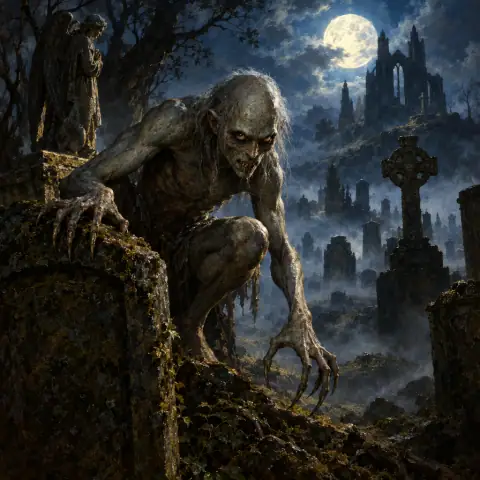
The collection's creatures went straight into the fantasy vocabulary. The Arabic ghul, a shape-shifting desert demon that feeds on the dead, became the Ghoul. And H. P. Lovecraft recalled adopting the name "Abdul Alhazred" as a small boy steeped in the Nights — the name he later gave to the "mad Arab" who wrote the Necronomicon.
Legacy
Cinema turned the Nights into spectacle: The Thief of Bagdad (1940), Ray Harryhausen's stop-motion The 7th Voyage of Sinbad (1958) with its cyclops and roc, and Disney's Aladdin (1992). Roleplaying games made it a bestiary. The original 1974 Dungeons & Dragons rules included the djinni and the efreet among their monsters, alongside the roc and the ghoul, and the flying carpet became a standard magic item. In 1992 TSR devoted an entire campaign line to the material: Al-Qadim, a setting of genies, caliphs and desert cities for Advanced Dungeons & Dragons designed by Jeff Grubb with Andria Hayday, which SSI adapted into the computer game Al-Qadim: The Genie's Curse.
On computers, Jordan Mechner's Prince of Persia (1989) drew its palace, princess and scheming vizier from the same storybook world, and Arabian Nights settings have remained a fixture of fantasy games since. The lasting gift may be structural: Shahrazad's endless, interlocking stories — each one opening onto another — are the ancestor of every campaign in which a tale told at the inn becomes the next adventure.
Marginalia
- The oldest known fragment, a 9th-century paper leaf bearing the title 'The Book of the Tale of a Thousand Nights', was identified by scholar Nabia Abbott.
- 'Aladdin' and 'Ali Baba' appear in no earlier Arabic manuscript; Antoine Galland added them after hearing them from the Syrian storyteller Hanna Diyab.
- The Nights introduced European readers to the ghul, a desert demon that haunts graveyards — the ancestor of the fantasy ghoul.
- H. P. Lovecraft said he took the name 'Abdul Alhazred' as a child reading the Nights; he later gave it to the author of his Necronomicon.
- Djinn and efreet were among the monsters of the original 1974 Dungeons & Dragons rules.
- Richard Burton's unexpurgated translation (1885) ran to ten volumes, plus six supplemental volumes.
Quick answers
- When was One Thousand and One Nights first published?
- One Thousand and One Nights was first published in earliest fragment 9th c.; Arabic manuscripts from c. 15th c.; Galland's French version 1704–17.
- What kind of work is One Thousand and One Nights?
- One Thousand and One Nights is a story collection in the Myth & Epic, Fairy-Tale Fantasy and Mythic Fantasy tradition.
- Why is One Thousand and One Nights important?
- The Nights gave Western fantasy its genies, ghouls, rocs, magic lamps and flying carpets, and its frame of endless nested stories; D&D's djinn and efreet, TSR's Al-Qadim and Prince of Persia all descend from it.