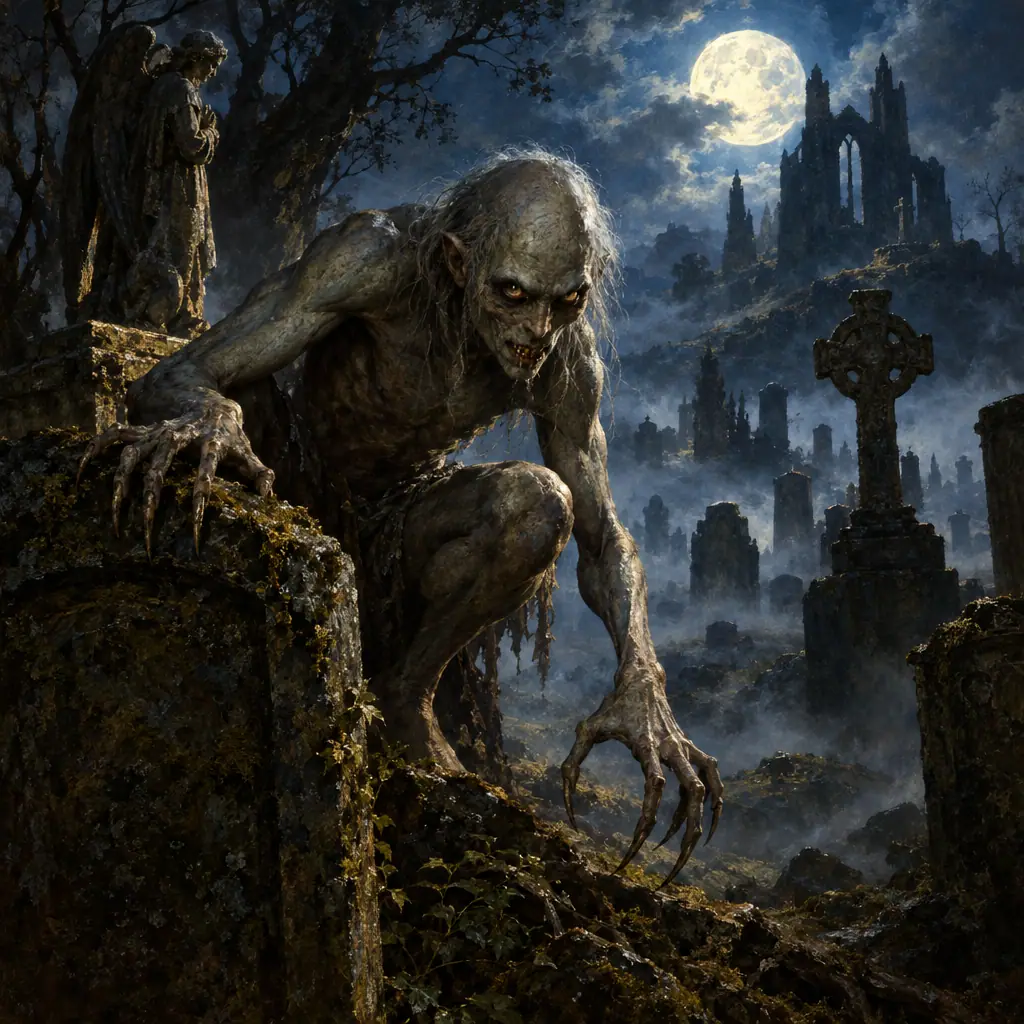
The ghoul is the bestiary's clearest example of a creature crossing cultures: an Arabic jinn reshaped by French translation, English Gothic, American pulp horror and finally the game rulebook into a staple undead.
Origins
The ghoul began in the Arabian desert, long before Islam. The ghūl — from the Arabic verb ghāla, "to seize" — belonged to the jinn, and pre-Islamic poets boasted of meeting one; the outlaw poet Ta'abbata Sharran made a famous verse of his fight with a ghūl. It haunted wastelands and burial grounds, changed shape at will, and lured travelers away from the road to devour them. In tales told to girls and young women it appeared to men as a long-lost female relative or a kindly old woman who lured them home to eat them, and often only the women of the family saw through the disguise. Later tradition held that reciting the call to prayer would drive it off. Islamic scholars disagreed about whether ghouls existed at all.
Europe learned of the creature through the Arabian Nights. Antoine Galland's French translation (1704–17) presented the ghoul as a monster that dwells in cemeteries and feasts on corpses, and that grave-robbing image stuck. William Beckford's Orientalist novel Vathek (1786) brought the word into English literature; by the 19th century "ghoul" also meant anyone who delights in the macabre.
The modern fantasy ghoul was finished in American pulp. H. P. Lovecraft's "Pickman's Model", published in Weird Tales in 1927, describes a Boston painter whose portraits of rubbery, doglike ghouls feeding in tunnels beneath the city turn out to be painted from life. In The Dream-Quest of Unknown Kadath, written in 1926–27 and published in 1943, Pickman has become one of them, and the ghouls — along with the more terrible ghasts — inhabit an underworld of their own. Lovecraft's creatures were a subterranean race, neither dead nor quite alive, and a model for the weird monster that is horrifying because it is almost human.
Into the dungeon
Dungeons & Dragons (1974) made the ghoul an undead corpse-eater with one memorable power: its touch paralyzed anyone it hit, leaving a helpless character to be clawed at leisure. The first-edition Monster Manual (1977) of Advanced Dungeons & Dragons kept the paralysis, exempted elves, and added the ghast, a stronger ghoul whose carrion stench causes retching — a name shared with Lovecraft's creatures. Ghouls became a fixture of low-level crypts because they were a real threat to careless parties: a single hit could take a fighter out of the fight, a textbook route to a TPK.
Chaosium's Call of Cthulhu (1981) returned the ghoul to its Lovecraftian roots as a species with its own society. Computer RPGs built on D&D's rules inherited its ghouls and ghasts along with its crypts, from the Gold Box era to Baldur's Gate and its successors. The Fallout series (from 1997) took the name in a new direction, making ghouls radiation-scarred human survivors of a nuclear war — citizens, shopkeepers and companions as often as enemies.
Variations
Four ghouls share the name. The folkloric ghūl is a desert shape-shifter, as likely to seduce as to eat. The Gothic ghoul of Galland and Beckford is a grave-robber. The Lovecraftian ghoul is a subterranean people with a culture and a history. The game ghoul of D&D is mindless, paralyzing undead. The first and the last have almost nothing in common but hunger. Like the Vampire, the ghoul shows how much a monster can change each time its story crosses a language — and how translation, as much as imagination, fills a bestiary.
Migration
How the creature traveled from story to story.
- 500Pre-Islamic Arabic poetry (c. 6th century)The ghūl, a shape-shifting desert demon of the jinn, appears in verse such as the poet Ta'abbata Sharran's boast of fighting one.
- 1704Antoine Galland's Mille et une nuits (1704–17)The French Arabian Nights presents the ghoul as a graveyard creature that feasts on corpses.
- 1786William Beckford, VathekThe first use of 'ghoul' in English literature.
- 1927H. P. Lovecraft, "Pickman's Model"Weird Tales readers meet doglike ghouls tunneling beneath Boston; the painter Pickman later joins them.
- 1974Original D&D boxed setGhouls become low-level undead whose claws paralyze.
- 1981Call of Cthulhu RPGChaosium brings Lovecraft's ghouls to the gaming table.
- 1997FalloutGhouls become irradiated survivors, a people rather than a monster.
Marginalia
- 'Ghoul' comes from Arabic ghūl, from the verb ghāla, 'to seize'; in early Arabic the word was feminine.
- Arabic tradition held that a lone traveler could escape a ghūl by reciting the call to prayer.
- Antoine Galland's French translation of the Arabian Nights (1704–17) introduced the ghoul to European readers as a corpse-eater of graveyards.
- William Beckford's novel Vathek (1786) is the first English work to use the word 'ghoul'.
- In AD&D a ghoul's touch paralyzed its victims, but elves were immune.
- D&D's ghast, a stronger ghoul with a nauseating stench, shares its name with a creature in Lovecraft's The Dream-Quest of Unknown Kadath.
Quick answers
- Where does the Ghoul come from?
- Pre-Islamic Arabian folklore (the ghūl), brought to Europe by translations of the Arabian Nights.
- When did the Ghoul first appear?
- c. 500, in Pre-Islamic Arabic poetry (c. 6th century).
- How did the Ghoul get into games?
- Key appearances: Original D&D boxed set (1974) and Call of Cthulhu RPG (1981).
- Why is the Ghoul significant?
- The ghoul is the bestiary's clearest example of a creature crossing cultures: an Arabic jinn reshaped by French translation, English Gothic, American pulp horror and finally the game rulebook into a staple undead.