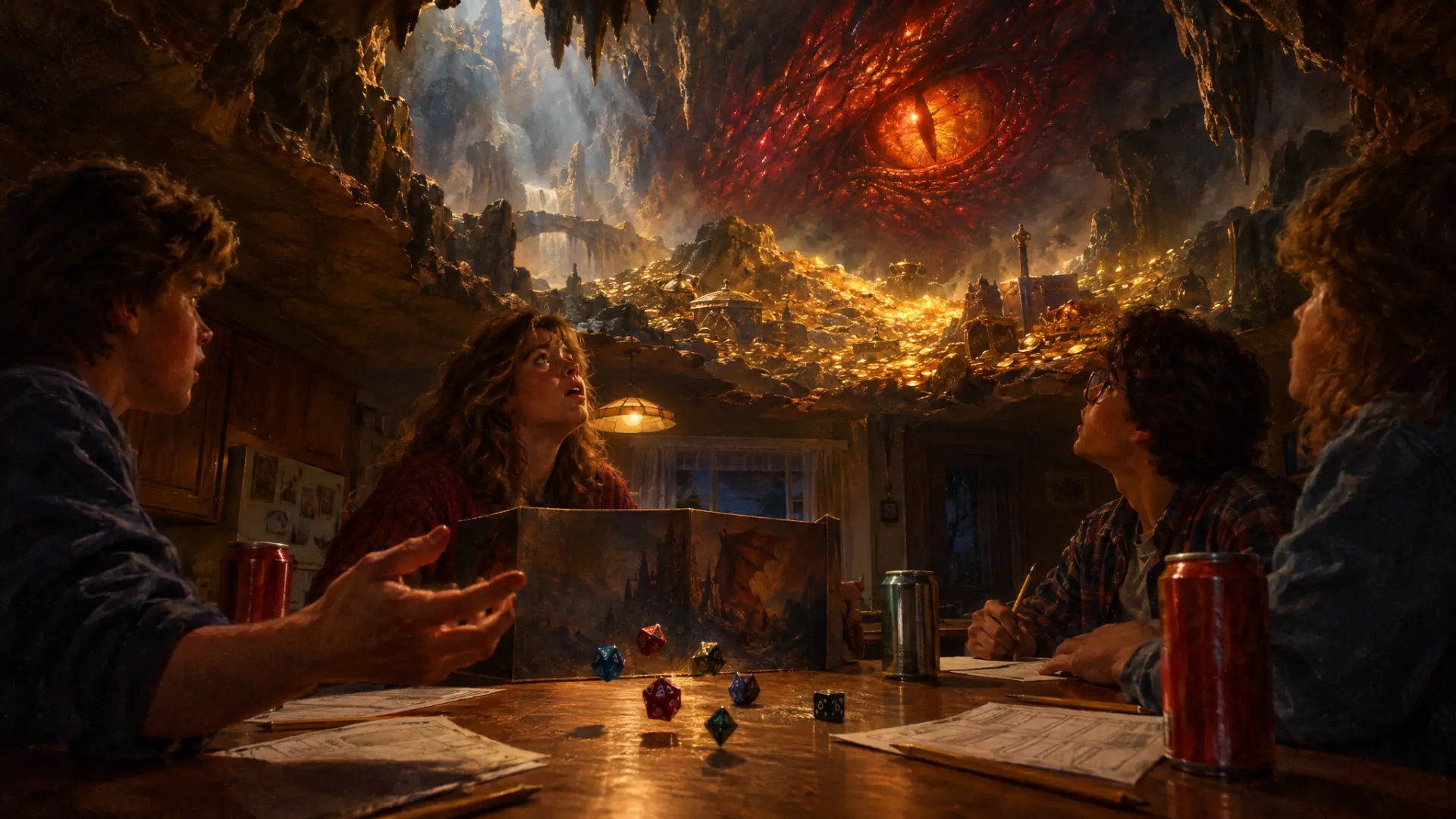
Call of Cthulhu proved roleplaying games could do horror and investigation, not just heroic fantasy. Its sanity mechanic and clue-driven scenarios established a genre, and it remains one of the longest-running RPGs in continuous publication.
Overview
Call of Cthulhu is a horror roleplaying game based on the fiction of H. P. Lovecraft and the wider Cthulhu Mythos, designed by Sandy Petersen and published by Chaosium in 1981. It took the machinery of roleplaying — a referee, a group of players, dice, character sheets — and aimed it at a completely different experience from the dungeon crawl. Its characters are not heroes, they are not meant to win, and the more they learn, the worse things get.
It has been in print, through seven editions, for more than four decades, and is widely regarded as the game that established horror as a major tabletop genre.
Origins
Chaosium had commissioned a Lovecraftian game called Dark Worlds that never materialized. Petersen, who had studied zoology and entomology and was a devoted RuneQuest player, contacted the company about a RuneQuest supplement set in Lovecraft's Dreamlands and ended up taking over the whole horror project. He built it on Chaosium's new Basic Role-Playing, the sixteen-page distillation of RuneQuest's rules that Greg Stafford and Lynn Willis had published in 1980. The first edition, a boxed set, appeared in 1981, set in the 1920s of Lovecraft's own stories.
How it plays
Players create investigators: professors, antiquarians, private detectives, journalists, doctors, dilettantes. Each has characteristics and a list of skills rated as percentages — Library Use, Spot Hidden, Occult, Psychology, Firearms — and tries to roll equal to or under the relevant skill on percentile dice. There are no character classes and no levels. Skills improve by use, and hit points stay low: a gunshot or a monster's claw is as deadly to a veteran as to a novice.
The referee is the Keeper of Arcane Lore. A typical scenario opens innocently — a missing relative, an odd bequest, a newspaper story — and the players follow a trail of clues through libraries, interviews and old houses. Petersen structured his adventures like layers of an onion: each discovery reveals a deeper and more terrible layer, from a local cult to a conspiracy to summon beings older than humanity. Combat is usually a mistake; the usual wise course is to research, prepare and run.
The defining rule is Sanity. Every investigator has a Sanity score. Witnessing the supernatural, finding a mutilated body, or reading a forbidden tome like the Necronomicon forces a Sanity roll, and failure — sometimes success too — costs points. Large losses bring temporary or indefinite insanity: phobias, fainting, catatonia. Learning the Cthulhu Mythos skill makes investigators more knowledgeable and permanently less sane. Most campaigns end with investigators dead, mad or broken, and players enjoy that trajectory — the horror is the point.
Reception & impact
Call of Cthulhu's first scenario collection, Shadows of Yog-Sothoth (1982), set the template for the linked campaign in which investigators trace a secret society across the globe. Masks of Nyarlathotep (1984) and Horror on the Orient Express (1991) became two of the most celebrated campaigns in the hobby, famous for their physical handouts — letters, newspaper clippings, matchbooks, even period passports — for players to examine as real evidence. White Dwarf rated the 1983 collection The Asylum and Other Tales 9 out of 10. Supplements moved the game to the 1890s (Cthulhu by Gaslight), to the present day (Cthulhu Now, 1987) and to many other eras.
The game also carried Lovecraft's Mythos — born in the pages of Weird Tales — to a large new audience of players. Designers took note: horror, investigation and fragile protagonists became legitimate subjects for roleplaying.
Legacy
Petersen moved into computer games in the late 1980s, working at MicroProse and then, from 1993, at id Software on Doom and Quake, before returning to tabletop design. Lynn Willis carried the game through later editions, and in 2014 Mike Mason and Paul Fricker delivered the heavily revised seventh edition, funded by a 2013 Kickstarter that raised more than fourteen times its $40,000 goal. Licensed spinoffs include Pagan Publishing's Delta Green, a 2001 d20 version from Wizards of the Coast, and Fantasy Flight Games' Arkham Horror line of board and card games. Few roleplaying games of its generation remain as widely played — and none has had a larger influence on how the tabletop tells stories of dread.
Did you know?
Early printings of TSR's Deities & Demigods (1980) included a Cthulhu Mythos chapter, which was dropped from later printings amid overlapping licensing claims to the material.
Marginalia
- The project began as a Chaosium commission called Dark Worlds; Sandy Petersen had approached the company proposing a RuneQuest supplement set in Lovecraft's Dreamlands.
- Players are "investigators" — ordinary people such as scholars, journalists and detectives — and the referee is the "Keeper."
- Seeing a monster, or reading the wrong book, costs Sanity points; investigators may end in an asylum rather than a grave.
- Characters do not gain levels or hit points; they improve skills by using them, as in RuneQuest.
- Its campaigns, such as Masks of Nyarlathotep (1984), came with handouts — letters, clippings, matchbooks — for players to study as clues.
- Its 2013 Kickstarter for the 7th edition sought $40,000 and raised $561,836.
Quick answers
- When was Call of Cthulhu first released?
- Call of Cthulhu was first released in 1981 (1st ed.); 7th ed. 2014.
- Who created Call of Cthulhu?
- Call of Cthulhu was made by Sandy Petersen (designer) and H. P. Lovecraft (source author (Cthulhu Mythos)).
- Who published or developed Call of Cthulhu?
- Chaosium.
- What kind of work is Call of Cthulhu?
- Call of Cthulhu is a tabletop RPG in the Tabletop Roleplaying Games and Weird Fiction tradition, released for Boxed set (1981); later single rulebooks and Percentile dice.
- Why is Call of Cthulhu important?
- Call of Cthulhu proved roleplaying games could do horror and investigation, not just heroic fantasy. Its sanity mechanic and clue-driven scenarios established a genre, and it remains one of the longest-running RPGs in continuous publication.