On rough wood-pulp paper, Lovecraft summoned Cthulhu, Howard unleashed Conan, and Leiber, Moore, Smith and Vance built the dark, thrilling fantasy that D&D would play.
In the hard years after the Crash, in the cattle-and-oil town of Cross Plains, Texas, a young man who lived with his parents sat at a typewriter and pounded out stories at a penny a word. In December 1932 one of them appeared on newsstands across America between the lurid covers of a magazine printed on paper so cheap that it crumbled and yellowed within a few years. It began with a barbarian king, black-maned and sullen, alone in his chamber while conspirators gathered outside, and it introduced a character who would outlive his creator by nearly a century: Conan of Cimmeria. This chapter is the story of the pulps, the rough, disreputable, wildly inventive magazines where fantasy stopped being literary and became popular. Their writers were paid little and respected less. Yet in forty years they invented sword-and-sorcery and cosmic horror, created the thief, the barbarian and the forgetful wizard, and filled the bookshelf from which, in the 1970s, a group of Midwestern wargamers would build Dungeons & Dragons.
The Unique Magazine
"Pulp" meant the paper, rough wood-pulp stock that let publishers sell 128-page magazines for a quarter or less. By the 1920s American newsstands carried hundreds of them, sorted by genre: westerns, detective stories, air-war adventures, romance and, from 1923, the uncanny. Weird Tales was founded in late 1922 by J. C. Henneberger and J. M. Lansinger, and its first issue, dated March 1923, went on sale on February 18. It almost failed within a year; refinanced, it found its true editor in Farnsworth Wright, whose name first appeared on the masthead in November 1924 and who edited it until 1940. Wright, a war veteran who also wrote music criticism, had an eye for strange talent and a willingness to print stories no one else would touch. The magazine billed itself "The Unique Magazine," and it was.
From June 1933 to the late summer of 1936 every one of its covers was painted in pastels by a Chicago artist, Margaret Brundage, whose languid, scantily clad women made the magazine notorious and sold it off the racks. The pulps' visual grammar of the heroic male, the endangered, half-dressed woman and the looming monster would stamp fantasy art for half a century, through Frank Frazetta's paperback covers to the earliest D&D illustrations, and would eventually be argued over and rethought.
Weird Tales printed ghost stories, occult detectives and horror of every kind, and out of that mix it grew a distinct literary form, Weird Fiction: stories in which the supernatural is not a moral lesson or a fairy's whim but an alien, indifferent reality that breaks through the thin surface of the everyday.
The dreamer of Providence
The form's great theorist was a reclusive, fiercely literate New Englander, Howard Phillips Lovecraft of Providence, Rhode Island. Lovecraft began with Dunsany-style dream fantasies (see The Invention of Modern Fantasy) and Poe-style horror, and in "The Call of Cthulhu," written in the summer of 1926 and published in Weird Tales in February 1928, he found his own voice. A dead professor's notes, a bas-relief made by a dreaming sculptor, a police raid on a swamp cult and a sailor's account of a nightmare city rising from the Pacific add up to a revelation: that humanity is a recent accident on a planet once ruled by vast beings from beyond the stars, one of whom lies dreaming beneath the sea. "Pickman's Model" (October 1927) showed a Boston painter whose portraits of graveyard ghouls turn out to be drawn from life.
Lovecraft's most original move was to share. He let friends borrow his invented gods, books and towns, and borrowed theirs in turn: the forbidden Necronomicon, the sinister college town of Arkham, the toad-god Tsathoggua dreamed up by Clark Ashton Smith. The result, later labeled the Cthulhu Mythos, was fantasy's first open shared world, a precursor of the Shared-World & Tie-In Fiction of Thieves' World and of every setting built by many hands. Lovecraft died in poverty in Providence in March 1937, virtually unknown outside the pulps. Two of his friends, August Derleth and Donald Wandrei, founded Arkham House in Sauk City, Wisconsin, in 1939 to preserve him in hardcover; its first book, The Outsider and Others, had only 150 advance orders and a print run of 1,268 copies.
The rescue worked. Lovecraft's cosmic horror became one of the most influential strands in all of popular culture, and in games it has its own lineage. In 1981 Sandy Petersen and Chaosium published Call of Cthulhu, a roleplaying game in which investigators go mad rather than grow powerful, and whose sanity rules broke with the power-fantasy model of D&D. Lovecraft's monsters and gods also appeared in TSR's Deities & Demigods (1980), and his shadow falls across Dark Fantasy from Darkest Dungeon to the Souls games.
Blood and thunder from Cross Plains
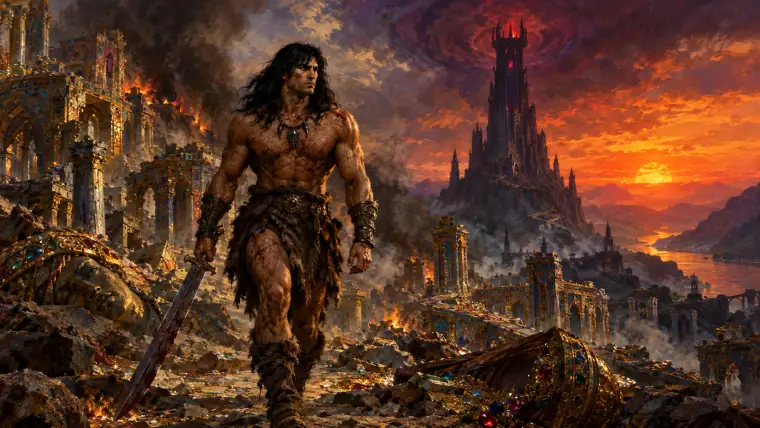
Robert E. Howard was Lovecraft's friend and most frequent correspondent, and his temperamental opposite: a Texan who boxed, drank in the oil-boom towns and loved blood-and-thunder history. He had sold his first story, the caveman tale "Spear and Fang," to Weird Tales for sixteen dollars in 1924, when he was eighteen. He created the grim Puritan swordsman Solomon Kane, hunting evil through the seventeenth century, and Kull, an Atlantean who wins the throne of a decadent kingdom, whose first story, "The Shadow Kingdom," appeared in August 1929. When a Kull tale called "By This Axe I Rule!" failed to sell, Howard rewrote it with a new hero. The result, "The Phoenix on the Sword" (December 1932), introduced Conan.
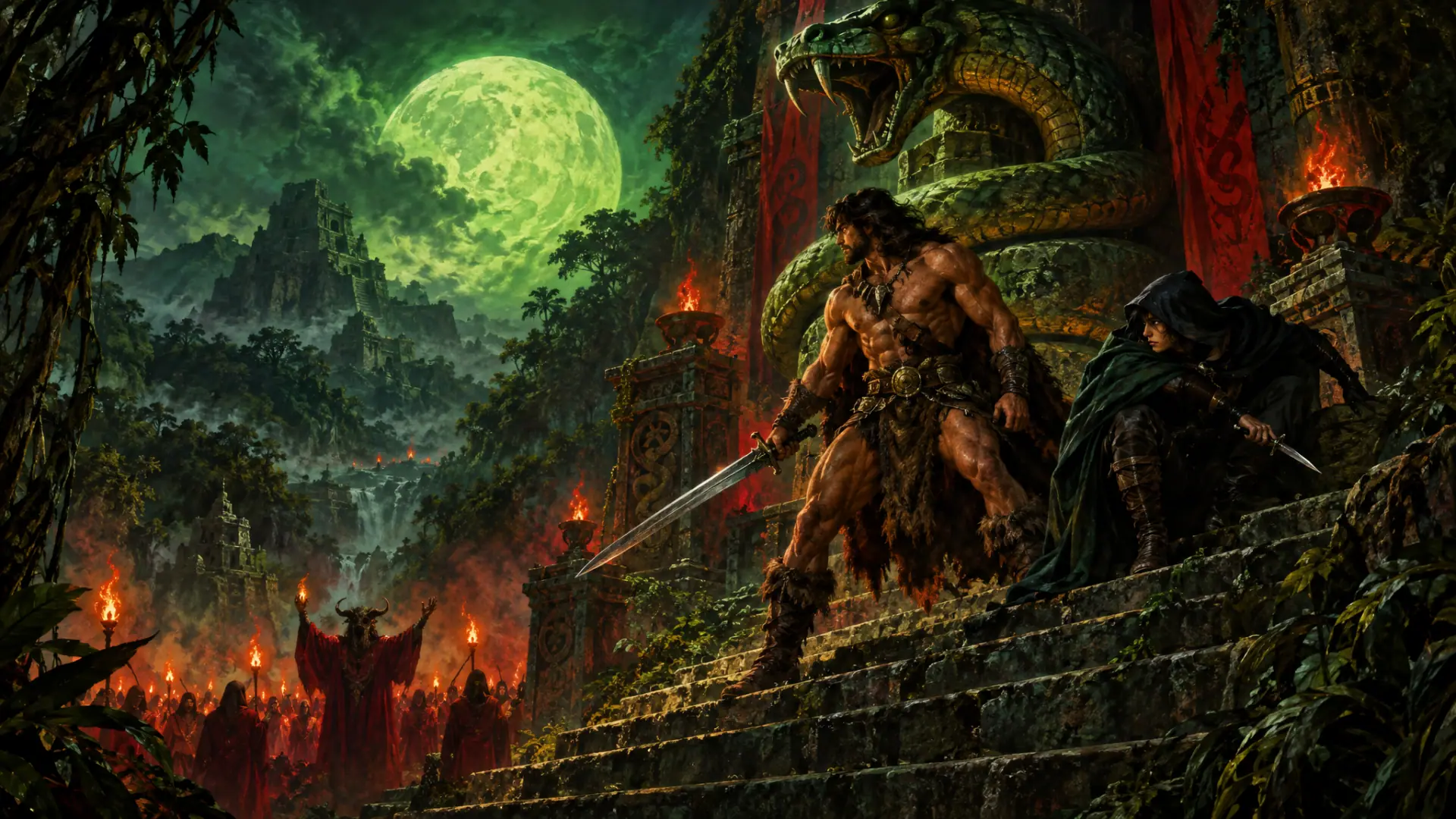
Howard gave his barbarian a whole invented prehistory, the Hyborian Age, a time between the sinking of Atlantis and recorded history, which he laid out in an essay and used as a stage for stories that roam from icy northern wastes to jungle kingdoms and decadent eastern cities. Conan is a thief, a pirate, a mercenary and finally a king, with an animal alertness to danger and a contempt for civilized hypocrisy. The magic in his world is almost always evil, practiced by degenerate priests and sorcerers from forgotten races. The stories, "The Tower of the Elephant," "Queen of the Black Coast," "Beyond the Black River," "Red Nails," are violent, sensual, fast and often darkly lyrical, and they created a new genre, Sword & Sorcery: personal stakes rather than world-saving, a mercenary hero rather than a chosen one, and sorcery as a thing to be feared.
Howard's career ended in tragedy. On June 11, 1936, as his mother lay dying, he died by suicide in Cross Plains. He was thirty. His stories had never been collected during his lifetime. Their afterlife belongs to the next decades: the small New York publisher Gnome Press collected Conan in hardcover from 1950 to 1957, with L. Sprague de Camp editing, rewriting and completing stories in ways that are still argued over; the paperbacks with Frazetta covers from 1966 (see The Paperback Boom & the Counterculture); and John Milius's Conan the Barbarian (1982). In gaming, the barbarian, the fantasy thief and every dungeon of evil sorcerer-priests trace back to Cross Plains.
Sorcerers of Averoigne and Joiry
The third of Weird Tales' great trio was Clark Ashton Smith, a self-taught poet from Auburn, California, who had been hailed at nineteen as a romantic prodigy and who wrote his fantastic fiction chiefly in a brief, astonishing burst in the late 1920s and 1930s. Smith set his tales in imagined times and places: Hyperborea, a primeval polar continent; Averoigne, a medieval French province of werewolves and sorcerers; and above all Zothique, Earth's last continent under a dying sun, where necromancers rule and the dead are raised to serve. His prose was ornate, his humor sardonic, and his vision of a far-future world where science has become forgotten magic founded the Dying Earth tradition that Jack Vance would name. After the deaths of his mother in 1935 and his father in 1937, Smith largely stopped writing fiction and turned to poetry and sculpture.
Weird Tales also published one of the genre's pioneering women. Catherine Lucile Moore, a secretary at an Indianapolis bank who signed her stories with her initials as C. L. Moore, made her professional debut with the science-fantasy "Shambleau" in November 1933, then in October 1934 published "Black God's Kiss," starring Jirel, the fierce red-haired lady of the castle of Joiry, who descends through a hellish underground passage to find a weapon against the man who has conquered her. Jirel is widely called the first female sword-and-sorcery protagonist, and the Jirel stories, with their journeys into alien otherworlds beneath a castle, read today like dungeon expeditions. In 1940 Moore married the writer Henry Kuttner, and the two collaborated on most of their work until his death in 1958.
Unknown worlds
At the end of the 1930s, the science-fiction editor John W. Campbell launched a fantasy companion to his Astounding. Unknown (1939–43) insisted that fantasy be as rigorous, witty and internally consistent as good science fiction, and it lasted only four years, until wartime paper shortages ended it with the October 1943 issue, but its influence on the genre's craft was enormous.
Its most lasting heroes were a pair of rogues. Fritz Leiber, the son of a Shakespearean actor, and his friend Harry Otto Fischer had invented them in letters in 1934: Fafhrd, a towering northern barbarian who sings and drinks and is gentler than he looks, and the Gray Mouser, a small, quick, sardonic thief and apprentice wizard. Their home city was Lankhmar, a teeming, decadent port in the world of Nehwon, with a Thieves' Guild and gods too small to be taken seriously. The first published story, "Two Sought Adventure," appeared in Unknown in August 1939, and Leiber would write about Fafhrd and the Gray Mouser until 1988. The pair were witty where Conan was grim, loyal to each other above all, and more interested in treasure and adventure than in thrones. They are, in almost every respect, a two-person D&D party, and Lankhmar is the ancestor of every fantasy city of thieves' guilds and back alleys. TSR would publish Lankhmar game material in the 1970s and 1980s, and D&D's thief class, introduced in the Greyhawk supplement in 1975, has the Mouser's shadow on it.
Unknown also ran L. Sprague de Camp and Fletcher Pratt's comic Harold Shea stories, beginning with "The Roaring Trumpet" (1940), in which a psychologist uses symbolic logic to travel into the worlds of myth and literature, the Norse world first and later the worlds of The Faerie Queene and Orlando Furioso, and discovers that each has its own laws of magic. The idea that magic, like physics, can be a consistent system with rules to be learned is one root of the modern Hard & soft magic systems, and a very gameable one.
Digests, paperbacks and the end of the pulps
The pulps did not survive the 1950s. Paper rationing, comic books, paperbacks and television all ate into their market. Weird Tales switched to the smaller digest format in 1953 and published its last original-run issue, its 279th, dated September 1954. By then the future was already on the racks in new forms. Donald A. Wollheim, a fan-turned-editor who would shape paperback fantasy for decades, edited the Avon Fantasy Reader from 1947, reprinting pulp classics for a new generation. The Magazine of Fantasy, founded in 1949 by Anthony Boucher and J. Francis McComas, soon renamed The Magazine of Fantasy & Science Fiction, gave fantasy a respectable literary home.
In 1950 a small paperback house, Hillman, published Jack Vance's The Dying Earth, linked tales of wizards and wanderers in Earth's final age, owed openly to Clark Ashton Smith. Vance's magicians can hold only a few spells in their minds at once, memorizing their complex formulas from books; once spoken, a spell is gone from memory. Two decades later, Gygax gave D&D's magic-users exactly that rule, which is why players still speak of Vancian magic.
Poul Anderson, a physicist-trained science-fiction writer with a deep love of Scandinavia, published two landmark fantasies in these years. Three Hearts and Three Lions (a novella in F&SF in 1953, expanded to a novel in 1961) sent a modern Danish engineer into a world of Carolingian legend, where he becomes the champion of Law against Chaos; it gave D&D its first Alignment system, its regenerating Troll and much of the inspiration for the paladin. The Broken Sword, published on November 5, 1954, just months after Tolkien's The Fellowship of the Ring, was its opposite: a savage, tragic saga of elves, trolls and a cursed sword in Viking-age Britain, grim where Tolkien was hopeful. Its elves are cold and cruel, and its tone points toward Grimdark decades early.
The genre even got its name in this aftermath. In the fanzine Amra, published by the Hyborian Legion of Conan enthusiasts, the young British writer Michael Moorcock asked what to call Howard's kind of story, suggesting "epic fantasy." In the fanzine Ancalagon in April 1961, and again in Amra that July, Fritz Leiber proposed "sword-and-sorcery." (The phrase had appeared at least once before, in 1953, but Leiber's use is the one that stuck.)
From the pulp page to the game table
In 1979 Gary Gygax appended to the Dungeon Masters Guide a list of "inspirational and educational reading" (see Appendix N). It is a portrait of this chapter. Howard, Leiber, Vance, Lovecraft, Merritt, Burroughs, de Camp and Pratt, Anderson, Moorcock, Dunsany and Tolkien are all there, and Gygax singled out de Camp and Pratt, Howard, Leiber, Vance, Lovecraft and A. Merritt, the Munsey-pulp author of lost-world fantasies such as The Moon Pool (1918) and The Ship of Ishtar (1924), as the most immediate influences on the game. One notable name is missing: Clark Ashton Smith, an omission Gygax later acknowledged.
The debt is concrete. The Conan stories supplied the barbarian, the ruined temple and the evil sorcerer. The Gray Mouser supplied the thief and the thieves' guild. Vance supplied the spell slots. Lovecraft supplied the tentacled horrors from beyond; Gygax said one inspiration for the octopus-headed Mind Flayer (Illithid) was the cover of Brian Lumley's Mythos novel The Burrowers Beneath. Anderson supplied Law and Chaos. Moore and Smith supplied the descents into alien underworlds. The distinctive feel of early D&D, adventurers who are more mercenary than noble, who go into dangerous places for gold, and who might be killed by a trap or driven off by a sorcerer, is sword-and-sorcery's feel, not Tolkien's. When D&D players speak of "old-school" play (see Old-School Renaissance (OSR)), this is the tradition they mean.
What came next
The pulps were only half the story of fantasy between the wars. While Conan hacked his way through Hyboria, a very different fantasy was taking shape in the ancient colleges of Oxford, where a group of Christian academics met to read their work aloud over beer and pipes. One of them had just published a children's book about a creature called a hobbit, and was beginning a sequel that would take seventeen years. Their story is told in Tolkien, Lewis & the Inklings.