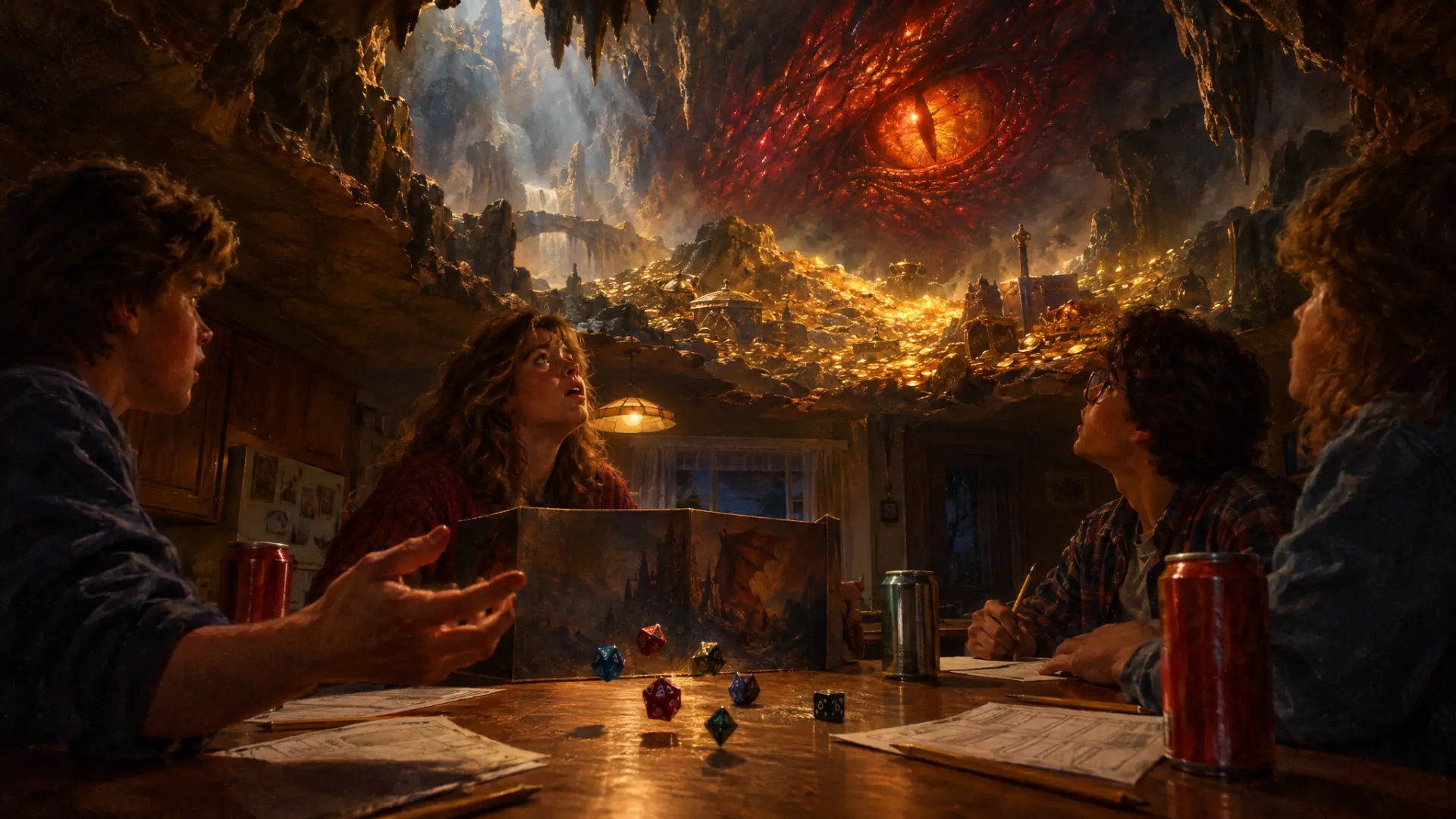
Shared-world and tie-in fiction is where tabletop gaming changed publishing. TSR's Dragonlance and Forgotten Realms novels made game worlds bestselling literature, introduced millions of readers to fantasy, and built the franchise model that now spans games, books and screens.
Hallmarks
- One setting, many authors, each contributing stories that stand alone
- A canon — sometimes policed by an editor or rights-holder — and the continuity problems that follow
- Worlds that originate in games, films or franchises and are licensed to novelists
- Recurring locations and characters handed from writer to writer
- Commercial purpose: extending, promoting and monetizing a property
- A training ground and a steady living for many working fantasy writers
What it is
Shared-world fiction is writing in which many authors contribute independent stories to a common setting. Each story can stand on its own, but together they build a larger history, cast and geography. Tie-in fiction is its commercial sibling: novels and stories licensed from a property that began somewhere else — a game, a film, a television series — written to extend and promote it. In fantasy the two overlap almost completely, because the richest shared worlds of the last half-century began as gaming campaign settings.
The form comes with its own problems. Many hands create contradictions, so shared worlds develop a notion of canon (what the owner says is official) and tools such as retroactive continuity. Tie-in writing, for its part, has long been underpaid, deadline-driven and disdained by literary critics — and has nonetheless produced some of the genre's most-read books.
Origins
Fantasy's first shared world was informal. H. P. Lovecraft and his correspondents in Weird Tales — Clark Ashton Smith, Robert E. Howard, Robert Bloch and others — traded references to one another's gods and grimoires, and after Lovecraft's death August Derleth systematized the "Cthulhu Mythos," to mixed critical reception. Comics formalized the idea: Marvel merged its heroes into one universe in the early 1960s, and in 1970 the historian Don Markstein first defined the "shared universe."
The literary shared-world anthology arrived in 1979, when Robert Asprin edited Thieves' World for Ace Books: stories by many writers, all set in Sanctuary, a seedy port city of thieves and sorcerers. The series ran through 1989, spawned imitators such as Janet Morris's Heroes in Hell and George R. R. Martin's Wild Cards (from 1987), and crossed into gaming almost immediately when Chaosium published a Thieves' World supplement in 1981.
Evolution
Games turned shared worlds into an industry. TSR's Dragonlance project (1984) was conceived as a coordinated campaign: game modules and novels telling one story. Margaret Weis and Tracy Hickman's Dragons of Autumn Twilight (1984), the first of the Dragonlance Chronicles, followed the first two modules with a different ending. The Forgotten Realms, created by Ed Greenwood, got its first novel with Douglas Niles's Darkwalker on Moonshae (1987), and R. A. Salvatore's The Crystal Shard (1988), opening The Icewind Dale Trilogy, introduced Drizzt Do'Urden, who became one of fantasy's most popular characters. For many readers of the late 1980s and 1990s, TSR's paperbacks were a gateway into adult fantasy.
Across the Atlantic, Games Workshop began commissioning Warhammer fiction in the late 1980s and founded the Black Library in 1997, which grew into one of the largest bodies of tie-in fiction anywhere. Video games followed the same path — World of Warcraft and The Elder Scrolls have both spun off tie-in novels — while The Witcher ran the other way, from Andrzej Sapkowski's books to games and television. Franchises now flow in every direction between books, games and screens. The practice of shared authorship persists in anthologies, licensed lines, and in collaborative settings built by roleplaying communities.
The newest shared worlds come from actual play. Critical Role's home campaign world, Exandria, began at Matthew Mercer's table, grew through two published setting books, Tal'Dorei Campaign Setting (2017) and Explorer's Guide to Wildemount (2020), and reached television as The Legend of Vox Machina (2022) — a canon co-written, in effect, by a group of players.
How to tell it apart
- Shared-world vs. single-author worlds: Middle-earth is a single author's creation, even when later adapted; Sanctuary and Faerûn belong to many writers by design.
- Tie-in vs. LitRPG & Progression Fantasy: a Forgotten Realms novel is set in a game's world but written as ordinary fantasy, with no hit points on the page. LitRPG makes the game mechanics part of the story.
- Shared world vs. Tabletop Roleplaying Games setting: they are often the same world viewed two ways. A campaign setting is a toolkit for players; the novels are the canon other readers experience.
- vs. High / Epic Fantasy and Sword & Sorcery: "shared world" describes how a book is made, not its genre. Dragonlance is high fantasy; Thieves' World is sword and sorcery.
Where to start
- Thieves' World — the anthology that invented the modern shared world.
- Dragonlance Chronicles — Dragons of Autumn Twilight, D&D's first great novel.
- The Icewind Dale Trilogy — The Crystal Shard and the debut of Drizzt.
- Wild Cards (ed. George R. R. Martin, 1987) — the long-running shared world beyond fantasy.
Marginalia
- H. P. Lovecraft's Cthulhu Mythos became an informal shared world as fellow Weird Tales writers borrowed and added gods and forbidden books.
- Robert Asprin's Thieves' World anthologies (1979–89) set many authors' stories in one city, Sanctuary; Chaosium turned it into a gaming supplement in 1981.
- Dragons of Autumn Twilight (1984) by Margaret Weis and Tracy Hickman, the first Dragonlance novel, was written alongside TSR's game modules for the same story.
- Douglas Niles's Darkwalker on Moonshae (1987) was the first novel set in the Forgotten Realms.
- R. A. Salvatore's first published novel, The Crystal Shard (1988), introduced the drow ranger Drizzt Do'Urden.
- Games Workshop's publishing arm, the Black Library, was founded in 1997 to publish Warhammer fiction.
- George R. R. Martin's Wild Cards (from 1987) is a long-running shared world written by more than forty authors.
Quick answers
- What is Shared-World & Tie-In Fiction?
- Worlds with many authors: from Lovecraft's circle trading gods and Thieves' World's city of Sanctuary to Dragonlance, Drizzt and the Black Library — where fantasy fiction and gaming merged into one business.
- What are the hallmarks of Shared-World & Tie-In Fiction?
- One setting, many authors, each contributing stories that stand alone; A canon — sometimes policed by an editor or rights-holder — and the continuity problems that follow; Worlds that originate in games, films or franchises and are licensed to novelists; Recurring locations and characters handed from writer to writer; Commercial purpose: extending, promoting and monetizing a property; A training ground and a steady living for many working fantasy writers.
- When did Shared-World & Tie-In Fiction emerge?
- Cthulhu Mythos precursors (1920s–30s); Thieves' World (1979); game tie-in lines from 1984.
- Where does the name “Shared-World & Tie-In Fiction” come from?
- "Shared universe" was first defined by comics historian Don Markstein in 1970; "shared world" became the anthology term in the 1980s.
- What are the key works of Shared-World & Tie-In Fiction?
- Thieves' World, Dragonlance Chronicles, The Icewind Dale Trilogy, Forgotten Realms, Dragonlance and Warhammer Fantasy Battle.